What is Prompt Tracking? A Guide for Marketers
Share this Article:


AI search has changed where audiences go to find information. Instead of scanning a list of blue links, people type questions into ChatGPT, Perplexity, or Google’s AI Overviews and take the response as the answer. For brands, visibility no longer depends on ranking on page one. It depends on whether an AI model mentions you, and what it says when it does. Prompt tracking is the practice that helps marketers understand and influence exactly that. This is not a technical SEO concern for specialists only. Any marketer responsible for brand awareness, content strategy, or competitive positioning needs to understand it now.
In this blog, we will break down what prompt tracking is, how it works, and how marketers can use it to measure and improve brand visibility in AI-generated responses.
What Is Prompt Tracking?
Prompt tracking means monitoring how AI models respond to specific queries relevant to your brand, category, or audience. You define a set of questions, run them through AI platforms regularly, and record what comes back: which brands appear, what language the model uses, which sources it cites.
Traditional keyword tracking measures where a webpage ranks in search results. Prompt tracking measures something different. It looks at AI-generated responses as a new kind of output and asks whether your brand is present, accurate, and framed favorably. The platforms where this matters include ChatGPT, Perplexity, Google AI Overviews, Microsoft Copilot, and any AI assistant that synthesizes web content to answer questions.
What Does Prompt Tracking Actually Measure?
To make prompt tracking actionable, it is important to understand the specific types of insights it generates and how they translate into marketing impact.
1. Brand Mention Frequency: Measures how often your brand appears across a defined set of AI responses. High frequency indicates relevance and recognition, while low frequency signals limited visibility.
2. Sentiment and Framing: Analyzes how your brand is described when it appears. AI responses shape perception by positioning your brand as a leader, budget option, niche player, or alternative.
3. Citation Sources: Identifies which publishers, review sites, and content types are driving your brand mentions. This insight helps refine PR, content distribution, and off-site authority strategies.
4. Visibility Gaps: Highlights queries and topics where competitors appear but your brand does not. These gaps reveal weaknesses in content coverage and opportunities to improve AI visibility.
Understanding these four dimensions allows marketers to move beyond surface-level tracking and build a strategy that actively improves how their brand is represented in AI-generated responses.
Why Prompt Tracking Matters for Marketers
AI search is already a significant share of how people find recommendations, compare products, and form opinions about brands. If your audience uses these tools, your brand visibility in AI responses is a live marketing problem, not a future one.
The reputation risk is real. AI models can generate inaccurate product descriptions, outdated pricing, or misleading comparisons. Without a way to detect these responses, marketers have no way to know the problem exists, let alone fix it.
Prompt tracking also surfaces content gaps that keyword research misses. A query like “what’s the best tool for X” might not appear in any keyword volume report, but thousands of people could be asking it in AI assistants every day. If a competitor appears in that response and you do not, that is a concrete, measurable disadvantage.
The competitive opportunity is significant right now. Most marketing teams run no structured prompt tracking program at all. Starting one gives you a clear picture of your AI brand visibility before the practice becomes standard.
The Three Types of Prompts to Track
To track AI visibility effectively, you need to group prompts based on user intent and how they influence decision-making.
Branded Prompts
Branded prompts include your company or product name directly. “What does [Brand] do?” or “Is [Brand] worth it?” are typical examples. These tell you whether AI models describe your brand accurately. Inaccurate descriptions are the first thing to flag and address, making branded prompt tracking the baseline for any monitoring program.
Comparison Prompts
Comparison prompts reflect how users evaluate options. “Brand A vs Brand B” or “best alternatives to [Brand]” are queries where AI models actively position your brand against competitors. How the model frames those head-to-head responses, which brand it recommends and why, directly affects purchase decisions. Tracking these prompts shows you where you win and where you lose in AI-mediated comparisons.
Non-Branded (Topic) Prompts
Topic prompts carry no brand name. They are industry questions or problem-based queries: “how do I reduce customer churn?” or “what software helps with inventory management?” This is where organic AI brand visibility is won or lost at scale. If your brand appears in responses to these prompts, you are building awareness with audiences not yet looking for you specifically. If you are absent, a competitor fills that space.
How to Build a Basic Prompt Tracking Setup
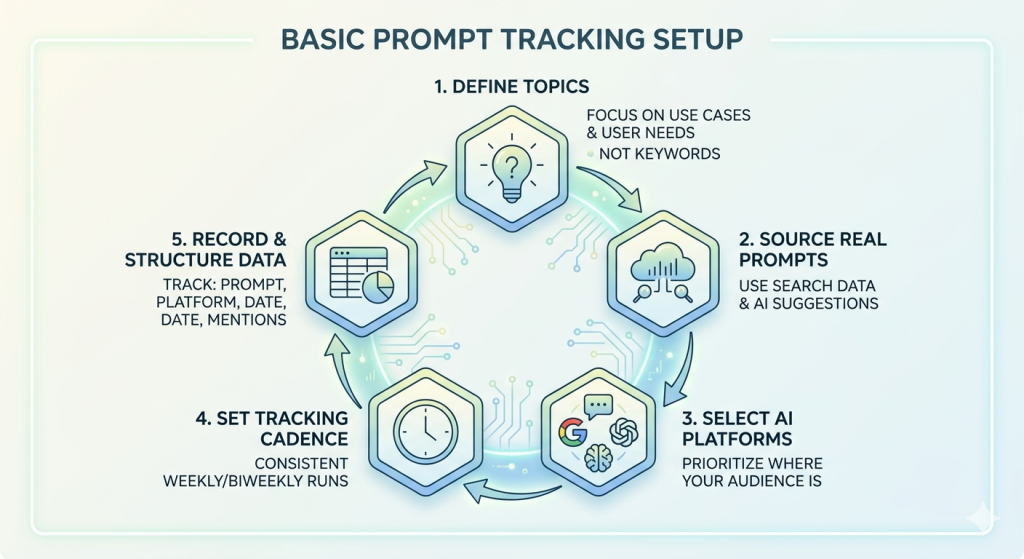
To get meaningful insights from prompt tracking, you need a structured setup that reflects real user behavior and is easy to maintain over time.
1. Start with Topics, Not Keywords: Focus on use cases, customer questions, and problems your audience wants to solve. Build prompts around how users naturally ask questions.
2. Source Real Prompt Ideas: Use Google Search Console queries, People Also Ask sections, and AI-suggested questions to gather prompts based on real search behavior.
3. Prioritize the Right AI Platforms: Choose platforms based on where your audience is active. B2B brands may focus on ChatGPT and Perplexity, while consumer brands may prioritize Google AI Overviews.
4. Set a Consistent Tracking Cadence: Run prompts weekly or biweekly to track changes without creating operational overload. Consistency helps identify trends over time.
5. Record Data in a Structured Format: Track key fields such as prompt, platform, date, brand mention, sentiment, and citation source to make analysis actionable.
A well-structured prompt tracking setup ensures you are not just collecting data, but building a system that continuously improves your brand’s visibility in AI-generated responses.
Turning Prompt Tracking Data Into Action
Absent mentions are content briefs. When your brand does not appear in responses to relevant topic prompts, that absence points to a content gap. Build authoritative content around that topic, optimize it for the sources AI platforms tend to cite, and track whether your visibility in that prompt improves over time.
Citation sources are PR targets. If AI responses about your category consistently reference specific publications, review platforms, or industry sites, those are the outlets where your brand needs a presence. Use that data to prioritize earned media and link-building efforts.
Inaccurate AI responses need authoritative correction. Publishing clear, well-structured content that directly addresses the inaccuracy, on your own site and through credible third-party sources, gives AI models better material to draw from.
Feed all of this back into existing SEO and content workflows. Prompt tracking data is not a separate reporting stream. It sharpens the brief, strengthens the content calendar, and adds a dimension to competitive analysis that traditional search data cannot provide.
Prompt tracking is an emerging marketing discipline, and it is becoming essential faster than most teams expect. Start with a focused set of prompts across three or four key topics. A manageable program you run consistently delivers more insight than a sprawling one you abandon after two weeks.
Turning Insights Into AI Visibility
Prompt tracking is not just about observing how AI models respond, it is about actively shaping those responses. The brands that win are the ones that treat every insight as an input for action, whether that means creating new content, strengthening authority signals, or correcting how they are represented.
As AI search continues to evolve, the gap between brands that track and those that do not will widen quickly. Prompt tracking gives you a direct line of sight into how your brand is perceived, recommended, and positioned in AI-generated answers, making it one of the most valuable inputs into modern marketing strategy.
See where your brand stands across AI responses and turn prompt tracking insights into action with Cite AI.
Start writing with confidence
Verify your content, add real citations, and publish with trust.