What Is AEO (Answer Engine Optimization) and Why It Matters in 2026
Share this Article:


Search behavior has changed in a fundamental way. People no longer type a few fragmented words into Google and scroll through a page of links. They ask full questions and expect a direct answer, right away. Tools like ChatGPT, Perplexity, and Google’s AI Overviews have made that the default experience. For businesses and content creators, this creates a challenge that traditional SEO was never designed to solve: getting your content selected as the answer, not just as a result. By the end of this article, you will understand what AEO is, how it compares to SEO, why it demands attention right now, and what an effective strategy actually looks like.
What Is AEO?
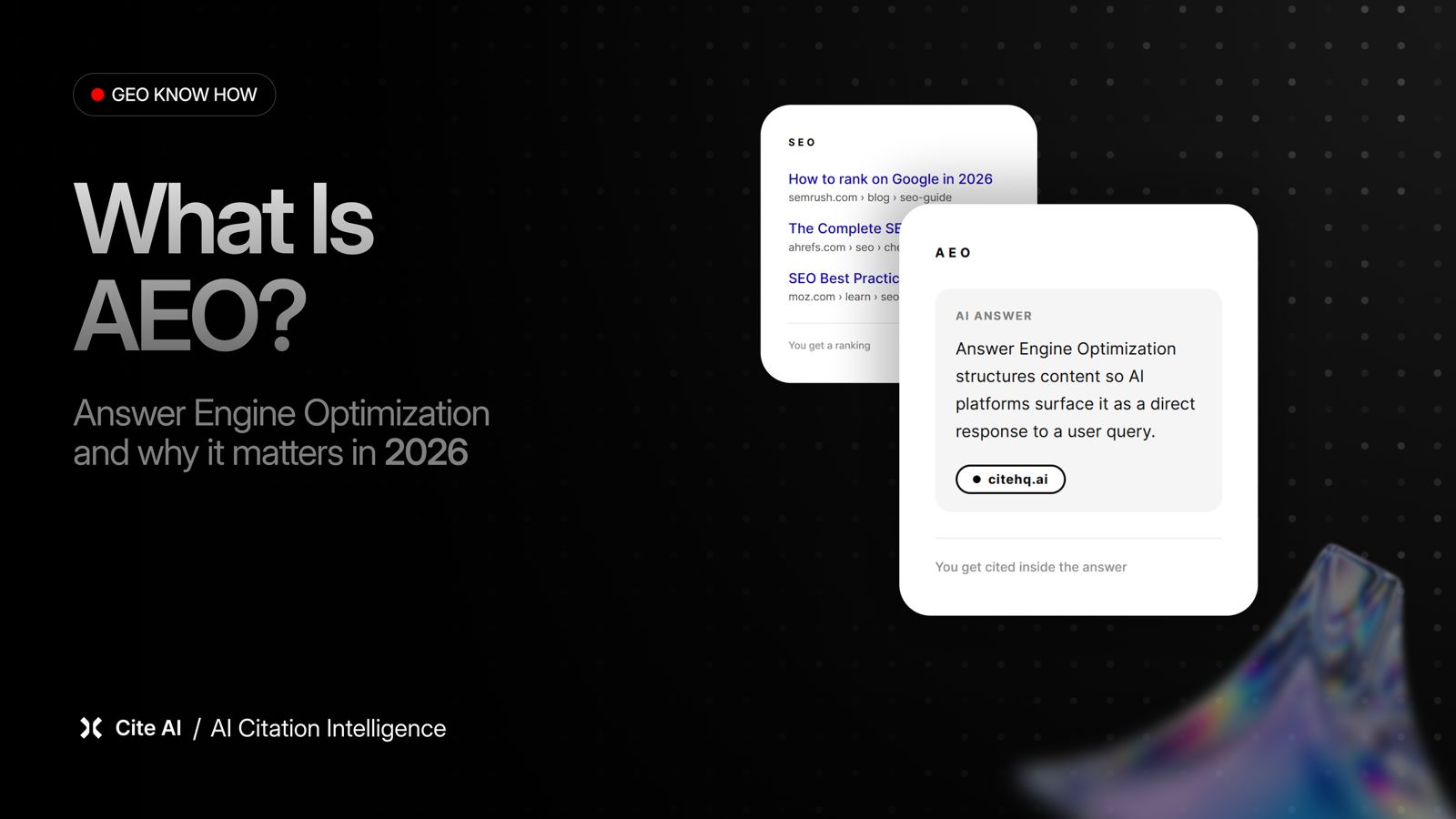
Answer engine optimization is the practice of structuring content so AI-powered platforms can extract it and present it as a direct response to a user’s question. Traditional SEO gets your page onto a results list. AEO gets your content placed inside the answer itself.
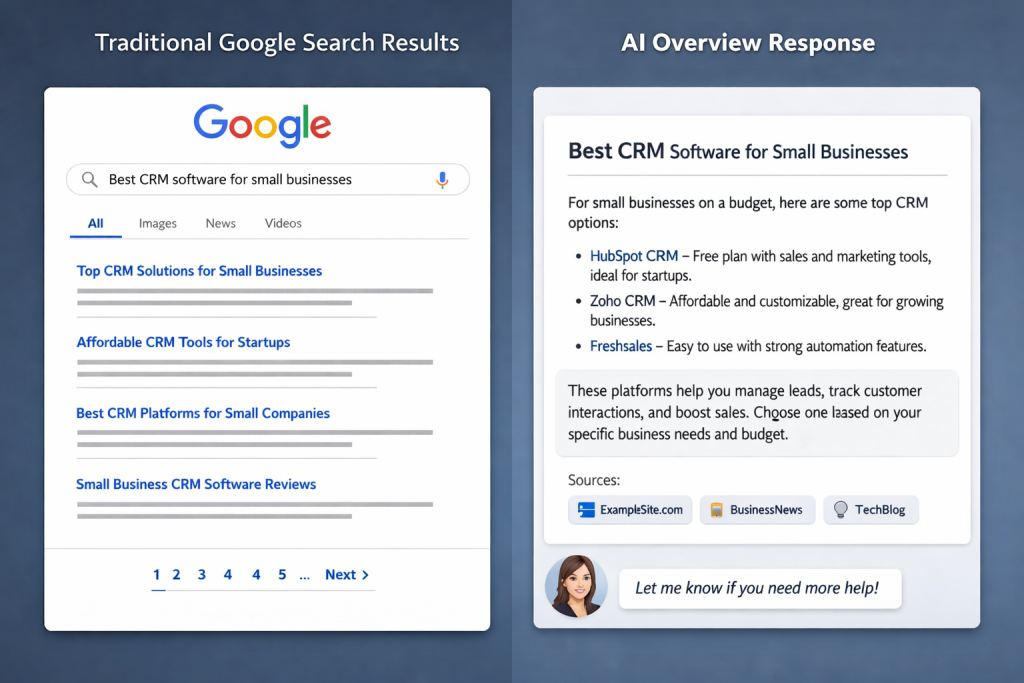
Answer engines are platforms that generate synthesized responses rather than lists of links. ChatGPT, Perplexity AI, Google AI Overviews, and Microsoft Copilot all fall into this category. When someone asks one of these tools a question, the engine pulls from indexed content, weighs credibility and relevance, and produces a response. The user often gets what they need without clicking through to any website.
That is the core shift. SEO earns you a position on a page. AEO earns your content a place in the answer. When a user receives a direct response from an AI engine, they rarely dig further. If your brand is not the source being referenced, it is absent from that interaction entirely.
How AEO Differs From SEO
SEO and AEO share a common foundation in quality content and credibility, but their objectives are different in ways that matter. SEO optimizes for rankings. AEO optimizes for answers. That changes how content gets written, how it gets structured, and how performance gets measured.
Traditional SEO runs on a click-based model. You earn a ranking, users click through, and traffic reaches your site. AEO runs on a zero-click model. Your content informs the response, your brand may be cited, and the user’s question is answered without a single visit to your page. Visibility still happens, but it no longer looks like a traffic number.
Intent matching works differently too. SEO targets keyword queries, often short and stripped of context. AEO targets conversational queries, the kind people type or speak when talking to an AI assistant. “Best CRM software” is a keyword. “What CRM works best for a small e-commerce business with a tight budget?” is the kind of question AEO is built to answer.
These two approaches work together, not against each other. Strong SEO builds the authority and discoverability that AEO depends on. AEO extends that authority into spaces where links no longer determine who gets heard.
Why AEO Matters for Businesses Right Now
AI answer engines already handle a substantial share of search activity, and that share keeps growing. Perplexity AI crossed 100 million monthly queries. Google’s AI Overviews appear across the majority of informational searches. ChatGPT is a daily tool for hundreds of millions of people. These are not niche products. They are primary research destinations for consumers and decision-makers alike.
Brands that have not optimized for AEO are becoming invisible in these responses. An AI engine does not guess at authority. It draws from content that is clearly structured, factually grounded, and marked up in ways the system can read. If your content does not meet those criteria, a competitor will fill the gap.
Trust and authority signals carry more weight in this environment than they ever did in traditional search. AI engines favor sources with demonstrated expertise, strong citation profiles, and consistent brand presence across the web. The brands investing in those signals now are building durable visibility. Those that wait face a compounding disadvantage as AI search adoption grows and established sources become harder to displace.
Core Elements of an Effective AEO Strategy
If you want your content to show up in AI-generated answers, it needs to be built differently. These core elements ensure your content is understood, trusted, and selected by answer engines.
Structured, Question-Based Content
The most direct AEO tactic is writing content that answers specific questions directly and concisely. AI systems favor content that front-loads the answer. State the response clearly in the first sentence or two, then expand with supporting detail. This mirrors how users ask questions and how answer engines evaluate relevance.
FAQ formats work well here. Using conversational headers framed as questions, like “How does schema markup help with AEO?”, signals to both users and AI systems that your content addresses a specific need. This structure also aligns with how voice queries are phrased, extending your content’s reach across multiple AI-driven surfaces.
Structured Data and Schema Markup
Schema markup is code added to your content that helps answer engines understand what the content covers and how to categorize it. Without schema, an AI engine infers context from text alone. With schema, you remove that ambiguity.
For AEO, the most relevant schema types are FAQ, HowTo, and Article. FAQ schema is particularly effective because it maps directly to the question-and-answer format AI engines are designed to deliver. Implementing these markup types is a technical step, but one with a measurable impact on how often your content gets selected as a source in AI-generated responses.
E-E-A-T and Trust Signals
Google’s E-E-A-T framework, Experience, Expertise, Authoritativeness, and Trustworthiness, applies directly to AEO. AI engines do not surface content from unknown or low-credibility sources. They favor brands and authors with verifiable expertise, strong backlink profiles, and consistent citations across reputable publications.
Backlinks, brand mentions, author credentials, and third-party citations all function as credibility signals. Building them is not a short-term exercise. It requires consistent content output, strategic outreach, and a reputation that accumulates over time. Brands that treat this investment seriously earn a presence in AI answers that competitors cannot replicate quickly.
How to Measure AEO Success
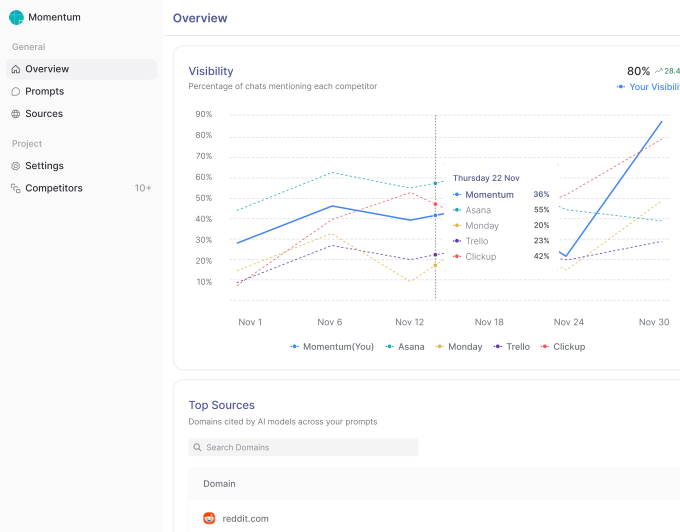
Measuring AEO performance requires different tools and metrics than traditional SEO. Ranking positions are largely beside the point when the goal is presence inside an AI-generated answer. What matters is how often your brand gets cited in AI responses, how frequently your content appears as a source in tools like Perplexity or ChatGPT, and whether traffic from AI referral sources is trending upward.
Tracking brand mentions and citations in AI-generated answers has become its own discipline. Manual spot-checking, AI monitoring platforms, and citation tracking tools all play a role. The goal is knowing which content assets answer engines pull from and which they ignore, so you can prioritize improvements with purpose.
Cite AI is built for this exact challenge. It gives brands clear visibility into where and how they appear in AI-generated responses, so AEO performance can be tracked, measured, and improved with real data rather than guesswork.
Common AEO Mistakes to Avoid
Even well-optimized content can fail in AEO if it is not aligned with how answer engines interpret and surface information.
1. Writing for Keywords Instead of Questions
Focusing only on short-tail keywords leads to vague, unfocused content. AEO requires a precise, question-driven structure that directly matches how users search and how AI systems evaluate relevance.
2. Burying the Answer Too Deep
If the core answer appears late in the content, it reduces your chances of being selected. Always front-load the response within the first few lines, then expand with supporting context.
3. Ignoring Structured Data
Skipping schema markup limits how well AI systems understand your content. Structured data helps define context, improve categorization, and increase eligibility for AI-driven results.
4. Treating AEO as Separate from SEO
AEO does not replace SEO. Without strong SEO foundations like authority, indexing, and crawlability, AEO performance will be limited. Both must work together.
5. Thinking Short-Term Instead of Long-Term
AEO is not an instant win strategy. It requires consistent effort in building structured, credible, and question-focused content that compounds visibility over time.
Start by auditing your existing content for AEO readiness, identify real user questions, and use tools like Cite AI to track and improve your presence across answer engines.
Building for the Future of Search
AEO is not a future concept, it is already shaping how users discover information and how brands earn visibility. As answer engines continue to replace traditional search behaviors, the brands that win will be the ones that make their content easy to understand, easy to extract, and impossible to ignore. By avoiding common mistakes and focusing on structured, question-driven, and credible content, you position your brand to be selected, cited, and trusted in AI-generated responses. The shift is already happening, and the advantage belongs to those who act early and build with intent.
Get clear visibility into how and where your brand shows up in AI-generated answers with Cite AI.
Start writing with confidence
Verify your content, add real citations, and publish with trust.