How Plum Leveraged Cite AI to Unlock New Growth Opportunities
Share this Article:


“AI-driven discovery is changing how companies evaluate partners. Cite AI helped us understand where we show up, and more importantly, where we don’t.“
Abhishek Poddar
Co-Founder & CEO – Plum
A Shift in How Companies Discover Benefits Platforms
Plum has built its reputation by reimagining employee healthcare and insurance for modern Indian businesses. From startups to enterprises, companies rely on Plum for a seamless, transparent, and human-first benefits experience.
But the way buyers discover and evaluate solutions has started to shift.
HR leaders are no longer relying only on search engines or referrals. Increasingly, they are turning to AI tools to explore vendors, compare platforms, and understand what options exist before ever speaking to a sales team. This shift introduced a new layer in the buying journey, one that is largely invisible unless you actively track it.
For Plum, the question became clear: where do we stand in this new AI-driven discovery layer?
The Challenge: Invisible in AI Conversations
Despite strong traction and brand recognition, Plum had little visibility into how it was being represented across AI platforms. They didn’t know when their brand appeared in responses, how it was being described, or how often competitors were being recommended instead.
This created a blind spot. AI tools were already influencing how HR leaders shortlisted vendors, yet Plum had no reliable way to measure or shape that influence. Without that visibility, they risked losing mindshare in a channel that was quietly becoming critical.
The Unlock: Turning AI into a Measurable Channel
By integrating Cite AI, Plum was able to turn this unknown into something tangible.
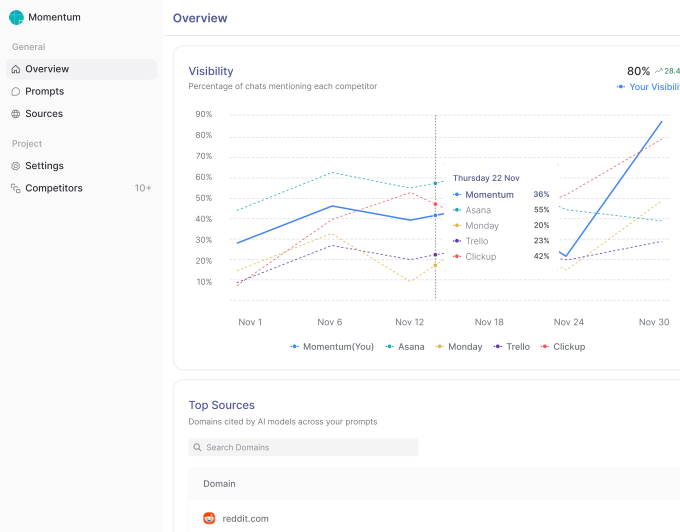
Almost immediately, their team gained clarity into how their brand showed up across AI-generated answers. They could see which types of queries triggered mentions of Plum, how their positioning compared to competitors, and where gaps existed in how their offering was understood.
What had previously felt abstract and untrackable became a structured, measurable channel. This allowed their marketing and leadership teams to move from assumptions to actual data.
The Impact: From Blind Spot to Growth LeverWith visibility came the ability to act.
Plum began refining how they communicated their core strengths, especially around claims experience, inclusive coverage, and their broader approach to employee wellbeing. Instead of generic messaging, they aligned their positioning with the kinds of questions HR leaders were actually asking AI tools.
At the same time, their content strategy evolved. By observing real AI-driven queries, they uncovered specific themes and intent patterns that weren’t fully addressed on their site. This led to the creation of more focused, high-intent content that directly matched how buyers were exploring solutions.
They also gained a clearer view of their competitive landscape. Seeing when and why competitors appeared more frequently allowed Plum to sharpen its differentiation and reinforce what made its offering distinct.
Over time, these changes started to show up in tangible ways. Inbound conversations became more informed, prospects had a clearer understanding of Plum’s value, and evaluation cycles felt more efficient. AI wasn’t just an awareness channel, it was actively shaping how decisions were being made.
The ROI: Better Visibility, Better Conversations
Instead of operating in the dark, Plum now has a clear view of how it is represented in AI-driven environments. This visibility has created a feedback loop where insights directly inform messaging, content, and positioning.
The result is not just increased presence, but more relevant presence. Plum is showing up in the right conversations, with the right context, at the right time.
What’s Next: Preparing for AI-Led Buying Journeys
Plum sees this as an early step in a much larger shift.
As AI continues to play a bigger role in how companies discover and evaluate products, the ability to understand and influence these systems will become essential. Plum is already building toward that future by continuously refining how it appears in AI responses and aligning its strategy with evolving buyer behavior.
What This Means for Modern B2B Brands
Plum’s experience highlights a simple but important reality.
AI is already part of the buying journey, whether companies are paying attention to it or not. Buyers are using it to research, compare, and validate decisions long before engaging with sales teams.
The difference is that some brands are actively measuring and shaping their presence in these conversations, while others remain unaware of how they are being represented.
Scaling with Cite AI
For Plum, Cite AI has become more than just a tool. It is now part of how they understand market perception and capture demand in a changing landscape.
As they continue to grow, this layer of insight will play a key role in helping them stay relevant, visible, and competitive in a world where AI is increasingly influencing every stage of the buyer journey.
Start writing with confidence
Verify your content, add real citations, and publish with trust.