AI Search Monitoring for Agencies: How to Track Every Client’s AI Visibility in One Place
Share this Article:


Buyers now ask ChatGPT, Gemini, and Perplexity which brands to shortlist, and they act on the answers.
Gartner predicts traditional search volume will fall 25% by 2026 as people move to AI chatbots. Clients have noticed. They now ask their agency one blunt question: “Where do we show up in AI answers?” AI search monitoring for one brand takes real effort.
AI visibility for agencies means doing that work for twenty or forty brands, each with its own market, buyers, and rivals. Here, we cover why monitoring falls apart at scale, what to track, and how we keep every client in one place.
Why AI Search Monitoring Breaks Down at Agency Scale
No two clients need the same setup. A B2B software company and a regional dental group have buyers who phrase questions differently, compete with different brands, and show up on different platforms. One template serves neither.
Manual checks make it worse. A strategist types a prompt into ChatGPT on Monday. A colleague rewords it on Thursday. Now the team has two answers, no shared baseline, and nobody can repeat either check next month.
AI answers also move. Wording, platform, and timing all change the response. A brand that appears in Perplexity today can vanish from Gemini tomorrow. Without multi-client AI tracking on a fixed schedule, those shifts go unnoticed.
Then, the spreadsheets pile up. Screenshots sit in one folder, notes in another, and someone pulls the report together the night before the client call. Clients spot shaky data fast, and it erodes trust in the work.
The Questions Clients Expect Their Agency to Answer
Good AI brand monitoring gives clients answers to four questions:
- Where does our brand appear across AI-generated answers?
- Why does a competitor get cited instead of us?
- Which sources shape what AI engines say about our category?
- How do we improve our presence in ChatGPT?
Agencies that answer with data earn the role of AI search advisor. Agencies that answer with screenshots end up defending the retainer.
What an Agency AI Dashboard Should Track for Every Client
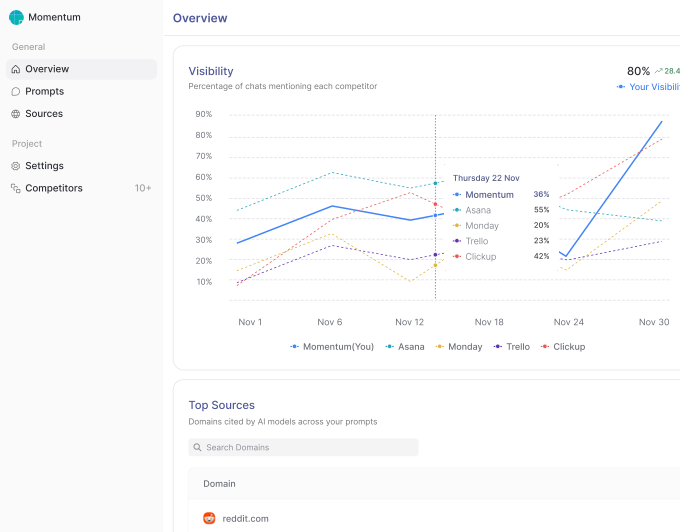
An agency AI dashboard should put ChatGPT, Gemini, Perplexity, Google AI Overviews, and Google AI Mode in one workspace for every client. Separate tools per platform eat hours and split the data into pieces nobody can compare.
Brand Mentions and Share of Voice
Brand mentions count how often a client appears in AI answers next to category competitors. Share of voice turns that count into a percentage any client can read. Watch the trend by platform over time. A client gaining ground in Perplexity while slipping in ChatGPT needs a different plan from one slipping everywhere.
Citations and Source Influence
Citations show which URLs AI engines point to when they mention the brand. Some lead to the client’s own site. Many lead to review sites, trade publications, and forums. Source influence data shows which third-party pages push competitors into recommendations, and those pages become your outreach list.
Competitor Presence and Prompt Performance
Prompt-level data shows exactly where competitors win and where your client disappears. Split it by platform and buyer intent. A client that shows up for “what is” prompts but disappears from “X vs. Y” prompts has a bottom-of-funnel problem, and that calls for a different fix than weak awareness.
How We Set Up Multi-Client AI Tracking Without the Chaos
Multi-client AI tracking works when every account follows the same process with its own inputs. We use three steps.
Step 1: Build Client-Specific Prompt Sets
We write prompts the way real buyers type them. Category prompts (“best CRM for small teams”). Comparison prompts (“Brand A vs. Brand B”). Problem-solution prompts (“how to stop missing sales follow-ups”). We never reuse one generic list across clients in the same category. Two CRM clients often target different segments, so their prompts differ.
Step 2: Set Competitor Benchmarks and a Baseline
We name the competitors for each client and track them the same way every cycle. Before any optimization starts, we take a baseline snapshot of visibility. Skip that step, and you have nothing to point to when the client asks what changed.
Step 3: Create a Monitoring and Reporting Rhythm
We check for shifts weekly and report monthly. Weekly checks catch drops early. Monthly reports give clients trends they can act on. AI visibility never stays put. Models update, sources change, competitors publish new pages. Tracking runs for as long as the engagement does.
Turning AI Brand Monitoring Data Into Client Strategy
- Citation Gaps Feed Content Strategy: When a client misses a prompt, we brief answer-first pages that respond in the first lines and rework existing pages the same way. Our AEO guide covers the format.
- Source Influence Data Guides PR: The outlets and review sites AI engines cite move to the top of the outreach plan.
- Share of Voice Reports Prove Progress: Clients watch their share move against named rivals, which makes renewal conversations easier.
- Visibility Insights Shape Services: Agencies package AEO and GEO retainers around the gaps the data shows, with clear scope and measurable goals.
Why Affordable Pricing Matters When Monitoring Many Brands
Premium tool costs stack up with every new client. A price that works for one brand gets hard to defend across twenty.
Cite AI gives agencies the same core AI visibility workflow as premium platforms on accessible plans we priced for agencies and multi-brand teams. You track brand mentions, citations, share of voice, competitor presence, prompt performance, and source influence without paying enterprise-only rates. Cite AI tracks more than 50,000 prompts every day.
Lower tool spend means better margins on AI visibility retainers and reporting work. AI search monitoring becomes a service you can sell repeatedly at a profit.
FAQs
Can agencies monitor multiple clients from one AI search monitoring tool?
Yes. Cite AI lets agencies keep each client’s prompts and competitor lists separate inside one platform, so accounts stay organized and reports stay consistent.
Which AI platforms should agencies track for clients?
Track ChatGPT, Gemini, Google AI Overviews, and Google AI Mode. The same prompt returns different answers on each one.
How many prompts should we track per client?
Start with a tight set around the client’s core topics. Once the baseline shows the gaps, add prompts by intent and buyer stage.
How is AI brand monitoring different from traditional rank tracking?
Rank tracking measures blue-link positions. AI brand monitoring measures mentions, citations, and recommendations inside AI-generated answers, where many buyers decide without clicking anything.
Centralized AI search monitoring replaces scattered manual checks with consistent data for every client. That data sharpens content strategy, cleans up reporting, and keeps clients around longer.
With affordable multi-client tracking, AI visibility becomes a service that grows with your roster. Start tracking AI visibility for every client with Cite AI.
Start writing with confidence
Verify your content, add real citations, and publish with trust.