Which Sources Do AI Models Cite Most: Blogs, Forums, News Sites, or Product Pages?
Share this Article:


People increasingly ask ChatGPT, Gemini, Perplexity, and Google’s AI features for direct recommendations instead of comparing pages of search results themselves. That changes the job for marketing teams.
When an AI platform builds an answer about your category, which sources shape the response, and which ones earn a visible citation? Blogs, forums, news publications, and product pages can all contribute, but their influence depends on the question being asked. Understanding those differences helps you build measurable AI content authority instead of guessing why a competitor keeps appearing and you do not.
How Generative AI Platforms Select Sources
Generative AI platforms can answer from information learned during training, retrieve current information from the web, or combine both approaches. Training data may shape what a model already associates with a brand, but live retrieval usually determines which pages can be cited in a current answer.
There is no universal source hierarchy that every AI platform follows. Source selection can depend on the prompt, relevance, topical authority, freshness, accessibility, corroboration, and the retrieval system being used. A product page may be the strongest source for specifications, while a forum may be more useful for firsthand opinions and a news article for independently reported facts.
Technical clarity matters too. Descriptive headings, direct answers, crawlable text, accurate metadata, internal links, and relevant structured data can make a page easier for search and retrieval systems to understand. But formatting alone does not create authority; the underlying information must still be useful, specific, and reliable.
Blogs: Owned Content and Its Real Weight in AI Answers
Blogs give brands control over how they explain a category, answer customer questions, and connect products to real use cases. However, a brand-published claim may be less persuasive when it cannot be independently verified. The strongest blog content combines clear answers with original research, expert input, first-party data, examples, and transparent sourcing.
Answer-first formatting can also improve usability. Give readers a direct response, then add the evidence, context, and limitations needed to support it. This creates a passage that both people and retrieval systems can understand without reducing the article to generic summaries.
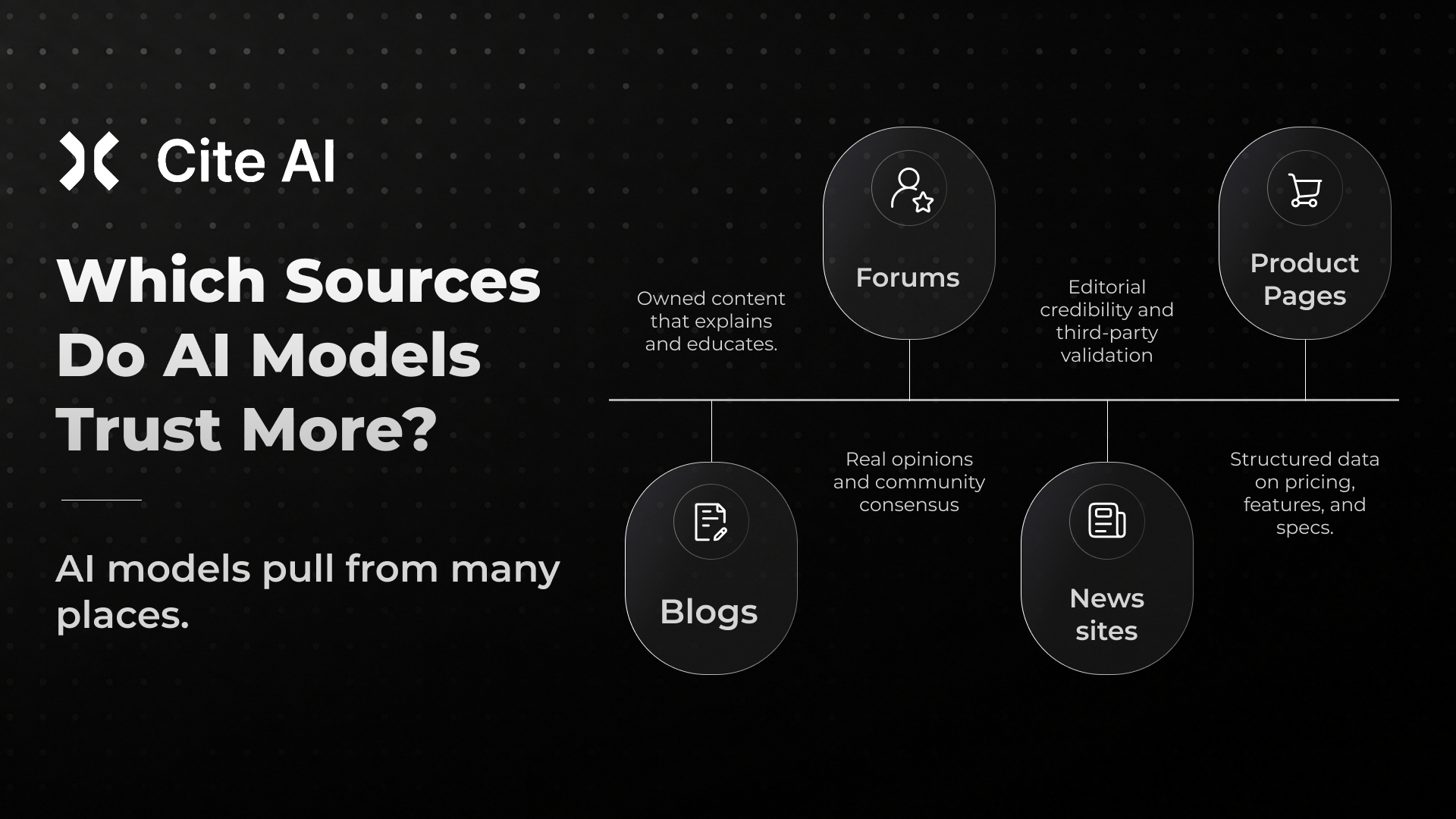
Best Use: Brand narrative, product detail, and structured explanations other sources can reference and reinforce.
Forums: Where Firsthand Experience Can Matter
Community platforms such as Reddit and Quora can influence AI answers because they contain firsthand experiences, comparisons, objections, and the language customers naturally use. They are particularly relevant for prompts such as “Is this product worth it?”, “What are the drawbacks?” and “Which option worked for people like me?”
However, visibility does not automatically equal credibility. Forum content can be anecdotal, manipulated, outdated, or factually incorrect. Its value is strongest when the query calls for lived experience or a range of opinions, not when an authoritative factual source is required.
Google has publicly stated that forum discussions can help people find firsthand advice and diverse perspectives. That does not mean every forum post receives greater authority than other sources; relevance and quality still matter.
Best Use: Firsthand experience, product comparisons, objections, sentiment, and “Is it worth it?” queries.
News Sites: Earned Coverage and Independent Verification
Reputable news publications can become influential sources when a prompt involves recent developments, company announcements, funding, leadership, market events, or independently reported claims. Their editorial processes and third-party status can provide validation that a brand’s own website cannot supply by itself.
But news sites do not automatically outrank every other source. A news article may be stronger for confirming an acquisition, while an official product page may remain the better source for current specifications or pricing. Relevance, recency, reputation, and corroboration all affect whether the source fits the answer.
This is where credible PR can support AI visibility. Accurate coverage gives retrieval systems an independent source for statements about a company’s milestones, expertise, or position in the market.
Best use: Recent developments, independently reported facts, company credibility, and third-party validation.
Product Pages: The Primary Source for Product Facts
Product pages can be highly relevant to commercial prompts involving features, materials, availability, compatibility, pricing, or specifications. Because they come directly from the business, they are often the primary source for facts about that company’s own products.
Clear product names, descriptive copy, accurate specifications, crawlable content, Merchant Center data, and relevant structured data can help search systems understand those details. Structured data supports machine understanding, but it does not guarantee inclusion or citation.
Thin product pages remain a missed opportunity. If a page contains little beyond a product name, image, and marketing slogan, retrieval systems have limited information to work with.
Best use: Official product details, specifications, pricing, compatibility, availability, and commercial queries.
Source-Type Comparison: Side by Side
| Source type | Strongest use | Main advantage | Main limitation |
|---|---|---|---|
| Blogs | Educational and problem-solving queries | Depth, structure and brand control | Self-published claims may require corroboration |
| Forums | Opinions, comparisons and lived experience | Authentic customer language and diverse perspectives | Anecdotal, variable and difficult to control |
| News sites | Recent events and independent validation | Editorial credibility and third-party reporting | May become outdated or lack product-level depth |
| Product pages | Features, pricing and specifications | Direct source for official product facts | Naturally promotional and often too thin |
No source type wins every query. AI platforms select sources based on how well each page supports the specific answer being generated.
Which Source Should Your Brand Prioritize?
Start with the intent behind the prompts you want to influence:
- Educational prompts: Publish expert-led blogs, guides, research, and clear explanations.
- Commercial prompts: Strengthen product and service pages with accurate, specific details.
- Comparison prompts: Earn independent reviews, community discussions, and credible editorial coverage.
- Brand-validation prompts: Build consistent facts across your website, media coverage, profiles, and authoritative third-party sources.
The strongest strategy is not to appear everywhere indiscriminately. It is to build the right mix of owned, earned sources, alongside relevant community discussions around the prompts that matter commercially. When several reliable sources independently support the same accurate brand facts, AI platforms have more evidence available when constructing an answer.
How We Track Source Influence Across AI Models
Referral traffic alone does not show the full effect of AI visibility. A user may see a brand mention or recommendation without clicking through to the cited page.
A more complete measurement framework tracks:
- Brand mentions
- Cited pages and domains
- Citation frequency
- Share of voice
- Competitor citations
- Changes by prompt and platform
- AI referral traffic and resulting conversions
Cite AI monitors these signals across major AI platforms, helping teams identify whether owned content, editorial coverage, community discussions, or competitor sources are shaping the answers in their category.
By tracking more than 50,000 prompts daily, Cite AI helps marketing teams find citation gaps, compare source influence, and prioritize the actions most likely to improve visibility.
Explore Cite AI pricing to find a monitoring plan that fits your prompt volume.
Frequently Asked Questions
Do AI models cite blogs or news sites more often?
Neither source type wins consistently. News publications may be more influential for recent events and independently reported claims, while blogs can perform better for detailed educational questions. The prompt, platform, relevance, freshness, and quality of the page all affect source selection.
Why do Reddit and other forums appear in AI answers?
Forums contain firsthand experiences, comparisons, objections, and natural customer language. That makes them useful for opinion-led prompts. However, forum visibility should not be confused with factual reliability, and individual claims may still require verification.
Can product pages earn citations in ChatGPT and other AI platforms?
Yes. Product pages can be useful sources for official features, specifications, pricing, compatibility, and availability. Clear copy, crawlable information, and accurate structured data can improve machine understanding, although none guarantees a citation.
How can I tell which sources influence AI answers about my brand?
Track your brand across a consistent set of commercially relevant prompts. Measure mentions, citations, cited URLs, source types, share of voice, competitor visibility, referral traffic, and conversions over time. Cite AI brings these signals together across major AI platforms.
Build Authority Across Multiple Sources
No single source type earns every citation. Source influence changes with the prompt, platform, topic, and information required. Blogs build depth, product pages establish official facts, forums contribute firsthand perspectives, and credible news coverage provides independent validation.
Brands that appear consistently across AI answers build an evidence network rather than relying on one publishing channel. The first step is seeing which sources already shape those answers.
Start tracking your AI source influence with Cite AI.
Start writing with confidence
Verify your content, add real citations, and publish with trust.