Blog
How To
How to Track Citations Across AI Models

Your content is indexed, your rankings look fine — yet AI models keep citing your competitors instead of you. That gap between 'ranked' and 'cited' is the core problem Answer Engine Optimization exists to solve.
Tracking citations across AI models is not the same as checking backlinks or monitoring SERP position. AI engines pull from specific source types — owned pages, editorial coverage, community forums — and the mix matters as much as the count.
This guide walks you through every step: choosing the right prompts, logging raw AI responses, classifying citation sources, benchmarking competitor visibility, and turning that data into a content action plan. Follow the steps in order and you will have a repeatable citation tracking program running by the end.
Prerequisites: Four Things You Need Before Step 1
Before you run a single tracked prompt, you need the right inputs lined up. Skipping this setup is the most common reason citation tracking programs produce noisy, unusable data.
You do not need technical skills to get started — but you do need a clear picture of your brand's content landscape, your top competitors, and the queries your buyers actually type into AI tools. Gather these now so each step moves faster.
- A list of 10–20 high-intent discovery queries your ICP types into ChatGPT, Perplexity, or Gemini — not branded queries, but category and comparison questions.
- A confirmed list of 3–5 direct competitors whose AI citation share you want to benchmark against.
- Access to an AI search visibility platform that logs raw responses, extracts cited URLs, and refreshes data daily — not a manual spreadsheet.
- A content inventory: the URLs on your own site most likely to earn citations, organized by topic cluster.
- A defined reporting cadence — weekly is the minimum for meaningful share of voice trending.
Step 1: Build Your Prompt Library
Every citation tracking program runs on prompts — the real questions buyers type into AI tools. Your prompt library is the foundation. Weak prompts produce citation data that doesn't map to actual buyer behavior.
Focus on unbranded, high-intent queries first: comparison questions ('best [category] tools for [use case]'), problem-aware questions ('how do I solve [pain point]'), and consideration-stage questions that pull in multiple vendors. These are the prompts where citation share of voice is actually contested.
Aim for 20–50 prompts to start. Batch-create them by topic cluster so you can analyze citation patterns at the category level — not just per individual query. Most AI visibility platforms let you import prompts in bulk, which cuts setup time significantly.
- Group prompts into topic clusters (e.g., 'competitor comparisons', 'best-of lists', 'how-to queries') for cleaner analysis.
- Include at least 5 prompts that directly name competitors — these reveal how AI frames your brand relative to theirs.
- Use your ICP's actual language, not internal product terminology.
- Avoid branded queries at this stage — they inflate your apparent visibility without revealing competitive gaps.
- Use a prompt suggestion engine if available; review and approve suggestions rather than accepting them blindly.
- Common mistake: Starting with fewer than 10 prompts and drawing conclusions from too small a sample — citation data at low prompt counts is highly volatile.
Step 2: Run Prompts Across Multiple AI Models
A single AI model gives you a partial picture. ChatGPT, Gemini, Perplexity, and Google AI Overviews each draw on different source pools and weight authority differently. A brand that dominates citations in Perplexity may be nearly invisible in AI Overviews — and that gap matters if your buyers use both.
Run every prompt against at least three models in the same 24-hour window. This creates a comparable baseline. Do not stagger runs across days — model behavior shifts, and mismatched timing introduces noise that makes week-over-week trending unreliable.
Log the full response for each prompt-model combination, not just a brand mention flag. You need the raw text to extract cited URLs accurately. Manual copy-paste into spreadsheets is not scalable past 20 prompts — use a platform that does this automatically.
- Run every prompt on ChatGPT, Gemini, Perplexity, and Google AI Overviews as a minimum coverage set.
- Log the full AI-generated response — not just a yes/no brand mention flag.
- Time-stamp every run; same-day runs across models are essential for a clean baseline.
- Record both explicit brand mentions and linked source citations — these are different signals.
- Common mistake: Only checking the model your team personally uses, then missing that a competitor dominates the model your buyers prefer.
Step 3: Extract and Classify Every Citation Source
Counting brand mentions is not source analysis. The real signal is in the URLs AI engines cite when constructing an answer — specifically, which domains win citations and what type of source they are.
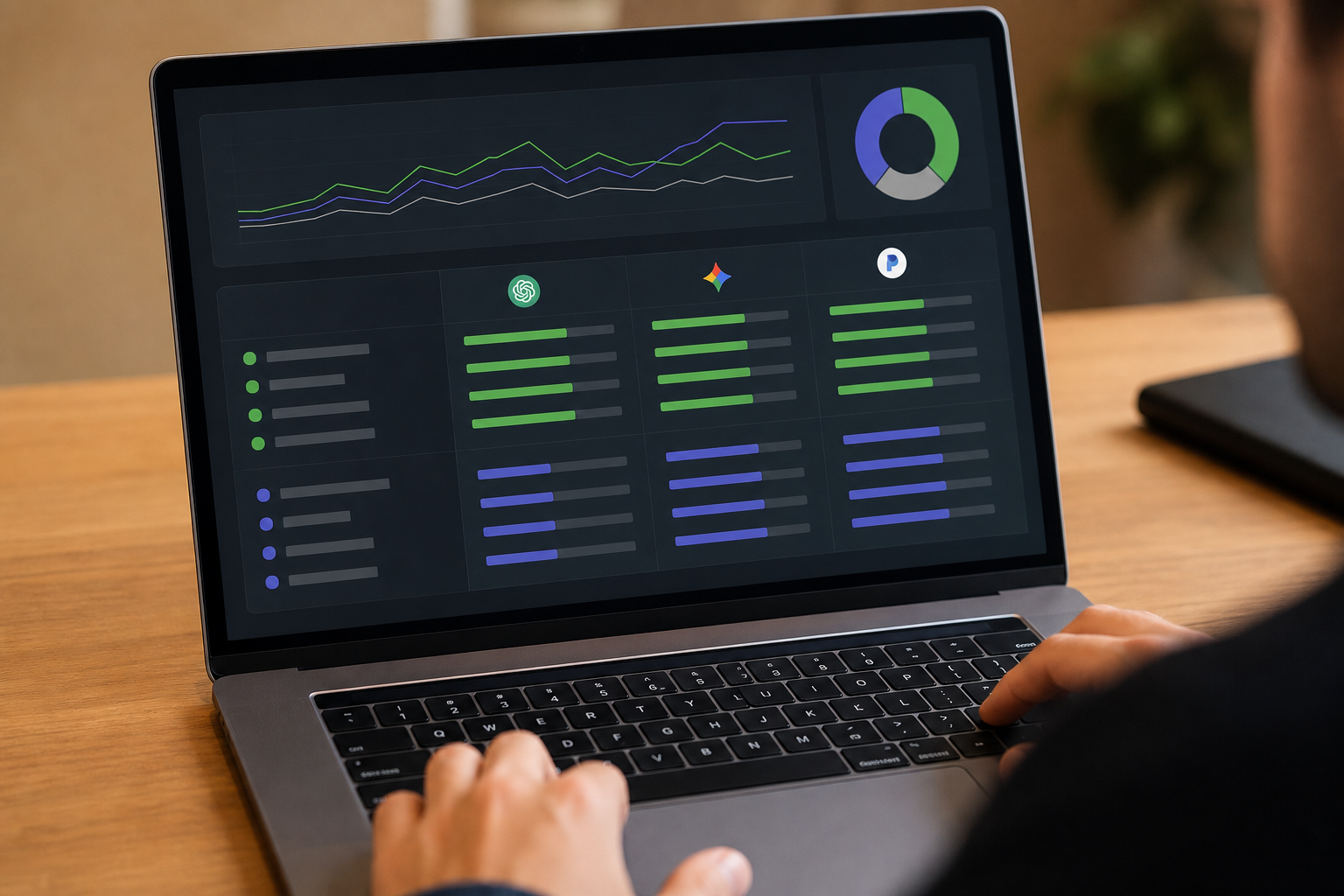
Classify every cited URL into one of four source types: owned (your own site), competitor (a rival brand's domain), earned media (press, editorial, review publications), or community and social (forums, Reddit, Quora, LinkedIn). This classification is what turns a flat citation count into an actionable gap analysis.
Once classified, look at the ratio. If 80% of citations pointing to your category come from editorial sources you don't appear in — that is a concrete earned media gap, not a content quality problem. If your own pages are never cited despite being indexed, that points to a different root cause entirely.
- Extract every hyperlinked and in-text cited URL from each logged AI response.
- Assign each URL to a source type: owned, competitor, earned media, or community/social.
- Flag competitor domains winning citations on prompts where your brand should be appearing.
- Note whether cited pages are current, outdated, or returning errors — broken citation links are a fixable issue.
- Aggregate citation source counts by topic cluster, not just per prompt.
- Common mistake: Treating all citations as equal — a Reddit thread citation and an editorial citation carry different strategic implications.
Step 4: Run a Root Cause Analysis on Citation Gaps
Before you can improve your citation rate in AI outputs, you need to know why it's low — and there are two distinct failure modes that look identical on the surface but require completely different fixes.
The first failure mode: AI crawlers are not visiting your pages at all. GPTBot, ClaudeBot, and Google-Extended need to crawl a page before it can be cited. If AI agent traffic is absent from your site analytics, no amount of content optimization will fix the citation gap — the problem is access, not quality.
The second failure mode: AI is reading your pages but choosing a competitor's source instead. This is a content authority and source credibility problem. It means the page exists and is accessible, but a competitor's content — or a third-party editorial source — is winning the citation. These two scenarios require completely different responses, so confirm which one applies before acting.
- Check AI bot traffic (GPTBot, ClaudeBot, Google-Extended) in your site analytics for each page you expected to be cited.
- Cross-reference pages with zero AI crawler visits against your citation gaps — if the page isn't visited, it can't be cited.
- For pages with crawler traffic but no citations, compare your content depth against the competitor page that won the citation.
- Identify whether citation source analysis shows a consistent editorial source winning — this signals an earned media gap, not an on-page gap.
- Common mistake: Jumping straight to content rewrites when the real problem is that AI bots are blocked or deprioritizing your crawl path.
Step 6: Build a Citation Improvement Action Plan
Source analysis only creates value when it drives a specific content or outreach action. At this step, you translate citation gaps into a prioritized work list — split by what you own and what you need to earn.
Owned actions address gaps on your own site: pages that need updated content, clearer structure, or stronger topical depth to compete with the sources currently winning those citations. Earned actions address gaps in third-party coverage: publications, review sites, or editorial sources that AI engines are citing in your category but where your brand has no presence.
CiteHQ AI, which has been tracking AI search visibility since 2025 and runs over 50,000 prompts daily across major platforms, groups related citation sources into 'Actions' — bundling similar opportunities together rather than surfacing hundreds of individual URLs for manual review. That kind of grouping is what separates a usable action plan from an overwhelming data dump.
- List every citation gap by source type: owned, earned media, editorial, community.
- For owned gaps: identify the specific page to update or create, and the competitor page it needs to displace.
- For earned gaps: identify the specific publication or domain winning citations and build an outreach or PR priority list.
- Assign each action an estimated effort level and a target prompt cluster.
- Set a 30-day review checkpoint to re-run the same prompt set and measure citation share movement.
- Success criterion: After 30 days, your share of voice on the tracked prompt set has measurably shifted — at least one previously zero-citation prompt now returns your domain as a cited source, and you can attribute the change to a specific owned or earned action taken.
| Capability | Manual Spot-Checking | Backlink Tools | CiteHQ AI (citehq.ai) |
|---|---|---|---|
| Tracks citations inside AI-generated responses | Partial — one query at a time | No | Yes — across ChatGPT, Gemini, Perplexity, AI Overviews |
| Source type classification (owned / competitor / editorial) | No | No | Yes — every cited URL classified by type |
| Competitor citation benchmarking | No | Partial — backlink profiles only | Yes — side-by-side share of voice per prompt |
| AI crawler visit tracking | No | No | Yes — GPTBot, ClaudeBot, Google-Extended |
| Fan-out query visibility | No | No | Yes — surfaces hidden sub-queries driving AI answers |
| Daily data refresh at scale | No — hours of manual effort | Daily index updates (not AI-specific) | Yes — 50,000+ prompts refreshed every 24 hours |
| Multi-brand / agency workspace | No | Varies by tool | Yes — separate client profiles under one login |
Frequently Asked Questions
-
How to track citations across AI models?
Build a structured prompt library of high-intent discovery queries, run them across ChatGPT, Gemini, Perplexity, and Google AI Overviews in the same 24-hour window, and log every cited URL in each response. Classify sources by type — owned, competitor, editorial, community — and track share of voice week over week. A dedicated AI search visibility platform automates this at scale; manual spot-checking doesn't hold up past 20 prompts. -
Why is my content not being cited by AI systems?
There are two distinct root causes. First, AI crawlers like GPTBot or ClaudeBot may not be visiting your pages at all — if they can't read the page, it can't be cited. Second, AI may be reading your content but choosing a competitor or editorial source instead, which is a content depth or authority gap. Check AI bot traffic before rewriting content — the fix depends entirely on which failure mode applies. -
How to analyze which sources appear in AI responses?
Run your tracked prompts across multiple AI models, extract every cited URL from the full response text, and classify each domain by source type: owned, competitor, earned media, or community. Aggregate by topic cluster to see patterns. This source analysis reveals whether AI visibility in your category is dominated by editorial publications, competitor sites, or community forums — each of which requires a different response strategy. -
How to improve my citation rate in AI outputs?
First, confirm AI crawlers can access your key pages — no optimization improves citation rate if bots aren't visiting the page. Then compare your content against the specific competitor or editorial source winning the citation on each prompt. Owned gaps require content depth improvements; earned gaps require outreach to the publications AI consistently cites in your category. Track the same prompt set 30 days after each change to measure movement. -
What sources dominate citations in my niche?
This varies by category, but most niches see citations skewed toward a mix of editorial publications, established brand sites, and high-authority community sources like Reddit or G2. Running a citation source analysis across your tracked prompts will show exactly which domains AI engines favor — and what share is owned versus earned versus competitor-driven. That breakdown changes the strategy entirely. -
Why did my citations decrease in AI results?
Citation drops typically trace to one of three causes: a competitor published stronger or more recent content on a contested topic, an editorial source that previously cited you has been superseded, or AI model updates shifted which source types get weighted more heavily. A root cause analysis comparing your citation source mix before and after the drop — broken down by prompt and model — usually isolates the specific gap within one reporting cycle. -
How does citation tracking differ from backlink analysis?
Backlink analysis measures which external sites link to your domain inside traditional web pages. Citation tracking for AI models measures which URLs are referenced inside AI-generated answers in response to a specific prompt — a completely different signal. A page can have strong backlink authority and zero AI citations, or earn frequent AI citations with very few inbound links. The two disciplines inform different optimization strategies. -
How often is my content cited by AI?
Frequency depends on how many prompts you track, which AI models you monitor, and how competitive your category is. A consistent measurement program — running the same prompt set across multiple models every 24 hours — gives you a reliable citation frequency metric over time. Share of voice, expressed as the percentage of responses that cite your domain versus competitors, is more actionable than a raw citation count on its own.