The Hidden Risk of AI Hallucinations About Your Brand And How to Detect Them
Share this Article:


AI tools are now a primary discovery channel for consumers researching brands, products, and services.
But what happens when those tools get your brand wrong? AI engines like ChatGPT, Gemini, and Perplexity generate confident, fluent answers, and users trust them. When those answers contain false information about your brand, the damage happens silently, long before anyone visits your website or contacts your team. In this guide, we explore how AI hallucinations happen and why this is not a fringe technical problem. It is an active brand risk, and most marketing and SEO teams lack a system to detect it.
What AI Hallucinations Actually Mean for Your Brand
An AI hallucination is when a large language model generates information that sounds accurate but is factually wrong. The model is not lying. It is producing plausible-sounding text based on patterns in its training data, and sometimes that text simply does not reflect reality.
For brands, this shows up in specific, damaging ways: an AI might cite a pricing tier your company discontinued, describe a product feature you never offered, or reference a policy that does not exist. These are not vague inaccuracies. They are specific claims that consumers read, believe, and act on.
The difference between a wrong answer and a damaging one comes down to context. A hallucination about your brand in a product comparison prompt, or in response to “is this company trustworthy?”, carries real weight. That is the kind of AI search visibility problem that affects purchase decisions before a user ever reaches your site.
The Real Damage: How False AI Outputs Hurt Brand Trust
Wrong product claims, fabricated reviews, and invented policies in AI-generated answers erode consumer trust at the earliest stage of the buyer journey. A user who reads a false claim about your brand in an AI response forms an impression before they visit your site, read a review, or speak to your team. That impression is hard to undo.
The harm is often invisible. There is no traffic drop to signal that something is wrong. No alert fires in Google Search Console. No social listening tool flags an AI-generated answer. A competitor gets cited accurately while your brand gets described incorrectly, and no one on your marketing team knows it is happening.
There is also legal and regulatory exposure to consider. AI-generated misinformation about your pricing, compliance status, or product capabilities can create liability, particularly in regulated industries. Monitoring brand mentions in AI search is no longer optional for teams that take brand integrity seriously.
Why Most Brands Have No Idea About AI Hallucinations
Traditional SEO tools and web analytics platforms were built to track performance in link-based search. They measure rankings, clicks, and impressions. They were not built to track AI-generated answers, and they cannot tell you what ChatGPT or Gemini says about your brand when a user asks.
AI outputs are also dynamic. The same prompt returns different results across platforms, sessions, and time. A brand mentioned in AI search that appeared accurate last month may have shifted in accuracy. There is no static page to audit. Without continuous monitoring, teams have no way to know what AI engines are saying about them right now.
This is the monitoring gap that most marketing and SEO teams have yet to close. Social listening tools capture mentions on social platforms. Google Search Console captures organic search data. Neither captures how AI models describe, cite, or misrepresent your brand in AI-generated answers.
How to Detect AI Hallucinations About Your Brand
Manual prompt testing is a practical starting point. Run targeted queries across ChatGPT, Gemini, and Perplexity using prompts that mirror how your audience searches:
“What does [brand] offer?”, “How much does [brand] cost?”, “Is [brand] good for [use case]?” Look for inaccurate pricing, wrong feature descriptions, outdated positioning, or false comparisons to competitors.
The prompts most likely to surface brand misinformation are comparison prompts, recommendation prompts, and category-level queries where your brand appears alongside competitors. These are the prompts where AI engines draw on a mix of sources and are most likely to produce inaccurate synthesis.
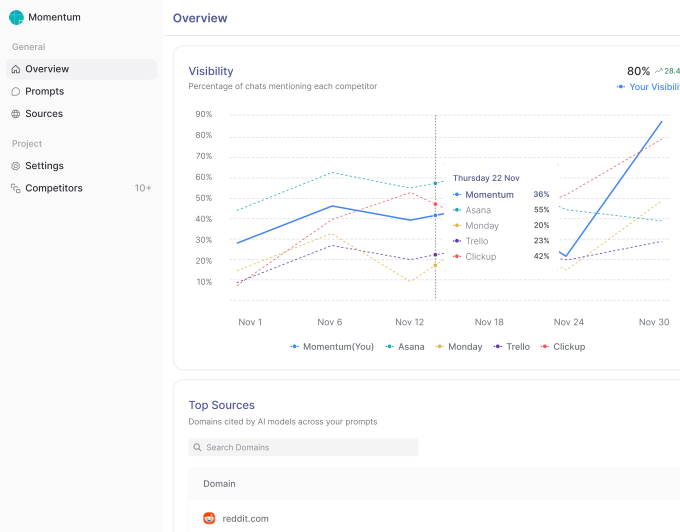
Scaling this manually is not realistic. An AI search visibility platform like Cite AI tracks brand mentions and citations across AI engines at scale, so teams can see where their brand appears, what is being said, which sources AI engines are pulling from, and where inaccuracies are entering the picture.
What to Do When You Find a Hallucination
You cannot submit a correction directly to an LLM. That is not how these systems work. What you can do is improve the source content AI engines draw from. Update your own site with clear, structured, factually precise content that directly addresses the inaccuracy. Make sure your pricing, features, and policies are stated plainly and consistently across your site and third-party sources.
Authoritative, well-structured content reduces the risk of hallucinations over time. AI engines weigh credible, frequently cited sources more heavily. Publishing accurate content on your own domain and earning coverage from credible third-party outlets- the publications and platforms that AI models tend to cite- gives these engines better material to draw from.
FAQs
What is an AI hallucination, and how does it affect my brand?
An AI hallucination is when a large language model generates text that sounds accurate but contains false information. For brands, this means an AI engine may describe your product incorrectly, cite a price you do not charge, or reference a policy you do not have. It matters even for brands that are not household names, because AI-generated answers shape consumer impressions at the very start of the research process, before a user ever reaches your website.
How do I find out if an AI engine is saying something false about my brand?
While this is not feasible in the long-term, start with manual testing. Run prompts across ChatGPT, Gemini, and Perplexity using the kinds of questions your audience asks: product comparisons, pricing questions, and category recommendations. Look for wrong pricing, false feature claims, and misattributed capabilities. For ongoing detection at scale, an AI search monitoring platform like Cite AI tracks brand mentions and citations automatically, so you are not relying on periodic manual checks to catch inaccuracies.
Can I fix what AI engines say about my brand?
There is no direct correction mechanism for LLMs. What influences AI outputs over time is the quality, authority, and consistency of the source content these engines draw from. Updating your own site with accurate, well-structured information and earning coverage from credible third-party sources gives AI models better material to reference. Ongoing monitoring is essential because AI outputs are dynamic. New hallucinations can emerge as platforms update their models and data sources, so detection needs to be continuous rather than a one-time exercise.
Systemic monitoring is the piece most teams skip, and it is the most important one. AI outputs change. A hallucination you correct today can resurface in a different form next month. A one-time audit gives you a snapshot. Continuous AI search monitoring gives you the ability to catch new inaccuracies as they emerge and respond before they compound.
The brands that win in AI search will be the ones that monitor and respond, not just publish. Knowing what AI engines are saying about your brand is step one, and it starts with having the right visibility in place.
Explore Cite AI to improve your brand’s visibility.
Start writing with confidence
Verify your content, add real citations, and publish with trust.