Best AI Visibility Platforms in 2026
Share this Article:


AI visibility is quickly becoming one of the most important areas brands need to monitor.
For years, SEO was the primary way businesses got discovered online. If your pages ranked well on Google, your brand was visible. If they did not, you knew where to focus your efforts.
But search behavior is changing fast.
Today, more people are turning to AI engines like OpenAI ChatGPT, Perplexity AI, Google Gemini, Claude, and Google AI Overviews to research products, compare solutions, and discover brands. Instead of browsing through multiple search results, users can ask a question and instantly receive a curated list of recommendations.
That completely changes how brands get discovered.
If someone asks an AI engine, “What is the best skincare brand for sensitive skin?” or “What is the best Shopify analytics tool for a growing store?”, your brand may or may not appear in the response. Even if you rank highly on traditional search engines, that does not guarantee AI systems understand your brand, reference your content, or recommend your products.
This is where AI visibility tools become essential.
These platforms help brands understand how AI engines perceive them, which prompts they appear for, which competitors show up alongside them, what sources AI engines rely on, and how their visibility can be improved over time.
In this post, we’ll break down the top AI visibility tools we tested, what each platform does well, where each one falls short, and which solution may be the best fit for your team.
What Is AI Visibility?
AI visibility refers to how your brand appears inside AI-generated answers.
It is not just about being mentioned once. A strong AI visibility strategy looks at a much broader set of signals, including:
- Whether your brand appears for high-intent prompts
- How often your brand is recommended
- Which competitors appear beside you
- Whether AI engines describe your brand accurately
- Which sources and websites do the AI engines cite
- Whether your product pages, reviews, and content are referenced
- Whether AI-driven traffic actually converts
In traditional SEO, brands focused on keywords, rankings, clicks, impressions, and backlinks.
In AI visibility, the focus shifts toward prompts, recommendations, citations, sentiment, competitor presence, and AI-referred traffic.
That is why terms like AEO (Answer Engine Optimization) and GEO (Generative Engine Optimization) are becoming more common. Both describe the process of improving how your brand appears in AI-generated responses.
The goal is simple: when potential customers ask AI engines for recommendations, your brand should be visible, trusted, accurately represented, and frequently cited.
Why Is It Important to Use an AI Monitoring Tool?
AI-driven discovery is no longer something brands can afford to ignore.
Based on proprietary data from Cite AI, AI-referred traffic has grown by more than 430% since early 2025. The data shows a sharp rise in users discovering brands through AI engines like ChatGPT, Perplexity, Gemini, and Google AI Overviews, highlighting how quickly AI platforms are becoming a meaningful traffic and discovery channel for businesses.
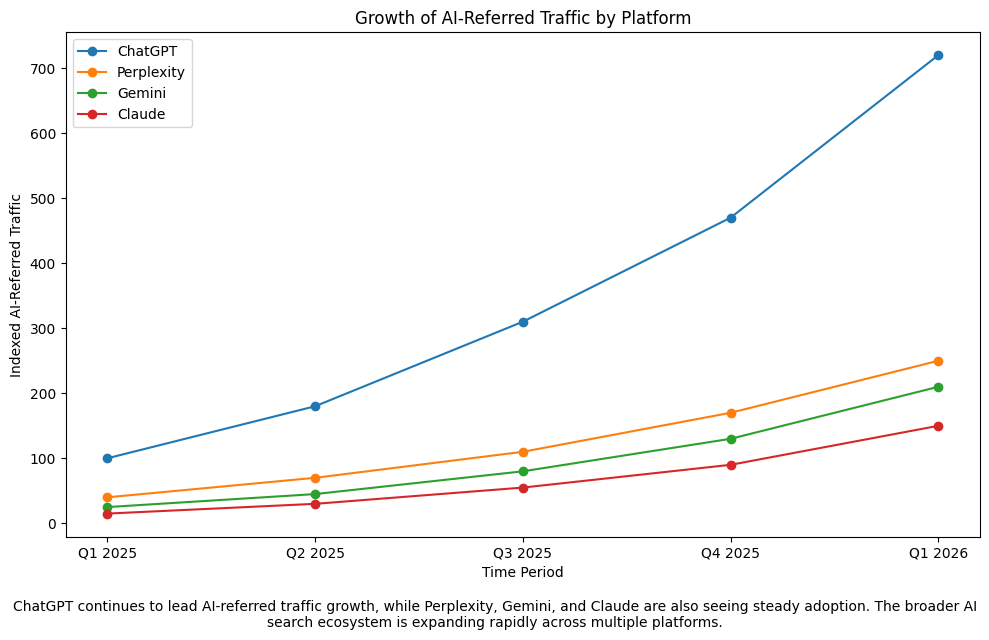
As the chart shows, ChatGPT currently leads AI-referred traffic growth and has seen the strongest adoption over time. At the same time, platforms like Perplexity, Gemini, and Claude are also growing steadily, making it clear that this is not just a one-platform shift. The entire AI search ecosystem is expanding, and brands need visibility across multiple AI engines, not just one.
This shift matters because the way people discover brands and products is changing rapidly.
Instead of relying only on traditional search engines, users are increasingly turning to AI platforms to ask questions like:
- What is the best [product] for my needs?
- Which brands should I consider?
- What is the best alternative to [competitor]?
- Which software or tool is best for my business?
In many cases, AI engines do not simply provide a list of links. They generate direct answers and recommend specific brands, products, and services. If your business is not being mentioned, cited, or recommended in those responses, you could be losing visibility during a critical stage of the customer journey.
That is why AI monitoring tools are becoming essential for modern marketing teams.
A strong AI visibility platform helps brands understand:
- Which prompts and questions matter most
- Whether their brand appears in AI-generated responses
- Which competitors are being recommended instead
- Which sources do AI engines rely on and cite
- How AI systems describe and position their brand
- What actions can improve visibility and recommendations
This is also why SEO alone is no longer enough. Traditional search optimization still plays an important role, but brands now also need to think about AEO (Answer Engine Optimization) and GEO (Generative Engine Optimization). Success is no longer just about ranking in search results. It is about being understood, trusted, and recommended by AI engines.
As AI-referred traffic continues to grow, brands that start monitoring and improving their AI visibility early will have a significant advantage.
Top 5 AI Visibility Tools
We tested a wide range of AI visibility platforms and evaluated them based on factors such as prompt tracking, monitoring accuracy, competitor analysis, source analysis, usability, pricing, reporting capabilities, and the actual actionability of their insights.
Here are the five AI visibility tools that stood out the most.
| Rank | Tool | Main focus | Price level | Quick takeaway |
| 1 | Cite AI | Clean AI search analytics, source tracking, and brand visibility monitoring | $ | User-friendly interface, and useful source analysis at affordable prices. |
| 1 | Profound | Enterprise-focused AI visibility and competitive intelligence platform | $$$ to $$$$ | Powerful analytics and competitor tracking, but better suited for larger teams due to pricing and complexity. |
| 2 | Semrush | AI visibility inside a broader SEO and digital marketing platform | $$ to $$$ | Great for existing Semrush users who want rich AI search data, but it can feel broad. |
| 3 | Promptwatch | Prompt monitoring, citations, competitors, and content agents | $$ to $$$ | Strong prompt monitoring tool with nice source visuals, but less focused on practical next steps. |
| 4 | Otterly AI | Affordable AI search monitoring and brand tracking | $ to $$$ | Good starting point for smaller teams, although the insights can feel a bit light. |
1. Cite AI
Cite AI is a clean, focused AI search analytics platform.
It helps marketing teams track, analyze, and improve their brands’ performance across AI platforms. The interface is easy to understand, and the source analysis is one of the product’s nicer features.
Cite AI is a good fit for teams that want a clear view of AI search visibility, prompt performance, cited sources, and competitors.
Key Features
1. Prompt Tracking and Organization
Cite lets users add prompts, organize them with tags, and track performance across countries and models. It also helps identify which prompts matter and provides AI-suggested prompts and search-volume data.
In our testing, the query set felt relevant, which is important. A tool can have a lot of data, but if the prompts are not connected to how customers actually search, the insights become less useful.
2. Visibility, Position, and Sentiment
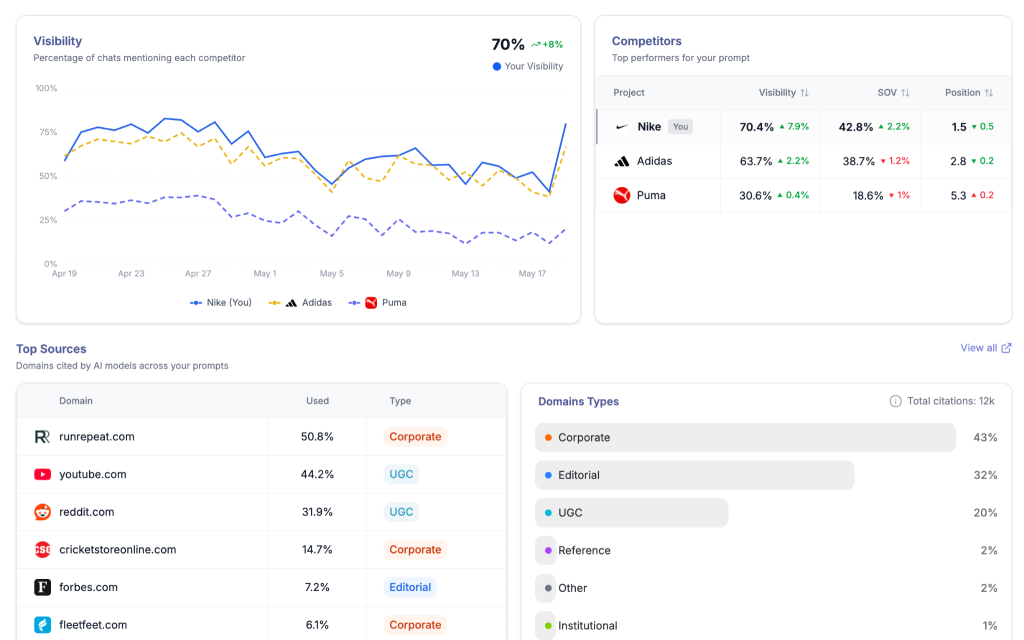
Cite tracks visibility, position, sentiment, and how your brand is perceived in AI-generated answers.
This gives you a clear overview of whether your brand is appearing, how it compares with competitors, and how AI engines describe it.
3. Source and URL Analysis
One of Cite’s strengths is source analysis.
It tracks source visibility, citations, domains, and URLs. You can analyze results by category, domain, and exact URL, which makes it easier to understand which pages are influencing AI answers.
This is helpful if your team is trying to improve content coverage or understand why certain competitors are showing up more often.
4. Clean Interface
Cite has a clean UI and is easy to navigate. The product feels focused and not overloaded, which is a plus.
For teams that want AI search analytics without a heavy SEO platform, Cite is a solid option.
Where Cite AI Wins
Cite AI stands out by offering many of the same core capabilities as larger AI visibility platforms, but in a much more affordable and accessible package.
Another major advantage is usability. The interface is clean, simple, and easy to navigate, making it approachable even for smaller marketing teams that prefer not to use overly complex enterprise dashboards. Reports are straightforward, the visibility data is easy to understand, and teams can start tracking AI presence without a steep learning curve.
For brands looking for practical AI visibility monitoring without enterprise-level pricing or complexity, Cite AI offers one of the strongest value-for-money options currently available.
Pricing
Cite AI offers one of the more affordable pricing structures in the AI visibility category, especially compared to enterprise-focused competitors.
The Basic plan starts at $25/month and includes 25 tracked prompts, daily tracking, unlimited users, 2 projects, and support for tracking across major AI engines like ChatGPT, Google AI Overview, Google AI Mode, and Gemini.
The Growth plan is priced at $90/month and increases the prompt limit to 100 tracked prompts, with support for 5 projects, making it a good fit for growing teams that want broader monitoring without enterprise pricing.
For larger teams, the Scale plan starts at $275/month and includes 350 tracked prompts and up to 20 projects. There is also a custom Enterprise plan that supports 1000+ prompts, expanded model access, unlimited projects, and custom tracking setups.
Overall, Cite AI provides strong value to teams seeking prompt tracking, competitor monitoring, source analysis, and AI visibility reporting, without the high pricing typically associated with enterprise AI visibility platforms.
Conclusion
Cite AI is one of the best value-for-money AI visibility tools currently available.
It offers many of the same core features found in larger enterprise platforms, including prompt tracking, source analysis, competitor monitoring, AI visibility reporting, and multi-engine coverage across ChatGPT, Gemini, Google AI Overview, Google AI Mode, and more.
What makes the platform stand out is its simplicity and accessibility. The interface is clean, easy to use, and designed for teams that want actionable AI visibility insights without overly complex dashboards or enterprise-level pricing.
For startups, ecommerce brands, agencies, and growing marketing teams looking to monitor and improve their visibility across AI search engines, Cite AI is a strong and practical choice.
2. Profound
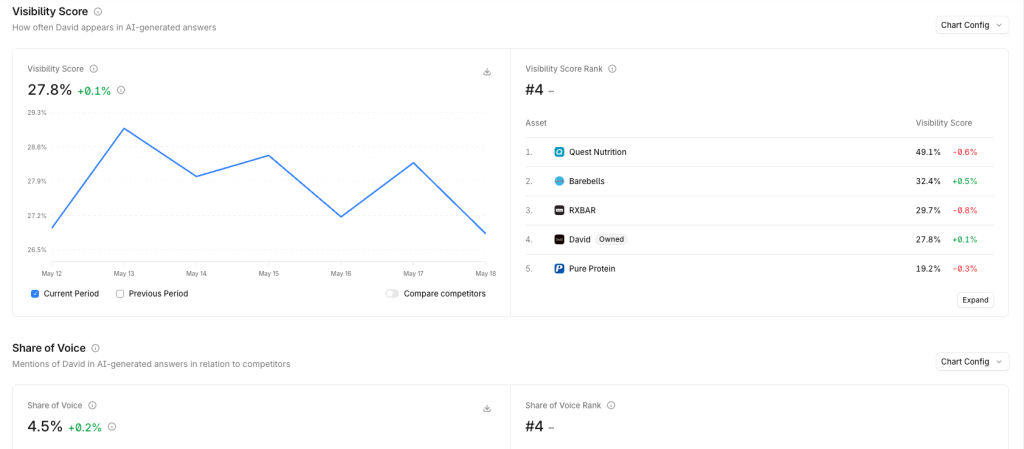
Profound is one of the most advanced AI visibility platforms built for enterprise brands that want deep monitoring and large-scale competitive intelligence. While many tools focus mainly on tracking mentions, Profound is designed to help teams understand how brands are positioned across AI engines, how competitors are performing, and how visibility changes over time.
The platform supports tracking across AI engines like ChatGPT, Perplexity, Gemini, Claude, and Google AI Overviews, helping brands monitor where and how they appear in AI-generated answers.
Key Features
1) Prompt Tracking
Profound allows brands to monitor prompts across different categories, including discovery, comparison, transactional, and competitor-related queries. This helps teams understand which prompts drive visibility and where competitors are outperforming them.
2) Competitive Intelligence
One of Profound’s biggest strengths is competitor analysis. The platform provides detailed insights into which brands are most often recommended, how visibility changes over time, and where competitors are gaining share across AI engines.
3) Visibility Analytics and Reporting
Profound offers detailed reporting dashboards designed for larger teams and enterprise workflows. Brands can track visibility trends, citation frequency, share of voice, and AI engine performance across different categories and prompts.
4) Source and Citation Analysis
The platform helps brands understand which websites and sources AI engines use to generate answers. This makes it easier to identify gaps in content, authority, and third-party coverage.
5) Enterprise Workflows and Integrations
Profound is built for larger organizations and includes enterprise-focused workflows, reporting structures, and collaboration features to help teams manage AI visibility at scale.
Where Profound Falls Short
Profound is extremely powerful, but it is also built primarily for enterprise teams. For smaller brands, startups, or lean marketing teams, the platform can sometimes feel overly complex and difficult to navigate compared to simpler AI visibility tools.
The pricing is another major consideration. Since Profound uses custom enterprise pricing, it is typically much more expensive than newer AI visibility platforms, especially for teams that only need prompt tracking, source analysis, and basic monitoring.
The platform is also heavily analytics-focused, which is great for deep reporting, but it may require more interpretation and onboarding before teams can turn insights into clear action steps. In some cases, users may receive a large amount of data without immediate prioritization of which changes will have the biggest impact.
For teams looking for a simpler, more affordable, and easier-to-use AI visibility workflow, Profound may feel more enterprise-heavy than it needs to be.
Pricing
Profound uses custom enterprise pricing and is generally considered one of the more expensive AI visibility platforms on the market. It is mainly designed for large enterprises with bigger budgets and advanced reporting needs.
Conclusion
Profound is a strong choice for enterprise teams seeking deep AI visibility, analytics, advanced competitor tracking, and large-scale reporting capabilities. While it may be more complex and expensive than some newer tools, it offers one of the most comprehensive enterprise AI visibility platforms currently available.
3. Semrush
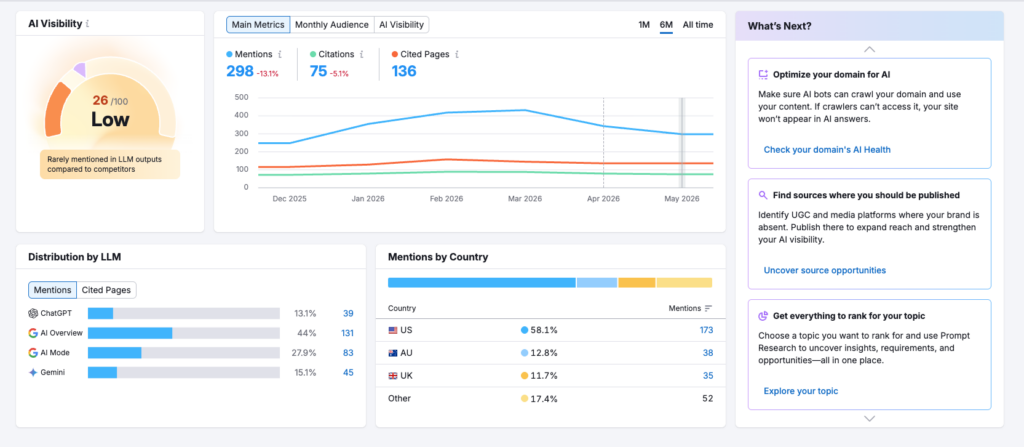
Semrush is one of the most established names in SEO, and its AI Visibility Toolkit brings AI monitoring into a broader search and marketing workflow.
This makes Semrush a strong option for teams that already use it for SEO, keyword research, content, competitor tracking, and site audits.
The biggest advantage is the amount of data. Semrush already has a large SEO database, so its AI visibility product can connect AI mentions, prompts, topics, competitors, and cited pages with traditional search data.
The downside is that it can feel broad. If you want a focused AI visibility workflow for one brand, especially with clear prompt-by-prompt action steps, Semrush can sometimes feel like a lot to process.
Key Features
1) AI Visibility Overview
Semrush’s AI Visibility Toolkit helps brands understand how they appear in AI-generated answers, benchmark visibility and mentions, analyze sentiment, discover prompts and topics, track AI visibility daily, audit technical blockers, and identify competitive gaps.
The main reports include:
- Visibility Overview
- Competitor Research
- Prompt Research
- Brand Performance
- Prompt Tracking
- AI Search Site Audit
This gives teams a broad view of where the brand stands across AI answers.
2) Strong SEO Context
One of the biggest reasons to use Semrush is that AI visibility does not exist in isolation. It is part of a broader SEO platform.
If your team already uses Semrush, adding AI visibility can make sense, as you can connect AI discovery to keyword research, technical SEO, competitor analysis, and content work.
Semrush One combines its SEO Toolkit with AI Visibility features, including visibility across Google AI Overviews, ChatGPT, Gemini, and Perplexity.
3) Prompt and Topic Coverage
Semrush can feel very complete because it tracks a large number of prompts and topics. It can quickly identify brand topics and provide a wide view of how your brand appears across AI-generated answers.
This is useful if you want a broad market view or if you work with a large brand that needs detailed reporting.
4) Cited Sources and Pages
The cited sources section is one of the strongest parts of the product.
It helps you see which domains and pages appear in AI answers, which sources are shaping the market, and whether your pages are being used as references.
This can be useful for content planning because it shows which sources AI engines trust and where competitors may be getting an advantage.
5) Competitor Analysis
Semrush also gives you competitor visibility data, including how your brand compares with other brands in AI answers.
Based on our testing, the Brand Performance section is useful, but it can feel somewhat limited if you want a wider and more flexible competitor view. It focuses heavily on a small set of competitors, which may not always match the competitors that AI engines naturally bring into answers.
Where Semrush Falls Short
Semrush is rich in data, but that can also be the issue.
The interface gives you a lot to analyze: topics, prompts, competitors, sources, domains, sentiment, and site audit data. For SEO teams, that may be a plus. For smaller teams, it can feel overwhelming.
It also feels better suited for broad monitoring and reporting than for clear, brand-specific action steps. If you want to know exactly what to change this week to improve your visibility for a specific prompt, you may need to interpret it yourself.
Pricing
Semrush’s standalone AI Visibility Toolkit is listed at $99/month and includes one folder, one domain, daily AI analysis query limits, Prompt Research limits, 25 tracked prompts, and AI Search Checks in Site Audit for up to 100 pages. Additional domains and prompt packages are available as paid add-ons.
Semrush One plans, which combine SEO and AI visibility features, start at $199/month.
Conclusion
Semrush is a strong choice if you already use Semrush or if your team wants AI visibility inside a larger SEO platform.
It is powerful, detailed, and useful for larger teams. However, it may feel too broad if your main goal is simple prompt tracking, direct recommendations, and AI-driven conversion measurement.
4. Promptwatch
Promptwatch is a focused AI visibility and prompt monitoring tool.
It helps brands track how they appear across AI engines, understand citations, monitor competitors, analyze sentiment, and create content based on visibility gaps.
Overall, we liked Promptwatch. It has a clean dashboard, useful source visuals, and a strong focus on prompt-level monitoring.
Key Features
1) Prompt Tracking Across AI Engines
Promptwatch tracks brand visibility across AI engines like ChatGPT, Claude, Gemini, Perplexity, and others. It focuses on showing how your brand appears in AI-generated answers, how visibility changes over time, and which sources are connected to those answers.
For teams that want a dedicated prompt monitoring tool, this is useful.
2) Visibility Score, Share of Voice, and Sentiment
Promptwatch includes AI visibility monitoring, sentiment, share of voice, and tracking across prompts. This makes it easier to understand not only whether your brand appears, but also whether AI engines describe it as positive, neutral, or negative.
That is helpful because brand mentions are not always good. You want to know whether AI engines understand your brand correctly and whether they recommend it in the right context.
3) Competitor and Source Analysis
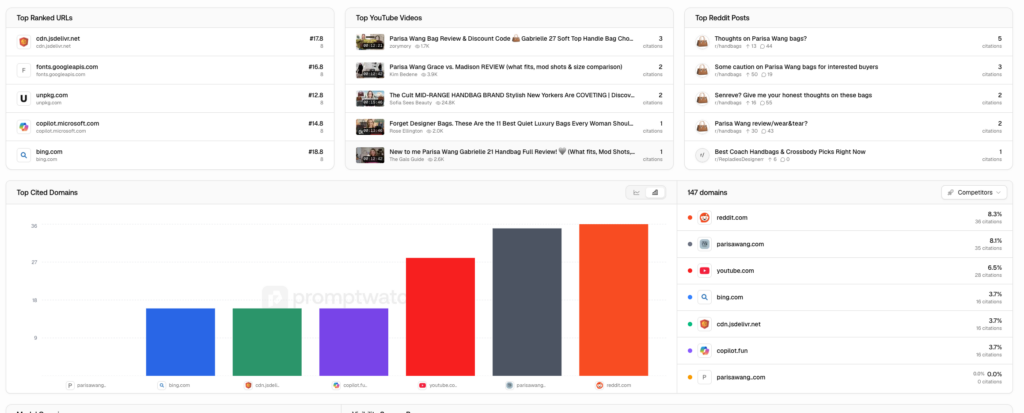
The dashboard gives a nice overview of competitors and sources. In our testing, the source visuals were one of the strongest parts of the product.
Promptwatch also includes off-site citation tracking, Reddit tracking, YouTube analysis, and citation analysis.
This is useful because AI engines often rely on third-party content, not only your own website. Reddit discussions, YouTube videos, reviews, and comparison pages can all influence how your brand appears in AI answers.
4) Content Agents and Content Gap Analysis
Promptwatch also includes content gap analysis, content briefs, citation tracking, and agents that can help create content for your website.
This can be helpful if your team wants to move from monitoring to content production.
Where Promptwatch Falls Short
Our main issue with Promptwatch is that some prompts can feel too directly connected to the brand.
For example, prompts like “Is [brand] worth it?” are useful, but they can also make visibility look higher than it really is. If many tracked prompts already include your brand name, the results may feel a bit inflated.
For AI visibility, non-branded prompts are often more important. These are the prompts in which a potential customer is seeking a recommendation but does not yet know which brand to choose.
Promptwatch is very good as a prompt-monitoring tool, but it could do more to prioritize the specific actions that will improve visibility.
Pricing
Promptwatch has a free Explore plan that includes one website, ChatGPT/OpenAI tracking, and 10 prompts. Its paid plans start at $99/month, with higher tiers for more prompts, more generated articles, location tracking, and additional analytics features.
Conclusion
Promptwatch is a good option if your main goal is prompt monitoring, source tracking, and understanding how your brand appears across AI engines.
It is easy to like, especially because the dashboards and source views are clear. Still, if your team needs stronger action recommendations and conversion tracking, you may outgrow it.
5. OtterlyAI
OtterlyAI is a solid AI visibility tool for brands that want to start monitoring how they appear across AI search engines.
It tracks brand mentions, citations, competitors, prompts, and visibility across platforms like ChatGPT, Perplexity, Google AI Overviews, Google AI Mode, Gemini, and Microsoft Copilot. It also includes brand reports, competitor views, citation tracking, crawlability checks, and GEO audits.
Otterly is easy to understand and offers a relatively accessible starting plan, making it appealing to teams just beginning to monitor AI search.
Key Features
1) Brand Visibility Reports
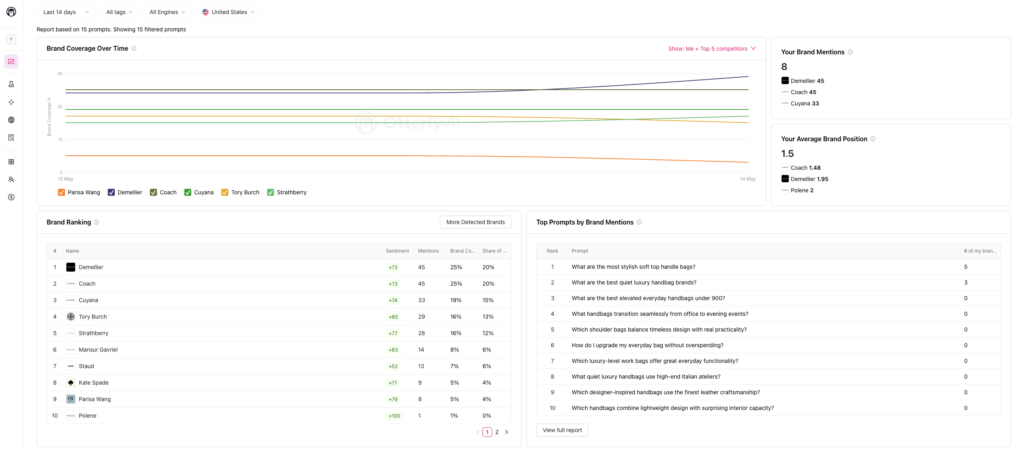
Otterly gives you brand reports that show how your brand appears across different AI engines, countries, and prompts.
One thing we liked is that Otterly shows a list of top brands in the results. This gives you a quick view of the market and helps you understand which brands are most often recommended.
2) Prompt and Competitor Tracking
Otterly can help you monitor prompts and track how your brand performs across AI-generated answers. It also includes brand position tracking and competitor monitoring.
This is useful if you want a simple way to understand whether your brand is showing up for important searches and how often competitors appear next to you.
3) Citation Tracking
Otterly tracks link citations, so you can see which pages and domains AI engines are using in answers.
This is helpful for identifying content opportunities. If competitors are being cited from comparison pages, review pages, or product pages, you can see which sources may be helping them appear more often.
4) Crawlability and Content Audits
Otterly also includes GEO crawlability and audit features. These can help check whether AI bots can access your website and whether your pages are structured in a way that AI engines can read.
We liked the crawlability checker. It is useful and easy to understand.
The content audit was more mixed. Some recommendations felt useful, especially around HTML and metadata structure. Others felt a bit generic or less relevant than we would have liked.
Where Otterly Falls Short
Otterly is a nice tool, but it can feel a bit too focused on predefined or user-defined competitors.
That is not always bad, but we would also like to see more emphasis on competitors that AI engines naturally identify. Sometimes your real AI competitors are not the same as the ones you manually select.
The tool also provides recommendations, but they do not always feel as actionable or specific as they could be.
Pricing is another thing to keep in mind. The Lite plan is accessible, but it includes a limited number of prompts. If you need more serious monitoring, the cost moves up quickly.
Pricing
Otterly’s Lite plan starts at $29/month and includes 15 search prompts. The Standard plan is $189/month with 100 search prompts, while the Premium plan is $489/month with 400 search prompts. Annual billing lowers the monthly equivalent, and Otterly also offers a free trial for new users.
Conclusion
Otterly is a good option for teams looking for a clear, approachable way to start tracking AI visibility.
It gives you useful monitoring, citation tracking, competitor views, and crawlability checks. However, the lower entry price should be viewed in context. Once you need more prompts or broader tracking, Otterly becomes a more serious investment.
For smaller teams, it can be a good starting point. For e-commerce brands that need deeper action recommendations, AI traffic attribution, and conversion tracking, a more complete tool may be a better fit.
How to Choose the Right AI Visibility Tool?
The right tool depends on what your team needs.
If you are just getting started, a simple and affordable monitoring tool may be enough. If you already have a large SEO workflow, you may want AI visibility inside your existing SEO platform. If you are an e-commerce brand, you probably need more than prompt tracking. You need to understand whether AI visibility leads to traffic, customers, and revenue.
Here are a few things to look at before choosing a tool.
1. Does it track the prompts that matter?
Prompt quality is one of the most important parts of AI visibility.
A tool should not only track branded prompts like “Is [brand] worth it?” It should also track non-branded, high-intent prompts where customers are still deciding what to buy.
These are often the prompts that matter most.
For example:
- “Best running shoes for flat feet”
- “Best supplement brand for sleep”
- “Best Shopify analytics app”
- “Best alternative to [competitor]”
- “Which [product category] is worth buying?”
If your brand appears in these answers, you are getting discovered earlier in the buying journey.
2. Does it show real competitors?
Your real AI competitors may not be the same as your internal competitor list.
AI engines may recommend brands you did not expect. They may also ignore competitors you thought were important. A good AI visibility tool should help you discover which brands AI engines actually mention, compare, and recommend.
3. Does it analyze sources?
AI engines do not create answers from nothing. They rely on sources.
These can include:
- Your website
- Product pages
- Blog posts
- Review sites
- Comparison articles
- Reddit threads
- YouTube videos
- Press mentions
- Third-party directories
If you do not know which sources are shaping the answers, it is hard to know what to improve.
4. Does it give actionable recommendations?
This is one of the biggest differences between tools.
Some tools are great at showing data, but they leave the interpretation to you. Others help you understand what to do next.
The best AI visibility tool should help answer:
- Which prompts should we improve first?
- Which pages need better structure?
- Which missing content should we create?
- Which sources should mention us?
- Which competitors are beating us and why?
- What should we change on our website?
Data is useful, but action is what improves visibility.
5. Does it connect visibility with traffic and conversions?
This is especially important for e-commerce brands.
AI visibility is not only a branding metric. It can become a performance channel.
If AI engines recommend your brand and send users to your store, you need to know whether those users browse, add to cart, and make a purchase.
That is why Cite AI’s combination of AI visibility tracking and first-party traffic attribution is so valuable. It connects the discovery side with the revenue side.
Final Thoughts
AI visibility is still in its early stages, but it is quickly becoming an important part of modern marketing.
More customers are now using AI engines to discover brands, compare products, research software, and get recommendations. That means businesses need to understand how they appear inside AI-generated answers, which competitors are being recommended, which sources AI engines trust, and what actions can improve their visibility.
There are now several strong AI visibility platforms on the market. Semrush offers broad AI search insights within a larger SEO ecosystem. Promptwatch focuses heavily on prompt monitoring and source tracking. Otterly AI is a simple starting point for smaller teams.
But for teams seeking a balance among affordability, usability, and practical AI visibility monitoring, Cite AI stands out as one of the strongest options available today.
Cite AI makes it easy to track prompts, monitor competitors, analyze cited sources, measure visibility across AI engines, and understand how your brand appears in AI-generated answers. The platform offers many of the same core capabilities as larger enterprise tools, while keeping the interface clean, intuitive, and much more accessible for growing teams.
AI search is not replacing SEO overnight, but it is clearly becoming a new layer of discovery. The brands that start monitoring and improving their AI visibility today will be in a much stronger position as AI-driven search continues to grow.
Frequently Asked Questions about AI Visibility Tools
1) What are AI visibility tools?
AI visibility tools help brands understand how they appear inside AI-generated answers.
Instead of tracking only traditional Google rankings, these platforms monitor prompts, brand mentions, competitor visibility, cited sources, sentiment, and recommendations across AI engines such as ChatGPT, Perplexity, Gemini, Claude, and Google AI Overviews.
In simple terms, they show whether AI engines recognize, understand, and recommend your brand when users ask relevant questions.
2) Why are AI visibility tools important?
AI visibility tools are becoming increasingly important as more consumers discover brands through AI-powered search experiences.
Users increasingly rely on AI engines for recommendations, comparisons, alternatives, and buying advice. If your brand is not appearing in those responses, you could be losing visibility during an important stage of the customer journey.
These tools help you understand where your brand stands, which competitors are being recommended in its place, and what improvements can increase your presence across AI platforms.
3) How are AI visibility tools different from SEO tools?
Traditional SEO tools focus mainly on rankings, keywords, backlinks, and organic traffic from search engines.
AI visibility tools focus on how brands appear within AI-generated answers. That includes tracking prompts, AI recommendations, citations, competitor mentions, and brand perception across AI platforms.
SEO still matters, but AI visibility adds another layer to digital discovery. Brands now need to optimize not only for search rankings, but also for AI recommendations and citations.
4) What should I look for in an AI visibility tool?
A strong AI visibility tool should help you:
- Track important prompts and queries
- Monitor competitor visibility
- Analyze cited sources and references
- Understand how AI engines describe your brand
- Measure visibility across multiple AI engines
The best tools also provide actionable insights rather than just reporting data. It is not enough to know your brand is missing from an answer. You also need guidance on what to improve to increase visibility and recommendations.
A clean interface, easy reporting, and affordable pricing are also important, especially for smaller teams.
5) Which AI engines should AI visibility tools support?
A good AI visibility platform should support major AI engines and answer platforms, including:
- ChatGPT
- Google AI Overviews
- Google AI Mode
- Gemini
- Perplexity
- Claude
Since AI search behavior differs across platforms, tracking visibility across multiple engines gives brands a much more accurate picture of their AI presence.
6) How can brands improve AI visibility?
Improving AI visibility usually starts with identifying where your brand is missing and understanding why competitors are being recommended instead.
This can involve:
- Improving website structure and crawlability
- Creating clearer product and category pages
- Publishing comparison and educational content
- Earning mentions from trusted third-party sources
- Improving brand authority and citation coverage
- Making content easier for AI engines to interpret
Platforms like Cite AI help brands identify visibility gaps, analyze sources, monitor competitors, and track how visibility changes over time across different AI engines.
Start writing with confidence
Verify your content, add real citations, and publish with trust.