How to Analyze AI Sources for Better Marketing Insights
Share this Article:


Audiences no longer start their research on a results page. They ask ChatGPT, Gemini, and Google AI Overviews to compare options and point them toward a brand. Whatever answer they get depends on the content those engines pull from, and that content is what we call AI sources.
Understanding which sources feed AI-generated answers helps you understand why your brand gets described the way it does. Analyzing AI sources shows you where you show up, where a competitor takes your spot, and which moves will improve your presence in AI search.
What AI Sources Are and Why They Matter
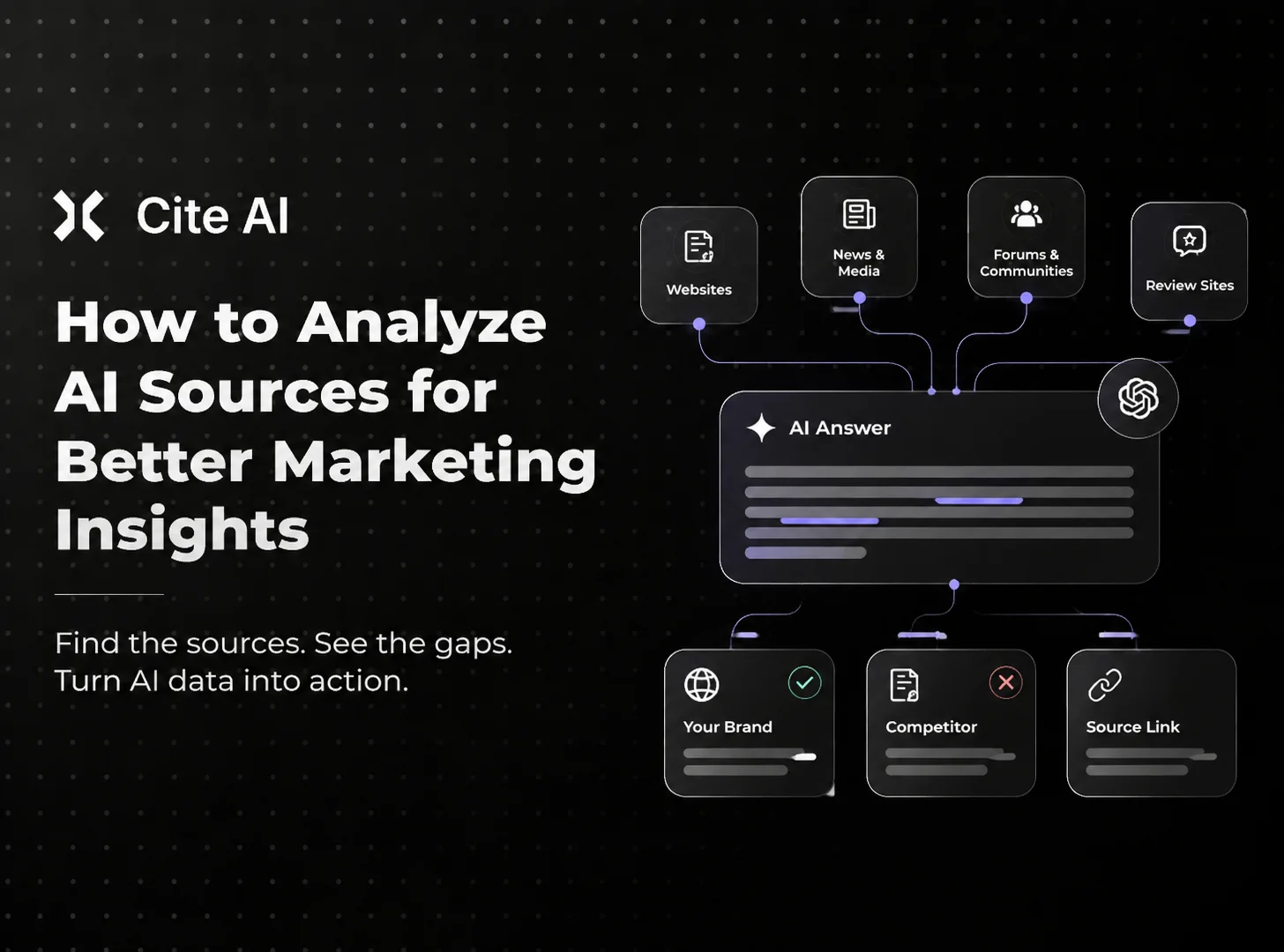
AI sources are the content and domains an AI engine references to build an answer. Ask Perplexity for the best tool in your category, and the model pulls from articles, review sites, forums, and product pages, then cites some of them directly. Those references are your AI search sources.
Each engine handles citations its own way. Perplexity shows its sources openly. Google AI Overviews links to pages inside the answer. ChatGPT mixes training data with live retrieval. The pattern underneath it all is that specific domains carry weight, and that weight is source influence.
Source influence ties straight to brand visibility. If the sites that describe your category never mention you, AI answers won’t either. This isn’t a concern you can leave to a specialist anymore. It shapes discovery, comparison, and the impression a buyer forms long before they reach your site.
What You’ll Need Before You Start
Start with a list of priority prompts your audience asks. These are the real questions buyers type into AI tools, things like “best affordable AI visibility platform” or “alternatives to a premium tracking tool.”
Next, gather competitor names for benchmarking. You want to see who shows up when you don’t. You also need an AI search visibility tool for structured prompt tracking, since manual checks across four engines won’t stay consistent or scale.
Set clear goals tied to brand visibility and share of voice. Defining success keeps your brand insights AI work pointed at decisions, not a pile of data you never use.
Step 1: Identify Which AI Sources Cite Your Brand
Run your priority prompts across ChatGPT, Gemini, and AI Overviews. Use the same prompts on every engine so the results compare fairly.
Log every place your brand mentions appear. Note whether the model names you, describes you correctly, and links to a source. Then record which domains the AI pulls citations from, because those domains tell you what feeds the answer.
Watch the gaps. When a relevant prompt returns no mention of you, that absence is a signal worth acting on. AI citation analysis of these empty spots shows you exactly where the visibility work starts.
Step 2: Map the Source Influence Behind Answers
Look for the sites that keep showing up across your prompts. These repeat references carry real source influence, and they matter far more than any one-off citation.
Sort them into owned, earned, and third-party sources. Owned sources are your pages. Earned sources are press and industry coverage. Third-party sources cover review sites and forums like Reddit, which AI engines lean on for opinions and comparisons.
Separate patterns from quirks. A domain cited across every engine holds broad influence. A citation that appears on one platform only might be a single-engine behavior. Sticking to cross-platform patterns keeps your AI search sources analysis honest.
Step 3: Run AI Citation Analysis on Competitors
When a competitor gets cited instead of you, the reason usually sits in the sources. Run the same shared prompts and record who the engines name.
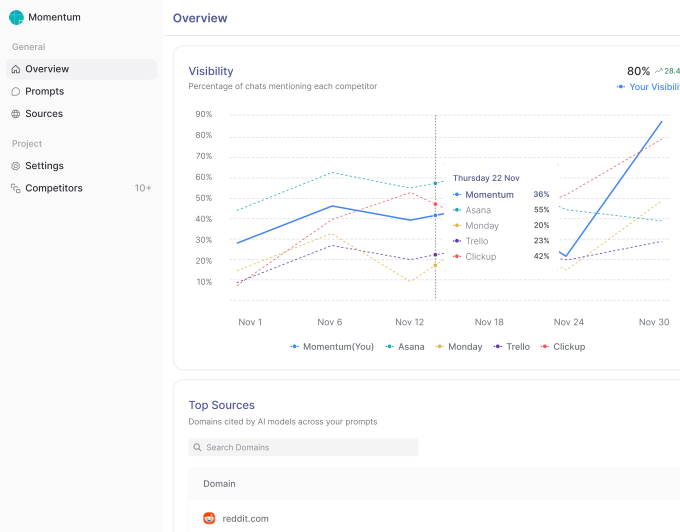
Compare share of voice across those prompts. If a competitor shows up in eight answers out of ten and you land in two, you have a measurable gap. Our competitor benchmarking approach turns that into a clear picture, not a hunch.
Find the sources giving competitors the edge. If a review platform or industry site cites them and skips you, that source becomes a content and PR opportunity you can work on directly.
Step 4: Turn AI Source Data Into Marketing Insights
Use source patterns to drive your content strategy. If AI engines pull from comparison articles and how-to guides in your category, those formats deserve a spot near the top of your calendar.
Use the data to decide which pages to strengthen. A thin product page that earns no citations needs clearer structure and answer-first content. Our citation tracking data shows which pages already pull their weight and which ones need attention.
Turn high-influence sources into PR targets. If a handful of publications shape AI answers about your category, those outlets belong at the top of your earned media list. Prioritize the marketing AI data that connects to visibility.
Prioritizing Sources That Actually Move Visibility
Rank sources by two things: how often they appear and how many engines they reach. A domain cited across every platform beats one that pops up occasionally.
Put your effort where influence compounds. Earning a mention on a high-frequency, multi-engine source lifts your presence across several prompts at once, which stretches your brand insights AI work further than chasing one-off wins.
Step 5: Monitor AI Sources Over Time
AI answers shift as prompts change and platforms retrain their models. A citation you hold today can vanish next month, so treating analysis as a one-time task leaves you blind to those shifts.
Build AI search monitoring into a continuous workflow. Track citation changes the way you track rankings, watching your mentions move as content and platform behavior change.
Set a review cadence, weekly or monthly, and measure progress against your baseline share of voice. Google documents how AI Overviews surface sources, and platforms like Perplexity update retrieval often, so steady prompt tracking keeps your insights current.
How We Make AI Source Analysis Affordable
Cite AI is an AI search visibility platform that tracks citations, brand mentions, and source influence across ChatGPT, Gemini, and Google AI Overviews. You see where you appear, who appears instead, and which sources drive the answers.
We track over 50,000 prompts daily across major engines, so your view of AI sources stays fresh, not stale. You get the same core workflow as premium tools at more accessible pricing.
That cost-efficient model fits agencies and multi-brand teams that need AI search visibility across many accounts without blowing a budget. Real usage shouldn’t demand an enterprise contract.
FAQs
What are AI sources in marketing?
AI sources are the content and domains AI engines cite when they build answers, from product pages to review sites and forums. They shape brand discovery because the sources an engine trusts decide how your brand gets described and whether it shows up at all.
How does AI citation analysis help my brand?
AI citation analysis shows where you get cited versus your competitors across shared prompts. That comparison guides your content and PR priorities, pointing to which pages to strengthen and which sources to target for stronger visibility.
How often should we analyze AI search sources?
AI answers change as prompts shift and platforms update their models, so a single check goes out of date fast. Regular monitoring, on a weekly or monthly cadence, keeps your insights current and your share of voice measurable over time.
AI sources shape how your brand shows up in every AI-generated answer, and the sites behind those answers decide whether you get named or skipped. This work is ongoing, not a one-time fix, because prompts and platforms keep moving.
Explore Cite AI to help you better analyze your brand!
Start writing with confidence
Verify your content, add real citations, and publish with trust.