AI Metrics Explained: How We Measure Visibility, Share of Voice, and Position in AI Search
Share this Article:


Buyers now find, compare, and pick brands inside AI-generated answers. A marketing lead asks ChatGPT for the best project management tool, reads the reply, and walks away with a shortlist. She opens no search results and visits no websites.
Bain research shows most consumers now settle a large share of searches without clicking through to a site, and AI summaries sit at the center of that shift. If the answer leaves your brand out, you lose that buyer before evaluation starts.
Blue-link rankings miss all of this. Your page can hold the top Google spot while ChatGPT and Gemini recommend three competitors and never say your name.
That gap is why AI metrics matter. We use three to measure AI visibility: visibility, share of voice, and position. Each one tells you something the other two can’t.
AI Visibility Measures How Often Your Brand Appears
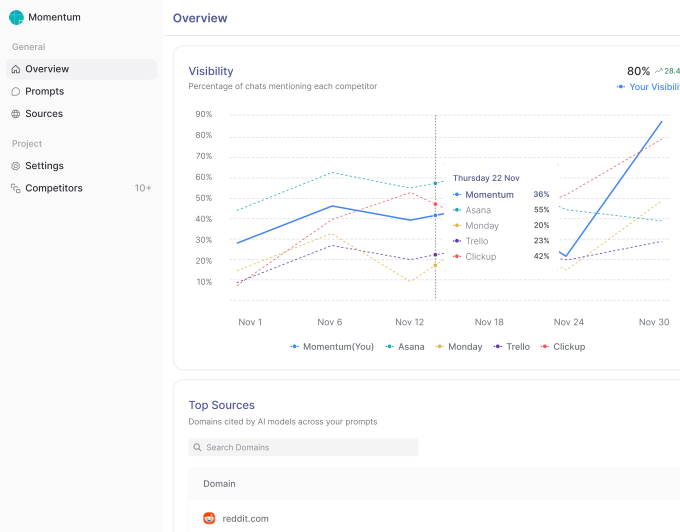
AI visibility is the percentage of tracked prompts where an AI engine mentions your brand. If you track 100 prompts and appear in 32 responses, your visibility score is 32%. It answers the first thing every marketer asks: where does our brand show up?
Mentions and citations measure different things. A mention means the AI names your brand. A citation means the AI points to your website or content as a source. Lots of mentions with few citations signal awareness without source authority. Lots of citations with few mentions mean AI engines read your content and then recommend someone else. We track both, because each gap calls for a different fix.
A single prompt run tells you very little. AI engines vary their answers by design, so the same prompt names different brands on different runs. We run each prompt many times and score the pattern, not the one-off result.
Visibility Differs Across ChatGPT, Gemini, Perplexity, and Google AI
Each platform pulls from different sources, so each one produces its own brand mention pattern. Perplexity shows its live web sources in every answer. ChatGPT mixes training data with web search. Gemini leans on Google’s index. A brand with heavy review site coverage can lead on one engine and disappear on another.
Google’s two AI experiences split as well. AI Overviews summarize a query above the standard results. AI Mode runs a back-and-forth conversation, breaks the question into related sub-queries, and draws from a wider pool of pages. Google Search Central’s documentation on AI features explains how each works. We report every platform separately so one strong engine never hides a weak one.
Share of Voice Shows How Much of the Conversation You Own
Share of voice measures your mentions against the total mentions across your competitor set. If AI engines name your brand 40 times and all tracked brands 200 times, your share of voice is 20%.
Visibility is a presence rate. Share of voice is a ratio against rivals. You can appear in 60% of prompts and still own a small slice of the conversation if five competitors show up beside you every time.
We measure it at two levels. Prompt-level share of voice shows who owns one specific question, such as “best CRM for startups.” Category-level share of voice rolls up every prompt in a topic. Use the first to write content briefs. Use the second for positioning and leadership reporting.
Why Your Competitor Set Changes the Score
The brands you choose to track change the math. Track three known rivals, and your share of voice will look healthier than it is. A closed list ignores every brand the AI recommends that you never added.
AI engines also surface new rivals with no warning. A startup with active Reddit threads and solid review-site coverage can appear in answers months before it shows up in your competitive analysis. Check which brands AI responses name each month and update your set.
Position Tracks Where Your Brand Lands Inside the Answer
Position measures where your brand lands inside the answer. Readers scan the top of a response and often stop there. The first brand named gets the attention. Readers skim past the brand at the bottom of a seven-item list.
AI ranking moves between runs and between models. The same ChatGPT prompt can put you second on Monday and fourth on Thursday. Gemini orders the same brands another way.
So, we treat average position as a trend line, not a fixed rank. A rolling average across many runs shows whether your placement climbs or slips over weeks and months. A single snapshot shows one run and nothing more.
How We Read Visibility, Share of Voice, and Position Together
Each metric answers a different question for marketers. Visibility answers “Do we show up?” Share of voice answers “How do we compare?” Position answers “Do AI engines recommend us first?” When read side by side, these AI metrics point to causes.
High Visibility, Low Position
AI engines name your brand often but rarely put it first. This usually traces back to the sources they read. When roundups, comparison pages, and third-party reviews list a competitor as the top pick, AI answers repeat that order. Publish clear comparison content on your own site and work toward stronger placement in independent reviews. Both give AI engines better material to place you higher.
Low Share of Voice Despite Strong SEO
Strong Google rankings do not guarantee AI presence. Competitors often earn citations from publications, directories, and review sites where your brand has no footprint. Source influence analysis shows which domains and pages AI engines cite for your category prompts. That list becomes your PR target list.
Inconsistent Scores Across Models
Model-specific gaps show you where to focus your effort. If Perplexity cites you and Gemini ignores you, study what Gemini pulls from. If ChatGPT skips you, check whether you appear in the publications and forums it tends to reference. Each gap becomes a content or PR priority.
Keep monitoring after you act. AI answers change as models update, sources shift, and competitors publish. A March score tells you little about June.
Tracking AI Metrics Without an Enterprise Budget
Manual prompt checks work for a first look. Open ChatGPT, type ten questions, and note who appears. The method breaks fast. You get one run per prompt, no history, no competitor math, and hours of copy-paste across five platforms.
Automated AI search monitoring fixes that. Cite AI’s prompt tracking runs your prompts across ChatGPT, Gemini, Google AI Overviews, and Google AI Mode, then reports brand mentions, citations, share of voice, competitor presence, and the sources shaping each answer. We track 50,000+ prompts daily, so your AI ranking data reflects patterns across many runs instead of a single screenshot.
Premium tools in this category often price out smaller teams. Cite AI offers the same core tracking workflow at a lower cost, with accessible plans that fit agencies and multi-brand teams monitoring several clients without enterprise contracts.
FAQs
What is the difference between AI visibility and share of voice?
AI visibility measures how often your brand appears across tracked prompts. Share of voice measures your portion of all mentions compared with competitors. The first shows presence. The second shows competitive standing.
Is AI ranking the same as Google ranking?
No. Google ranking reflects your page’s spot in search results. AI ranking reflects where an AI engine places your brand inside its written answer. They differ because AI engines pull from many sources, including reviews and forums, and weigh them differently than a results page does.
How often should we track AI metrics?
Track them continuously and review trends at least weekly. Prompts, model updates, and platform behavior shift often, and a monthly snapshot misses movement that matters.
Can we improve our share of voice in ChatGPT?
Yes, over time. Publish answer-first content, earn citations on the sources ChatGPT references, and close the gaps your competitors fill. No tool or tactic guarantees placement, but steady work on content and source presence moves the numbers.
Visibility, share of voice, and position work best together. One shows where you appear, one shows how you compare, and one shows whether AI engines put you first.
Together, they explain why. Treat AI visibility as an ongoing practice, not a one-time fix, and feed what you learn into your SEO, content, and PR decisions every month.
Explore Cite AI today to better position your brand!
Start writing with confidence
Verify your content, add real citations, and publish with trust.