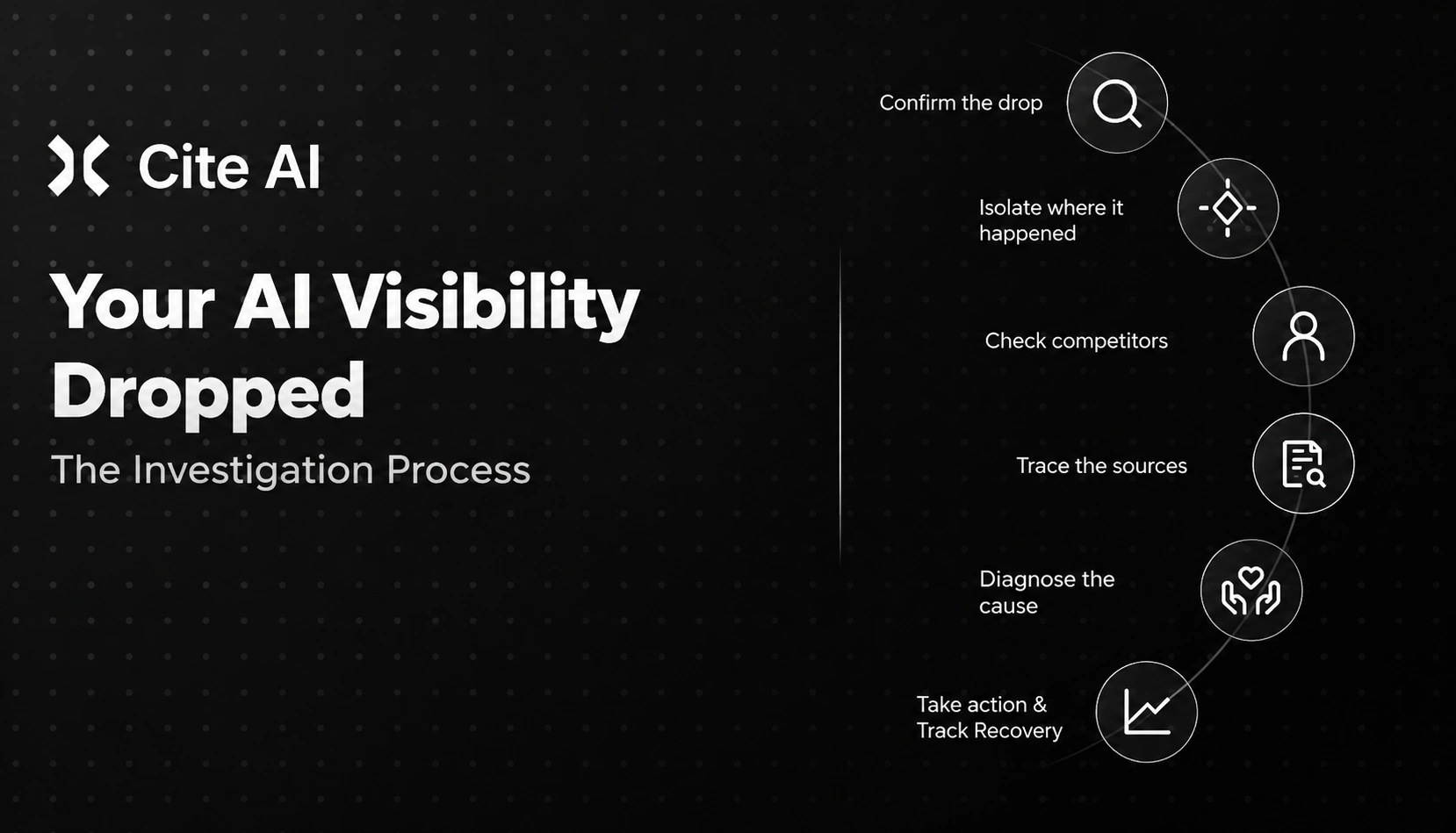
Your AI Visibility Dropped: The Exact Investigation Process
Share this Article:


Your audience now asks ChatGPT, Gemini, and Perplexity which brands to trust long before they land on your website. So, when your mentions fade from AI answers, the damage starts at discovery.
AI visibility moves around far more than traditional rankings. AI-generated answers rebuild themselves with every model update, source change, and prompt variation. A page-one ranking can hold for months. An AI citation can disappear in a week. This guide walks you through the exact investigation to run when your presence drops, using an AI visibility tool and AI search analytics to get you from panic to a fixable diagnosis.
What “AI Visibility Dropped” Actually Means
A drop is not one single thing. Fewer mentions means AI answers name your brand less often. Lost citations mean the answer stopped linking or attributing information to your site. Two separate problems, two separate fixes. Drops also land in different places. ChatGPT, Gemini, Perplexity, and Google AI Overviews each assemble answers in their own way, so a loss on one surface rarely means a loss everywhere.
Keep share of voice separate from absolute presence, too. You can hold the same number of mentions while a competitor doubles theirs, which shrinks your share without touching your raw count. And one weak prompt result is not a crisis. AI visibility monitoring and brand mention tracking exist to tell you whether a bad answer is noise or the first sign of a pattern.
Step 1: Confirm the Drop Is Real, Not Noise
AI answers vary run to run by design. Ask the same question twice, and you can get two different brand lists back. That variability means a single check proves nothing. Test across several prompts and several platforms before you call it a drop.
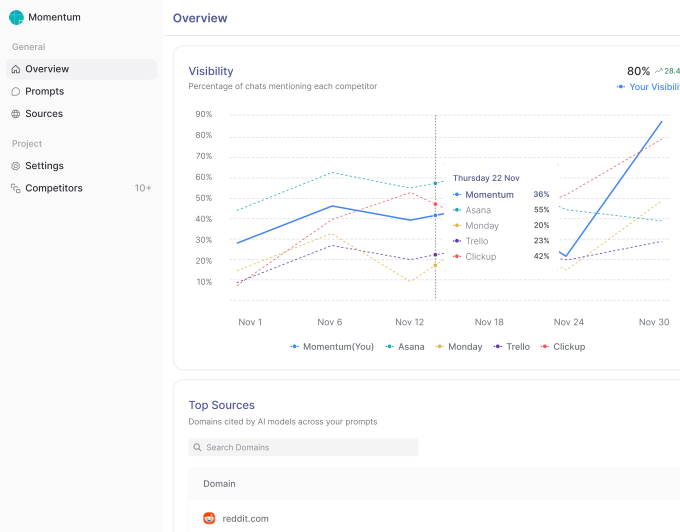
Look at trends over days, not single snapshots. A baseline from consistent AI performance tracking separates signal from randomness. When your mentions fall across a set of prompts over a week, that is real. When one answer skips you on a Tuesday, that is the model doing what models do.
Step 2: Isolate Where the Drop Happened
Narrow the problem to one surface. Figure out which platform lost you first: ChatGPT, Perplexity, Gemini, or Google AI Mode. A drop stuck to one engine points to that platform’s sources and model behavior, not a site-wide issue.
Then find which prompts stopped surfacing your brand. Split category prompts (“best tools for X”) from branded prompts, the ones that name you directly. Losing category prompts signals a competitive or source problem. Losing branded prompts signals something wrong with how AI reads your own content. Solid AI search analytics makes this split fast instead of a guessing game.
Step 3: Check If a Competitor Took Your Spot
When your brand vanishes from a prompt, something usually fills the gap. Check who gets cited or recommended in your place. Is it an existing rival gaining ground, or a new entrant the models started favoring? That answer changes your response.
Run competitor benchmarking on the exact prompts where you slipped. Track their mentions and citations against yours on identical questions. Their rising presence often points to a source shift, meaning AI engines started trusting sites that cover them more clearly than they cover you.
Step 4: Trace the Sources Feeding the Answers
AI engines build answers from sources, so trace which sites they cite for your category. Source influence sits at the root of most visibility drops. If the pages AI once pulled from stopped mentioning you, your presence falls right along with them.
Look for lost or updated third-party mentions. Review sites, directories, and editorial coverage carry heavy weight in what AI recommends. A competitor earning fresh coverage on a source the models trust can quietly push you out, even when your own site never changed. Per Google’s guidance on AI features, AI answers pull from a wide set of trusted web sources, which makes external presence a live lever for marketers.
Step 5: Diagnose the Likely Cause
Content and Site-Side Causes
Start with your own site. Removed pages, outdated pricing or product info, and crawl access issues all cut AI engines off from the material they need. Weakened answer-first, question-led content is another common culprit. When your pages stop answering the exact questions buyers ask, AI stops using you as the source. Our guide to answer engine optimization covers how to structure content AI can lift directly.
External and Platform-Side Causes
Some causes sit outside your control. Model updates regularly change what gets cited and reshuffle which brands appear. Lost external authority or fresher competitor sources shift the balance, too. These platform-side changes explain why AI visibility keeps moving and why a one-time fix never sticks.
Step 6: Take Action and Track Recovery
Now, act on the diagnosis. Fix crawl access, refresh stale content, and rebuild source presence by chasing coverage on the sites AI trusts for your category. Prioritize prompts tied to real buyer intent, since those touch revenue, not vanity counts.
Set alerts to catch future drops early, so you hear about a slide in days rather than quarters. Recovery is not a single project. AI search keeps moving, so holding your gains needs ongoing AI visibility monitoring, not one cleanup and a shrug. Our prompt tracking overview shows how to run this as a continuous program instead of a scramble. An AI visibility tool turns recovery into a measurable loop you can repeat.
Why We Built This Into an Affordable AI Visibility Tool
Running this investigation by hand does not scale. Checking every prompt across ChatGPT, Gemini, Perplexity, and AI Overviews, on repeat, would eat a full workweek and still miss the variation. That is why we built Cite AI to automate it.
Cite AI tracks your mentions, citations, and share of voice across the major AI engines, then benchmarks you against competitors on the same prompts. We track 50,000+ prompts daily for continuous visibility, so drops show up as trends you can watch, not surprises you find late. You get the same core workflow as premium platforms at accessible pricing, which keeps strong AI performance tracking and brand mention tracking within reach for lean teams and multi-brand agencies.
Teams using Claude can also connect Cite AI through Model Context Protocol (MCP) to analyze AI visibility, prompts, citations, and competitors directly within Claude.
FAQs
How do I know if my AI visibility actually dropped?
Lean on trend data across many prompts and platforms, not one check. Single answers vary by design. A consistent decline over several days across a prompt set confirms a real drop.
Why did a competitor start getting cited instead of us?
Usually a source shift, fresher competitor content, or a model update. AI engines follow the sites they trust, so when those sources start favoring a rival, the citations follow.
Can I recover lost AI visibility?
Yes. Fix the root cause, whether that is site access, stale content, or lost source presence, then keep monitoring to hold the gains as platforms change.
A visibility drop feels alarming, but it turns diagnosable the moment you have the right data behind it. Work the steps, isolate the surface, check your competitors, trace the sources, and act. AI search stays dynamic, so treat monitoring as continuous work rather than a fix you finish once.
Start tracking your AI visibility with Cite AI.
Start writing with confidence
Verify your content, add real citations, and publish with trust.