The 5 AI Visibility Metrics Every Marketing Team Should Be Tracking in 2026
Share this Article:


Audiences now use ChatGPT, Perplexity, and Google AI Overviews to discover, compare, and choose brands. That shift has created a visibility problem most marketing teams have not fully confronted. Traditional SEO metrics, such as rankings, organic traffic, and click-through rate, were built for a world where search results were links. In AI search, there are no links to rank. There are answers. And if your brand does not appear in those answers, you are invisible to a growing share of your audience.
In this post, we analyze the five metrics that generative engine optimization actually requires teams to measure in 2026.
Why Traditional SEO Metrics Are No Longer Enough
AI-generated answers have replaced ranked links for a significant portion of discovery queries. When someone asks ChatGPT which platform to use for AI search monitoring, they do not see ten blue links. They see one synthesized answer that names specific brands.
What gets lost when teams only track rankings and traffic is any visibility into whether they appear in that answer at all. AI search optimization requires an entirely different measurement framework. The question is no longer “where do we rank?” It is “does the AI mention us, how often, and what does it say?”
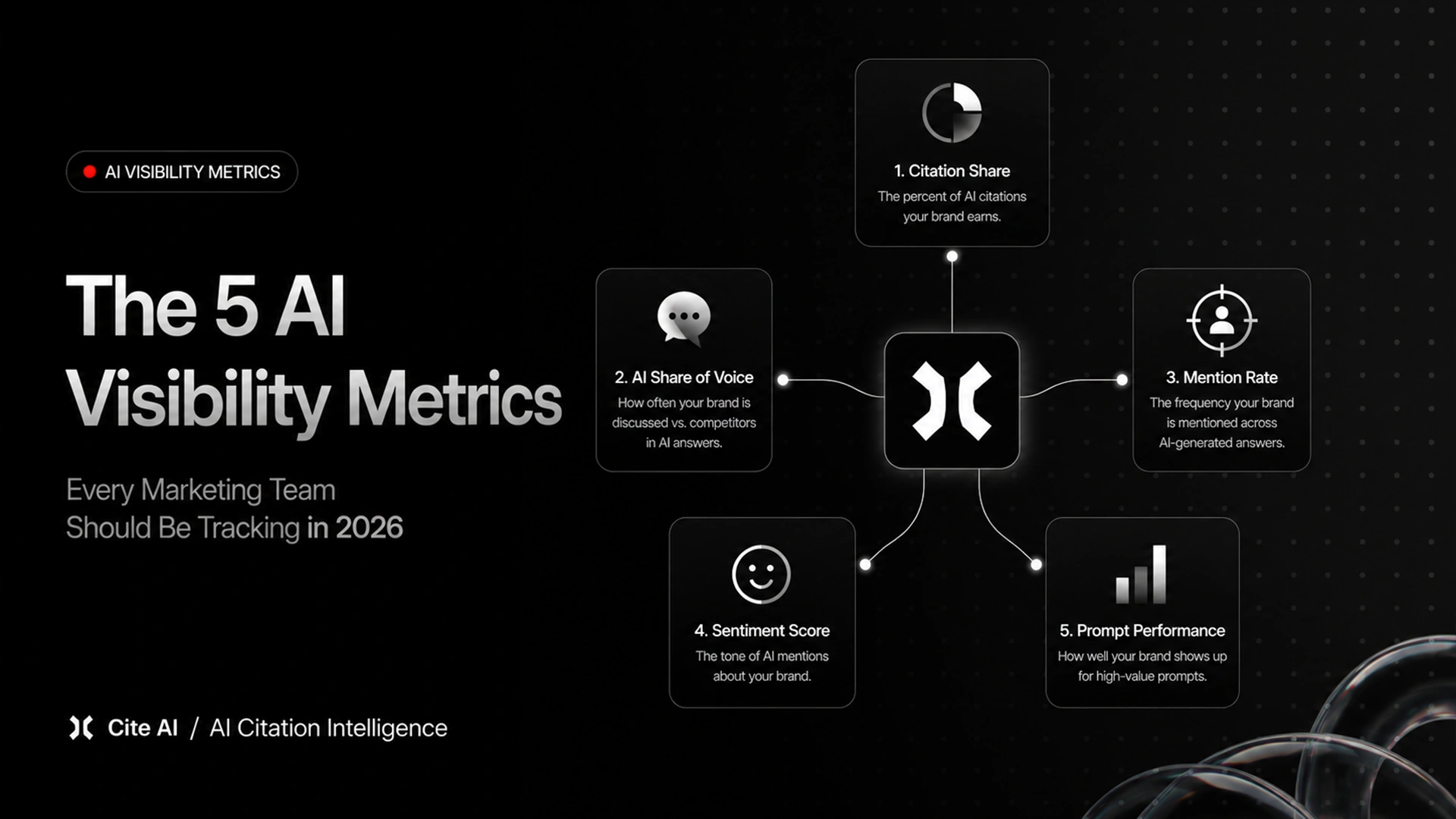
The 5 AI Visibility Metrics Every Marketing Team Should Track
1. Citation Share
Citation share measures how often your brand appears as a cited source across AI platforms such as ChatGPT, Gemini, and Perplexity. Being cited is the new version of ranking on page one. When an AI engine pulls a fact, recommendation, or comparison from your content and attributes it, that is a citation. Citation share connects directly to source authority and content structure. Pages that answer questions clearly, with structured formatting and credible sourcing, earn citations more consistently. This metric tells you how much of the AI answer ecosystem your content is actually feeding.
2. AI Share of Voice
AI share of voice tracks how often your brand is mentioned compared to competitors inside AI-generated answers. A brand with high domain authority can have a low AI share of voice if its content is not structured in a way that AI engines draw from. Share of voice varies by prompt type, platform, and query intent. A competitor might dominate in “best tool for X” prompts while you lead in comparison queries. A low share of voice is a direct signal of content gaps or weak source influence in your category, and it points to exactly where to focus next.
3. Mention Rate
Mention rate and citation share are related but different. Citation share measures attributed sourcing. Mention rate tracks how often your brand name appears across a broad set of prompts, with or without a formal citation. A brand can be mentioned frequently in AI answers without ever being cited as a source. Mention rate is a leading indicator of growing AI brand visibility. Rising mention rate across a tracked prompt set means AI engines are associating your brand with a topic, which often precedes stronger citation performance over time.
4. Sentiment Score
AI engines do not just mention brands. They describe them. Sentiment score measures how your brand is framed in generated responses: positively, neutrally, or negatively. A neutral framing might present your product as adequate. A positive framing positions it as a recommended choice. That distinction affects conversion. Competitor sentiment benchmarking is equally important. If a competitor is consistently described in warmer terms across comparison prompts, that reveals a positioning gap worth addressing through content, PR, and third-party source quality.
5. Prompt Performance
Prompt performance tracks which specific prompts trigger your brand to appear in AI answers and which ones do not. This metric maps directly to buyer intent stages. A brand that appears in “what is AI search monitoring” prompts but disappears from “best AI visibility tool for agencies” prompts has a clear content gap at the decision stage. Prompt performance data is one of the most actionable AI visibility metrics available. It tells you precisely where to build content and which sources to pursue for earned media coverage.
How to Put These Metrics to Work
Start by building a focused prompt tracking set around your category, key use cases, and top competitors. Running audits across multiple AI platforms matters because ChatGPT, Gemini, and Perplexity draw from different sources and produce different answers for the same query.
When you identify a metric gap, treat it as a content decision. Low citation share in a topic area means you need stronger, better-structured content there. Weak source influence means the publications and platforms that AI engines trust are not yet covering your brand. Every gap in AI search optimization data points to a specific action.
Choosing the Right AI Visibility Tool for Your Team
The right AI visibility tool tracks prompt volume at scale, covers multiple platforms, monitors competitor presence, and fits your budget. Affordability and multi-brand support are significant for agencies and growth teams managing multiple brands.
Cite AI tracks 50,000+ prompts daily across ChatGPT, Gemini, Perplexity, and Google AI Overviews, giving teams real data on citation share, share of voice, mention rate, sentiment, and prompt performance. It is built for marketing teams and agencies that need comprehensive AI visibility metrics without enterprise-level pricing.
FAQs
What is generative engine optimization, and how is it different from SEO?
Generative engine optimization (GEO) is the practice of improving how your brand appears inside AI-generated answers. Traditional SEO optimizes for keyword rankings in link-based results. GEO optimizes for citations, mentions, and accurate framing inside synthesized responses. The signals are different. AI engines prioritize content structure, source credibility, and topical authority over raw keyword density or backlink counts alone.
How often should marketing teams audit their AI visibility metrics?
AI search results shift more frequently than traditional rankings because they depend on model updates, source changes, and prompt behavior. A weekly review of core prompt performance data is a practical starting cadence. Monthly audits across all five metrics give teams enough data to identify trends without creating reporting overload. Consistency matters more than frequency.
Can smaller brands compete with larger ones in AI search?
Source quality and content structure matter more than domain authority in AI-generated answers. A smaller brand with well-structured, credible content on a specific topic can earn citations that larger brands miss. Niche and high-intent prompts are the best entry points. Winning share of voice in a focused set of prompts is more achievable than competing across broad category queries from the start.
AI search visibility is not a one-time fix. Prompts shift, platforms update, and competitors adjust their content strategies. The five metrics above give marketing teams a clear, measurable starting point for tracking where they stand and what to do next.
Choose better for your brand. Explore Cite AI today!
Start writing with confidence
Verify your content, add real citations, and publish with trust.