The 20 Domains That Dominate AI Citation Across Every Industry And the Pattern Behind Them
Share this Article:


Visibility in search used to mean ranking on page one. That standard no longer applies everywhere. Today, a growing share of discovery happens inside AI-generated answers, where platforms like ChatGPT, Perplexity, and Google AI Overviews choose which sources to cite, reference, and recommend. The domains that appear in those answers increasingly shape how people research products, compare brands, and make decisions. The domains that do not appear are often left out of the conversation entirely.
After analyzing citation behavior across major AI engines, we noticed the same domains appearing repeatedly. And the pattern behind their dominance is far from random.
In this post, we break down the domains that consistently dominate AI citations across industries, the types of content AI engines trust most, and the common patterns that influence visibility inside AI-generated answers.
What AI Citation Actually Means for Your Brand
Ranking in traditional search and being cited in an AI-generated answer are two different outcomes. A brand can hold a strong organic position and still receive zero mentions when someone asks ChatGPT or Perplexity for a recommendation in its category.
AI engines don’t crawl and rank in real time the way Google’s traditional algorithm does. They draw from training data, retrieval systems, and indexed sources to construct responses. When they cite a source, they’re signaling that the domain met a threshold of relevance, structure, and credibility. That citation shapes what a user reads and, in many cases, ends the search entirely. The user doesn’t click through to compare. They act on what the AI said.
For brands, the presence of citations now directly influences discovery and purchase decisions. These AI citation patterns are not a future concern. They are an active channel that most marketing teams are not yet measuring.
The 20 Domains That Get Referenced Most by AI Answer Engines
Across ChatGPT, Perplexity, and Google AI Overviews, a consistent set of domains earns citations at significantly higher rates than the rest of the web.
The top domains referenced by AI answer engines include Wikipedia, YouTube, Reddit, LinkedIn, Forbes, The New York Times, BBC, Healthline, Investopedia, NerdWallet, WebMD, The Verge, CNET, Statista, IMDb, Fandom, TripAdvisor, Amazon, Trustpilot, and GitHub.
What they share is not simply brand authority. They share structural characteristics that AI engines appear to weigh heavily: clear topical depth, answer-ready formatting, consistent publishing, and strong cross-platform signals. Some are institutional publishers. Others, like Reddit and Fandom, are community-driven. That split matters.
AI engines are not exclusively rewarding credentialed media. They reward content that answers questions directly, regardless of whether it was written by a journalist or a community member.
The Pattern Behind Every High-Citation Domain
Structural Authority: Format, Depth, and Trust Signals
The top-cited domains produce content that AI engines can extract and use directly. That means structured formatting, clear headings, direct answers near the top of the page, and sufficient topical depth to establish authority in the subject area. Long-form brand content that prioritizes narrative over clarity performs worse in AI citations than shorter, question-led content that delivers answers quickly.
E-E-A-T signals, covering experience, expertise, authoritativeness, and trustworthiness, carry significant weight. Domains with clear authorship, institutional credibility, and consistent editorial standards earn more citations across platforms. Multi-format presence reinforces this. YouTube earns citations because video content gets indexed and referenced by AI engines. Wikipedia earns them through structured knowledge formatting. Reddit earns them through volume and recency of community discussion.
Platform Behavior Differences: ChatGPT vs. Perplexity vs. Google AI Overviews
Citation behavior is not uniform across AI platforms. Reddit and Wikipedia have shifted post-2024 differently. Perplexity still surfaces in Reddit threads frequently for conversational and product-related queries. Google AI Overviews has grown more selective about user-generated content, favoring structured editorial sources. ChatGPT’s citation behavior depends on whether retrieval is active and which browsing tools are in use.
LinkedIn and Forbes show steady citation growth across all three engines, particularly for professional and business queries. This reflects their combination of institutional credibility, consistent publishing cadence, and structured content formats. A citation strategy built around one engine will miss a significant share of voice on the others, which is why understanding these platform-level differences matters.
How Citation Patterns Vary by Industry
The top-cited domains vary by vertical. In finance, accessible explainer content from Investopedia and NerdWallet consistently outperforms the official sites of major financial institutions. Plain-language answers to specific questions earn more citations than brand-led messaging.
In health, credential-heavy publishers like WebMD and Healthline dominate, with YouTube video content appearing alongside editorial sources for procedural and symptom-related queries. In e-commerce, how-to content and peer reviews on platforms like Amazon and Trustpilot shape AI shopping answers more than product pages do.
Gaming and sports show a different pattern. Community wikis like Fandom and highlight content consistently outperform official publisher sites because the depth of community knowledge exceeds that of institutional sources. In travel, booking platforms like TripAdvisor appear alongside local expert content, reflecting how AI engines blend transactional and informational sources within a single answer.
What the Top-Cited Domains Have That Most Brand Sites Don’t
Most brand sites are built around messaging, not questions. The top-cited domains are built around answering specific questions that specific audiences want answered. That structural difference is the core gap.
High-citation domains publish consistently within a defined subject area. They build topical depth over time rather than broad coverage across loosely related topics. They carry community signals, including user-generated content, reviews, and active discussion, that reinforce relevance in ways static brand pages cannot replicate. They maintain a cross-platform presence that reinforces domain authority in AI training data, appearing simultaneously on YouTube, in social discussions, in third-party coverage, and in directly indexed content. And they structure content around questions rather than brand positioning. These are the reasons why some websites get cited more in AI search, and they apply across every vertical we’ve tracked.
What This Means for My AI Search Visibility Strategy
Getting cited in AI answers requires a different content approach than traditional SEO. Optimizing for keywords and earning backlinks still matter, but they do not automatically translate into citation presence. AI engines select sources based on how well they answer a specific query, not solely on overall domain authority.
Source influence is a strategic lever worth tracking closely. When a brand earns coverage or citations from high-citation domains, those third-party references amplify its own visibility in AI-generated answers. A mention in Forbes or a well-structured Reddit thread discussing your product can influence what ChatGPT surfaces far more than a well-optimized product page alone.
We also track which prompts surface competitors and which ones surface our brand. That comparison, measured across ChatGPT, Perplexity, and Google AI Overviews, reveals exactly where citation gaps exist and which content investments will close them. Monitoring the citation share of voice across platforms is now a core marketing metric, not a bonus.
How to Track Whether My Brand Is Being Cited
Tracking AI citation presence means running structured prompts consistently across platforms. A prompt like “what is the best tool for X” or “who are the leading providers of Y” run across ChatGPT, Perplexity, and Google AI Overviews will surface which brands appear, which sources get cited, and where gaps exist. Running these manually at any meaningful scale isn’t practical, which is why AI search visibility platforms exist to handle it systematically.
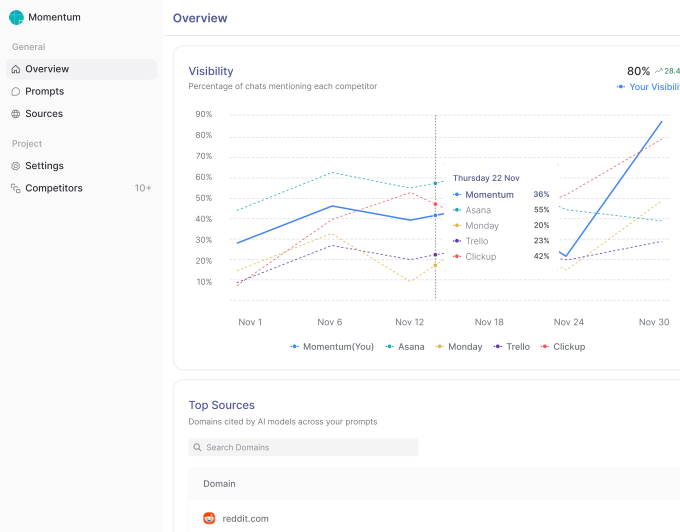
Measuring share of voice against competitors in AI-generated answers gives marketing teams a concrete benchmark. Cite AI tracks 50,000+ prompts daily across major AI engines, surfacing brand mentions, citation sources, and competitor presence in one place. That data reveals which domains are influencing AI answers in your category, where your brand appears, and where it doesn’t. For agencies and multi-brand teams, Cite AI is built to deliver that capability at a price point that works for real marketing teams, not just enterprise budgets.
Frequently Asked Questions
Why do some websites get cited more in AI search than others?
Structural authority is the primary driver. Domains that produce answer-ready content, maintain topical depth, carry strong E-E-A-T signals, and hold multi-format presence across video, text, and community channels earn citations at higher rates. AI engines extract and reference content that directly answers questions. Sites built around brand messaging rather than question-led content consistently earn fewer citations, regardless of their domain authority in traditional search.
Are the same domains cited across ChatGPT, Perplexity, and Google AI Overviews?
A core group of universal citation leaders, including Wikipedia, Forbes, YouTube, LinkedIn, and Healthline, appears consistently across all three platforms. Platform-specific differences exist, particularly around Reddit and user-generated content. Perplexity surfaces Reddit threads more frequently than Google AI Overviews does post-2024. Citation behavior varies because each platform uses different training data, retrieval design, and indexing approaches. Tracking share of voice across all three platforms together gives a more accurate picture than monitoring any single engine alone.
How can I improve my brand’s citation presence in AI-generated answers?
Publishing structured, question-led content that AI engines can cite directly is the starting point. Building source influence through coverage and mentions in high-citation domains further amplifies that presence. The third step is measurement: tracking which prompts surface your brand, which surface competitors, and how citation share shifts over time. An AI search visibility platform like Cite AI makes that tracking systematic, giving marketing teams real data to act on.
AI Citations and Your Brand
The brands showing up in AI answers are not winning by accident. They publish answer-ready content, earn citations from trusted domains, and track their presence across AI platforms before their competitors do.
AI citation patterns are measurable, and the gap between brands that monitor them and brands that ignore them is widening fast.
Explore Cite AI today to bridge that gap for your brand!
Start writing with confidence
Verify your content, add real citations, and publish with trust.