
Why Marketing Teams Are Turning to Cite AI for AI Search Optimization
Share this Article:


Buyers now pick brands inside AI tools. A marketing director types “best project management software for a 20-person team” into ChatGPT, reads three names, and has a shortlist before she opens a single website.
Your Google rankings won’t tell you whether you made that list. AI search optimization answers that question, and it starts with tracking. Here, we cover why AI brand visibility needs its own measurement and how Cite AI helps teams track and improve it.
AI Search Is Now Part of How Buyers Find Brands
Buyers research purchases in ChatGPT, Gemini, Google AI Overviews, and Google AI Mode the same way they once used page one of Google. They ask category questions, compare vendors, and check what other people say. The AI-generated answer names a few brands, gives a reason for each, and stops. Many people never click anything. Pew Research found that Google users click links less often when an AI summary appears in the results.
Marketing teams keep raising the same questions. Where does our brand show up? Which prompts mention us? Why does ChatGPT recommend a competitor for a query where we hold the top Google spot? Teams see AI engines cite rivals instead of them, and their analytics dashboards offer no explanation. AI brand visibility has become a marketing metric that someone on the team needs to own.
What AI Search Optimization Means Beyond Traditional SEO
AI search optimization means improving how AI engines mention, cite, and recommend your brand. Some teams call it answer engine optimization (AEO). Others call it generative engine optimization (GEO). Either way, the goal is to get a spot in the answer.
Two signals matter here. A brand mention means the AI names you in its response. A citation means the AI links to a specific page as its source. Mentions shape how buyers see you. Citations drive traffic and show which content an engine trusts. You can earn one without the other, so track both.
Ranking first on Google won’t guarantee an AI recommendation. AI engines pull from review sites, Reddit threads, trade publications, and comparison articles, and each engine has its own habits.
Ask ChatGPT, Gemini, and Perplexity the same question, and you’ll often get three different source lists. Answers also shift when someone rewords a prompt, a model updates, or a platform changes how it sources. That makes AI search a channel you measure continuously.
How We Help Marketing Teams Measure AI Brand Visibility
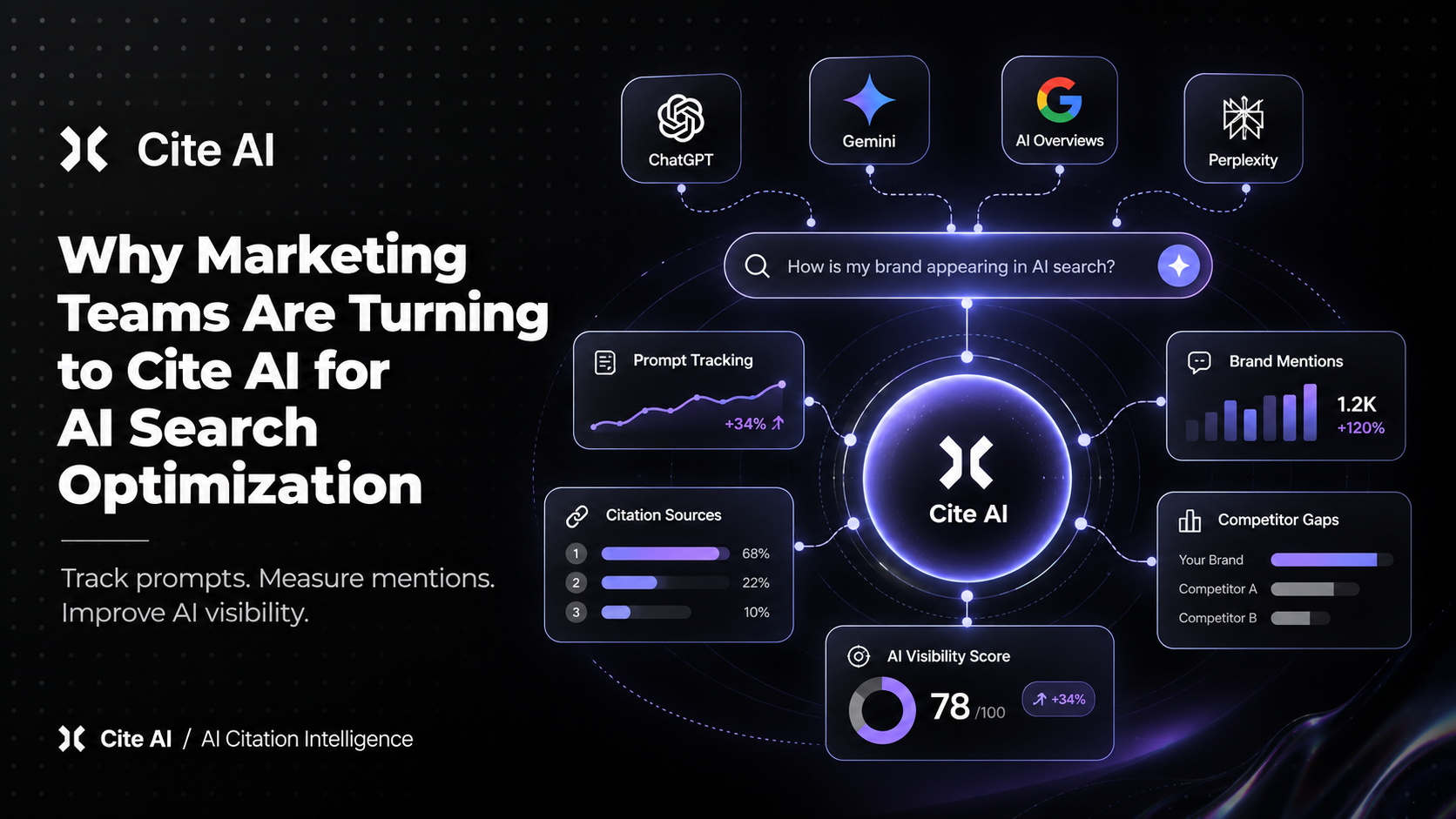
Cite AI is an AI search visibility platform, not a generic SEO tool. We track more than 50,000 prompts daily across the major AI engines. Teams use our platform to see where their brand appears, what AI engines say about it, and which competitors and sources shape those answers.
Prompt Tracking Across ChatGPT, Gemini, Perplexity, and Google AI
Prompt tracking starts with the questions your buyers ask. You build a prompt set that mirrors real searches in your category, like “best CRM for small agencies” or “alternatives to [competitor].” Cite AI records how each engine responds and logs prompt performance over time. One screenshot of a ChatGPT answer tells you very little. Six weeks of trend data tell you whether your visibility is growing, flat, or slipping.
Citations and Source Influence
Citation data shows which pages, publications, and sources AI engines rely on when answering questions in your category. Cite AI lists the URLs each engine cites and how often. That includes your own pages and the third-party sources shaping how AI describes you. Keyword reports miss most of this. If Perplexity keeps citing one trade publication, put that outlet on your PR list. If engines keep pulling from a competitor’s comparison page, you know which content gap to close first.
Competitor Benchmarking and Share of Voice
Share of voice measures how often your brand appears in AI answers compared with competitors across a set of prompts. Cite AI calculates it for your priority prompts and maps competitor presence on each engine. The view teams use most is the gap list, which shows prompts where competitors appear and we don’t. Each gap answers “Why does AI cite them instead of us?” and points you toward the sources behind that answer.
Turning AI Search Insights Into an Ongoing AI Marketing Strategy
AI search insights only pay off when they change what your team publishes and pitches. Here is how that plays out.
- Visibility Gaps Become Content Briefs: If you miss a high-intent prompt, write or refresh a page on that topic and watch the prompt in the following weeks.
- Answer-first Pages Give Engines Clean Material: Put the answer near the top, use question-led headings, and back claims with specifics. AI engines pull from pages built that way.
- Source Data Sets Your PR Priorities: The publications and review sites AI engines cite most should sit at the top of your outreach and partnership plans.
- Regular Monitoring Replaces One-time Fixes: Engines change models and sourcing habits, so a strong position in March won’t automatically hold in May.
Teams that review prompt data on a fixed schedule catch drops early and learn which changes move the numbers. Google’s own documentation on AI features also explains how its AI Overviews and AI Mode treat content, which helps you set expectations for that engine.
Why Teams Choose Cite AI for Affordable, Scalable Tracking
Cite AI gives you the core AI visibility workflow without premium-tier pricing. Prompt tracking, brand mentions, citations, share of voice, competitor benchmarking, and source influence data all come on affordable plans.
Our plans fit in-house teams of any size. You shouldn’t need an enterprise contract to find out what ChatGPT says about your product.
Agencies get the most out of this. When you manage eight or ten clients, you need multi-brand tracking and client reporting, and you need costs that don’t climb with every account you sign. Our cost-efficient pricing lets agencies sell AI search monitoring as a service and keep their margins intact.
Peec AI and Profound both build capable AI visibility tools, and some teams will find a good fit there. Compare the features you’ll use against what you’ll pay each month. For teams that want a core tracking workflow at an accessible price, Cite AI delivers more value per tracked brand. Check our pricing page to compare plans.
FAQs
What is AI search optimization?
AI search optimization means improving how AI engines mention, cite, and recommend your brand. It pairs content, PR, and source strategy with steady measurement.
How is Cite AI different from a traditional SEO tool?
Traditional SEO tools track keyword rankings and backlinks. Cite AI tracks AI-generated answers, including brand mentions, citations, share of voice, and the sources that shape what AI engines say about you.
Which AI platforms does Cite AI track?
Cite AI tracks ChatGPT, Gemini, Perplexity, Google AI Overviews, and Google AI Mode.
How often should we monitor AI brand visibility?
Track it continuously. AI answers shift with prompt wording, model updates, and platform behavior. Ongoing monitoring shows real trends and flags drops before they hurt your pipeline.
Is Cite AI a good fit for agencies?
Yes. Our cost-efficient plans support multi-brand tracking and client reporting, so agencies can monitor AI visibility for several clients without paying premium-tier rates.
AI search is a measurable visibility channel, and it keeps moving. Teams that track prompts, citations, and share of voice stop guessing about how AI engines recommend brands and start working from data.
Cite AI keeps that tracking affordable for in-house teams and agencies, so AI search optimization becomes a standing part of your marketing, SEO, and PR planning.
Start writing with confidence
Verify your content, add real citations, and publish with trust.
