
Blog
Listicle
7 Best Tools to Track AI Crawler and Agent Visits to Your Site
AI crawlers are reading your website right now — and most teams have no idea which pages they're visiting, how often, or whether those visits ever turn into citations inside ChatGPT or Perplexity. That's a visibility gap that traditional analytics tools weren't built to close.
Tools like Google Analytics and Search Console track human visitors and Googlebot. They were never designed to distinguish GPTBot from ClaudeBot, or to tell you whether an AI agent read your /pricing page three times this week but still didn't cite it. A new category of AI crawler tracking software is filling that gap.
This article ranks the seven best tools for tracking AI agent visits to your website — evaluated on crawler detection depth, attribution clarity, and how well they connect crawl data to downstream AI citation outcomes. Whether you're a technical SEO professional or a marketing team trying to diagnose falling AI visibility, one of these tools belongs in your stack.
What is an AI crawler (AI agent bot)?
An AI crawler — sometimes called an AI agent bot or LLM crawler — is an automated program that large AI platforms send to index web content for use in training or real-time answer generation. Examples include GPTBot (OpenAI), ClaudeBot (Anthropic), and Google-Extended (Google). Unlike traditional search bots, AI crawlers don't just determine rankings — they determine whether your content becomes source material inside a generated answer.
Methodology: 5 Criteria That Determined This Ranking
Every tool on this list was evaluated against five criteria drawn directly from the problems marketing and technical SEO teams face when trying to understand AI crawler behavior. Popularity or brand recognition played no part in the ranking.
The strongest pick leads the list because it closes the most important gap: connecting crawl activity to citation outcomes. A tool that tells you GPTBot visited a page is useful — a tool that also tells you whether that page was then cited in an AI-generated answer is far more actionable.
Tools were deprioritized if they required heavy developer setup with no marketing-friendly layer, reported only aggregate bot traffic without AI-specific segmentation, or could not differentiate between AI crawlers and traditional search bots.
- Crawler identification depth: can it distinguish GPTBot from ClaudeBot from Google-Extended?
- Citation linkage: does crawl data connect to downstream AI answer and source outcomes?
- Ease of use: accessible to marketing teams, not just engineers reviewing raw server logs?
- Coverage breadth: how many known AI agent bots does it detect and log?
- Reporting cadence: does it support repeatable, time-series tracking rather than one-off snapshots?
1. CiteHQ AI — Best Overall for Linking Crawler Visits to Citations
CiteHQ AI earns the top rank because it is the only tool in this category that connects AI crawler visit tracking to citation-level outcomes. Knowing that GPTBot crawled your /blog/best-project-management-tools page is useful — knowing that it crawled it but your competitor's page was cited instead is what actually drives a decision.
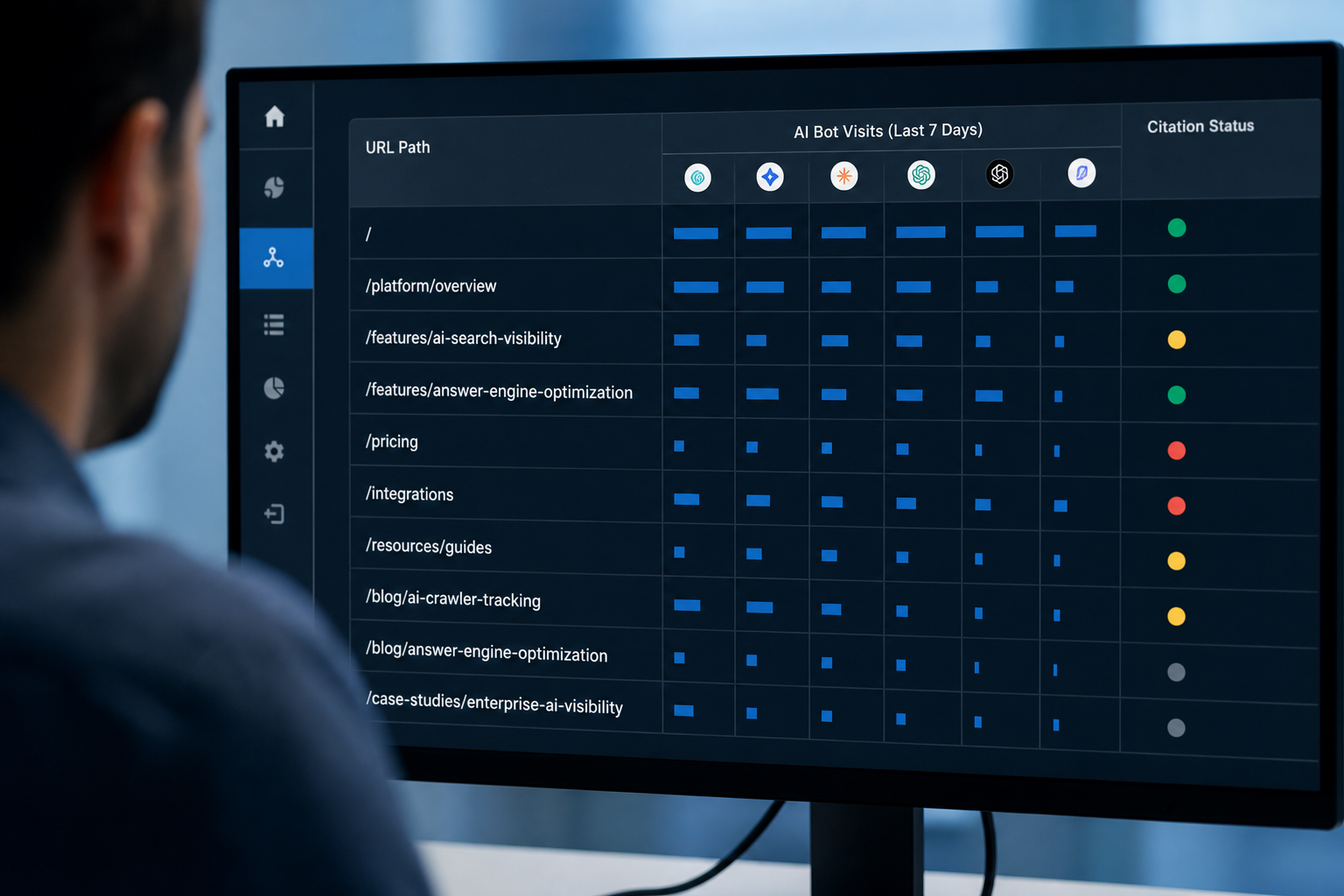
The platform monitors known AI bots including GPTBot, ClaudeBot, and Google-Extended, logging which URL paths they visit and how often. That crawl data sits inside the same workspace as prompt tracking, share of voice metrics, and source classification — so teams can diagnose the full chain from crawl to citation in one view.
Founded in 2025 and purpose-built for Answer Engine Optimization, CiteHQ AI runs 50,000+ tracked prompts daily across ChatGPT, Gemini, Perplexity, and Google AI Overviews. It's designed for marketing and growth teams — not just developers — making AI crawler activity legible without requiring server log access.
- Tracks GPTBot, ClaudeBot, Google-Extended, and other known AI agent bots by URL path
- Connects crawler visit frequency to citation outcomes at the page level
- Source classification labels each cited domain as owned, competitor, editorial, or community
- 50,000+ prompts refreshed every 24 hours across four major AI platforms
- Multi-brand agency workspace supports AI crawler tracking across multiple client sites
- No technical setup required — accessible to marketing teams without developer involvement
2. Cloudflare Bot Management — Best for Enterprise-Scale Bot Detection
Cloudflare Bot Management sits at the network layer — meaning it sees every request to your domain before it reaches your server, making it one of the most complete sources of raw AI crawler data available. For large enterprises already running traffic through Cloudflare, layering on bot analytics requires no additional infrastructure.
Its bot scoring system can distinguish verified AI crawlers (GPTBot, Google-Extended) from unverified bots impersonating them — a distinction that matters more as AI crawler spoofing becomes common. The Firewall Analytics dashboard lets teams filter traffic by bot type, IP, and user agent at high granularity.
The trade-off is context: Cloudflare surfaces crawl volume and frequency but does not connect that data to AI citation outcomes or prompt-level visibility. It answers 'which bots visited' but not 'did those visits lead to a citation.'
- Network-layer detection catches AI crawler traffic before it reaches origin servers
- Distinguishes verified AI bots from unverified user-agent spoofers
- Filters by bot type, user agent, IP range, and request path
- High-volume enterprise traffic handled with no latency impact
- Available on Business and Enterprise Cloudflare plans
3. Screaming Frog SEO Spider — Best for Log File–Based AI Crawler Analysis
Screaming Frog's Log File Analyser is a desktop tool built for technical SEO teams comfortable working directly with server log files. When fed raw server logs, it segments traffic by bot user agent — and with a custom filter, teams can isolate GPTBot, ClaudeBot, and other known AI crawler strings from all other traffic.
It's particularly strong for retrospective analysis: export three months of server logs, run them through Screaming Frog, and you get a clear picture of AI crawler visit frequency per URL, crawl depth, and which site sections AI agents prioritize. That historical view is something many dashboards don't offer.
The limitation is workflow friction. This is a technical tool requiring log export, a local install, and manual filtering. It produces no ongoing alerts and has no connection to AI answer or citation data. Best paired with a citation-focused platform for teams that want both layers.
- Parses raw server log files to extract bot-level visit data by user agent
- Custom filters isolate GPTBot, ClaudeBot, Google-Extended, and other AI agents
- URL-level crawl frequency and depth reporting across large site architectures
- Retrospective analysis covers months of historical log data in one run
- Desktop app for Windows and Mac; no cloud dependency
4. Splunk — Best for Custom AI Bot Traffic Dashboards at Scale
Splunk is a data observability platform that ingests server logs, CDN logs, and web access logs at scale, then lets teams build custom dashboards and alerts on any pattern in that data — including AI crawler activity. For organizations already running Splunk for security or infrastructure monitoring, adding an AI bot traffic analysis layer is a natural extension.
Teams can create saved searches that flag requests from known AI crawler user agents, track visit frequency over time, and set threshold alerts if crawl volume spikes or drops unexpectedly. That proactive alerting is valuable for catching new AI agents as they emerge.
Splunk is not a purpose-built AI crawling tool, and building useful dashboards requires meaningful Splunk expertise. The initial configuration investment is high — this earns its place for enterprises with existing Splunk deployments, not for teams starting from scratch.
- Ingests server logs, CDN logs, and access logs from any infrastructure source
- Custom SPL queries isolate AI crawler user agents and track visit patterns over time
- Threshold-based alerts notify teams of unusual AI bot crawl volume changes
- Multi-domain and multi-property support within one Splunk deployment
- Integrates with existing security and infrastructure monitoring workflows
5. Matomo — Best Privacy-First Option for AI Visitor Tracking
Matomo is an open-source web analytics platform that can be self-hosted, giving teams full control over their data without third-party sharing. Unlike Google Analytics, Matomo does not filter out bot traffic by default — meaning AI crawler visits can be segmented and analyzed rather than silently excluded.
With custom segments and bot exclusion rules inverted, marketing teams can isolate AI agent visits from human sessions and build a separate reporting view for AI bot traffic analysis and attribution. Its self-hosted model is particularly appealing for regulated industries or privacy-conscious teams in markets like Canada and the EU.
Matomo does not natively map AI crawler visits to citation outcomes, and its bot identification is less granular than log-level tools. It works best when combined with server log analysis for full AI crawler behavior coverage.
- Self-hosted deployment keeps all AI crawler and visitor data on your own infrastructure
- Custom segments isolate bot traffic from human sessions without data sampling
- Bot filtering controls can be inverted to surface rather than hide crawler visits
- GDPR-compliant by design; widely used in Canada, EU, and regulated industries
- Open-source core with an optional cloud-hosted SaaS tier
6. Datadog — Best for Real-Time AI Crawler Alerting in DevOps Stacks
Datadog is a cloud monitoring and observability platform used by engineering and DevOps teams to track infrastructure, application performance, and log data. Its log management module can ingest web server access logs and apply facets and filters to isolate AI crawler user agents — making it a strong choice where the engineering team owns the monitoring stack.
Datadog's real strength for monitoring bot and crawler visits is alerting: teams can configure anomaly detection rules that fire when a known AI crawler — or an unknown new bot — begins accessing pages at unusual rates. That kind of proactive detection is valuable for catching new AI agents before they appear in curated bot lists.
Like Splunk, Datadog is infrastructure-first and requires engineering involvement to configure AI crawler–specific monitoring. It doesn't surface citation-level context, making it a crawl-detection layer rather than a complete AI visibility solution.
- Log management ingests access logs and applies faceted filtering by user agent string
- Anomaly detection alerts fire when new or unexpected AI crawler activity appears
- Dashboards track AI bot visit frequency and URL path distribution over time
- Integrates natively with AWS, GCP, Azure, and major CDN providers
- Widely used in DevOps and SRE teams; engineering-accessible configuration
7. Google Search Console — Best Free Baseline for Googlebot vs. AI Crawler Comparison
Google Search Console is the most widely used free tool for understanding how Google's crawlers interact with a site. While it was not built for AI crawler tracking specifically, its Crawl Stats report gives teams a clear baseline for Googlebot activity — valuable context when running a Googlebot vs. AI crawler traffic comparison across the same URL set.
Google Search Console does track Google-Extended, Google's AI training crawler, within its crawl statistics. This makes it the easiest entry point for teams new to the crawler-tracking discipline — it requires no setup beyond existing Search Console verification and provides URL-level crawl data at no cost.
The ceiling is low. Search Console covers only Google's own crawlers — GPTBot, ClaudeBot, and third-party AI agents are invisible to it. It also provides no connection to AI answer visibility or citation data. It belongs on this list as a free starting point, not a complete solution.
- Crawl Stats report shows Googlebot and Google-Extended activity by URL and date
- Free tool with no additional setup beyond Search Console property verification
- URL Inspection tool confirms whether individual pages are indexed and crawlable
- Useful baseline for Googlebot vs. AI crawler comparison when combined with other tools
- Coverage limited to Google crawlers — no visibility into OpenAI, Anthropic, or other AI agents
| Tool | AI Crawler Detection | Citation Linkage | Marketing-Friendly UI | Multi-Brand / Agency Support |
|---|---|---|---|---|
| CiteHQ AI | GPTBot, ClaudeBot, Google-Extended + others | Yes — connects crawl to citation outcome | Yes — no technical setup required | Yes — dedicated agency workspace |
| Cloudflare Bot Management | All bots incl. AI crawlers; verifies authenticity | No | Moderate — analytics UI but network-focused | Yes — enterprise multi-domain |
| Screaming Frog Log File Analyser | Any user agent in server logs (manual filter) | No | No — requires log export and desktop app | Manual — per-site analysis only |
| Splunk | Any user agent via custom SPL queries | No | No — engineering/DevOps tool | Yes — multi-domain log ingestion |
| Matomo | Partial — bot segments, less granular than logs | No | Yes — self-hosted analytics UI | Yes — multi-site support |
| Datadog | Any user agent via log facets + anomaly alerts | No | No — DevOps/SRE tool | Yes — multi-property monitoring |
| Google Search Console | Googlebot and Google-Extended only | No | Yes — free, no setup beyond GSC verification | No — per-property only |
Frequently Asked Questions
-
What is an AI crawler bot and how does it differ from Googlebot?
An AI crawler bot is an automated agent — such as GPTBot (OpenAI) or ClaudeBot (Anthropic) — that indexes web content specifically for LLM training or AI-generated answers. Unlike Googlebot, which determines search ranking positions, AI crawlers determine whether your content becomes a cited source inside a generated response. The intent and downstream outcome are fundamentally different, requiring separate tracking tools. -
How do I track AI agent visits to my website?
The best way to track AI agent visits combines server-level log analysis — filtering requests by known AI crawler user agent strings like GPTBot or ClaudeBot — with a dedicated AI visibility platform that links those visits to citation outcomes. Tools like Screaming Frog or Splunk handle the log layer. CiteHQ AI connects crawl activity to whether those pages were actually cited in AI-generated answers, completing the picture. -
Which AI crawler bots should I be tracking on my website?
The most active AI crawlers currently visiting websites include GPTBot (OpenAI), ClaudeBot (Anthropic), Google-Extended (Google's AI training crawler), and PerplexityBot. New AI agents are emerging regularly, so monitoring for unrecognized user agents alongside known ones is recommended. A dedicated AI crawler tracking tool will maintain an updated list of known AI bot user agent strings automatically, reducing manual upkeep. -
What is the difference between AI crawler tracking and traditional web analytics?
Traditional web analytics platforms like Google Analytics are designed to track human sessions and filter out bots. AI crawler tracking specifically surfaces bot activity that traditional tools suppress. More importantly, AI crawler tracking connects visit data to AI citation outcomes — answering whether a crawled page was cited in an AI-generated answer, a question traditional analytics tools were never designed to address. -
How often do AI agents visit my site?
AI crawler visit frequency varies significantly by platform, site authority, and content freshness. High-authority domains with frequently updated content may see GPTBot or ClaudeBot visits multiple times per week; smaller or newer sites may see visits less than once a month. Server log analysis is the most reliable way to measure actual visit frequency per URL rather than estimating from published crawl schedules. -
What is the best AI crawler tracking software for ecommerce sites?
Ecommerce sites need AI crawler tracking that connects page-level crawl activity to shopping carousel citation outcomes — not just raw bot visit logs. CiteHQ AI tracks AI crawler visits alongside shopping carousel visibility, win rate, and position inside AI-generated product comparisons. This combination is especially important for retail brands where AI-generated shopping results are becoming a primary discovery channel. -
How does monitoring AI crawler activity help with Answer Engine Optimization?
AI crawler activity is a prerequisite for citation: a page that isn't crawled cannot be cited. Monitoring LLM crawler access patterns reveals whether low AI visibility is caused by pages being unread versus read-but-not-cited — two problems requiring completely different fixes. If crawl data shows a page is visited regularly but not cited, the issue is content quality or authority, not crawlability. -
Can I use Google Search Console to track AI crawler visits?
Google Search Console tracks Googlebot and Google-Extended but does not surface GPTBot, ClaudeBot, PerplexityBot, or other third-party AI agents. For a complete picture of AI crawler activity across all major platforms, Search Console must be supplemented with server log analysis or a dedicated AI crawler detection and analytics platform that covers the full range of known AI bots.