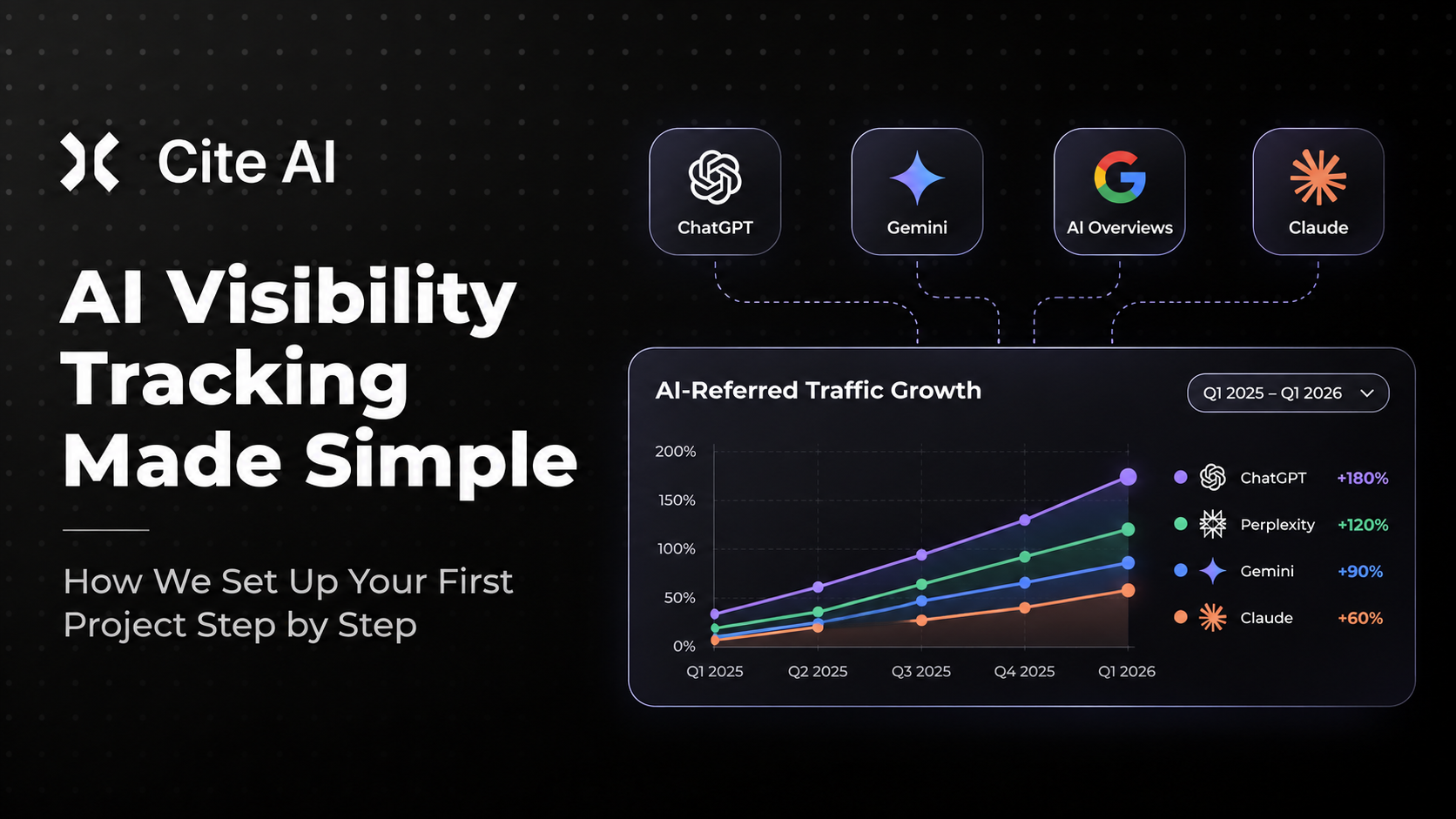
AI Visibility Tracking Made Simple: How We Set Up Your First Project Step by Step
Share this Article:


Buyers now ask ChatGPT, Gemini, and Perplexity which product to choose. Many of them treat the first answer as their shortlist. Gartner predicts traditional search volume will drop 25% by 2026 as people move to AI chatbots. That makes brand visibility in AI a live marketing problem today.
Marketing teams keep asking us the same things. Where does our brand show up in AI-generated answers? Which competitor appears when we don’t? AI visibility tracking answers both. It measures how AI engines mention, cite, and describe your brand across the prompts your buyers type. Here is how we set up a first project, one step at a time.
What We Need Before Starting an AI Visibility Tracking Project
Good AI project setup starts with four inputs. We collect them before we open the platform.
- A Business Goal: Pick awareness, competitive positioning, or pipeline. The goal decides which prompts matter most. A pipeline-focused team cares about “best tool for” prompts. An awareness team cares about broad category questions.
- Core Brand Details: List your brand name and its variants, your product names, your domain, and your category.
- Three to Five Competitors: Choose the brands you lose deals to, not every company in your space.
- Customer Language: Pull phrases from sales calls, support tickets, and reviews. Buyers rarely phrase questions the way your homepage does.
Step 1: Create the Project and Define the Brand
We create one project per brand, product line, or client. Putting two brands in one project blurs the share-of-voice data and makes every chart harder to read.
Next, we add every spelling of the brand name. For us, that means “Cite AI,” “CiteAI,” and our domain. AI engines write brand names inconsistently, and AI brand tracking only counts mentions accurately when it knows each variant.
Then, we define the market and category. “AI search visibility platform for marketing teams” produces a different prompt set than “SEO software.” A precise category keeps the prompts relevant.
Agencies and multi-brand teams can run a separate project for each client without signing an enterprise contract. Our pricing plans cover multi-brand workflows at a cost-efficient rate.
Step 2: Build a Prompt Set From Real Buyer Questions
Prompts work as the AI-search version of target keywords. Each one represents a question a buyer asks an AI engine. We start with 20 to 50 high-intent prompts. That gives AI visibility tracking enough data to show patterns without drowning the team in noise.
Unbranded Discovery and “Best Of” Prompts
Buyers first meet brands in category questions. “What tools track brand mentions in ChatGPT?” is a good example. These prompts show whether AI engines include you before a buyer knows your name.
“Best tool for” and recommendation-style prompts sit closest to a purchase. “Best AI visibility tool for agencies” tells you who makes the shortlist.
Comparison, Problem, and Branded Prompts
Head-to-head prompts (“Brand A vs. Brand B”) and “alternative to” prompts show how AI engines frame you against competitors.
Pain-point prompts tie to the problems you solve. “Why is my competitor showing up in Perplexity and we aren’t?” is the kind of question a real buyer types.
We track branded prompts separately. A prompt that names your brand almost always mentions your brand. Mixing those prompts into your main set inflates your scores and hides the gaps that matter.
Step 3: Choose AI Engines and Add Competitors
Cite AI covers ChatGPT, Gemini, Google AI Overviews, and Google AI Mode. Each engine pulls from different sources and answers differently. Google explains how its versions work in its documentation on AI features in Search.
We prioritize the engines our buyers use. A B2B software brand often sees heavy ChatGPT usage. A local or consumer brand may care more about AI Overviews. Start where your audience spends time and expand later.
Then we add the competitor list. This turns AI search monitoring into a comparison. You see which brands AI engines cite instead of you, on which prompts, and on which engines.
Step 4: Record a Baseline and Read the First Results
We capture a baseline before anyone changes content or launches PR. Without that starting point, you can’t prove a new page or press mention moved your brand visibility in AI.
AI answers vary. The same prompt returns different brands on different days, and sometimes within the same hour. Repeated prompt runs smooth out that variability and show what an engine tends to say, not what it said once.
The Core Metrics That Matter Most
- Brand Mentions vs. Citations: A mention means the AI named you. A citation means it linked to a source, often your page or a page about you. Mentions signal awareness. Citations signal trust in your content.
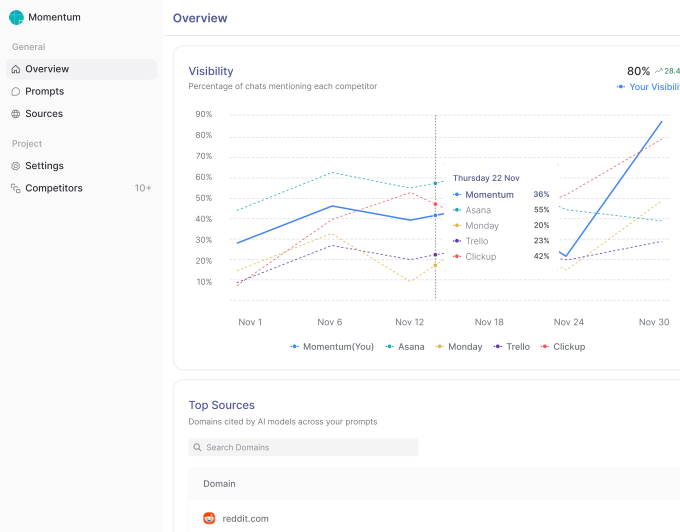
- Share of Voice: This shows how often you appear compared with your tracked competitors across the full prompt set.
- Prompt-level Results: Look for wins, gaps, and prompts where you never appear. Missing appearances on high-intent prompts deserve attention first.
Source Influence: Which Pages Shape AI Answers
Source influence shows which domains AI engines cite. Expect a mix of your site, review platforms, media outlets, and forums like Reddit.
Pay close attention to third-party sources behind competitor recommendations. If one review site keeps appearing when a competitor wins, that site belongs on your PR list.
Source gaps become direct inputs for content strategy and PR. A missing topic becomes a content brief. A missing publication becomes an outreach target.
Step 5: Turn Early Data Into an Ongoing Tracking Routine
AI visibility changes constantly. Models update, new sources appear, and competitors publish. Treat it as an ongoing practice, never a one-time fix.
We review results weekly or every two weeks. This pace catches trends early without making AI search monitoring a daily chore.
We also refine prompts as products launch, markets shift, and buyer questions change. Retire prompts that no longer matter and add new ones from fresh sales and support conversations.
Share findings across teams. SEO uses prompt gaps for content planning. PR uses source data for outreach. Leadership wants share of voice against named competitors. One dashboard serves all three.
FAQs
How is AI visibility tracking different from traditional rank tracking?
Rank tracking measures fixed positions on a results page. AI visibility tracking measures whether an AI engine mentions or cites your brand in a generated answer, which can shift from run to run.
How many prompts should we track in a first project?
Start with 20 to 50 focused prompts. Expand the set once patterns show up, and you know which topics drive results.
Why does our visibility change without website updates?
Model updates, new third-party sources, and competitor content all change AI answers. Your site may stay the same while everything around it moves.
Is AI brand tracking affordable for small teams and agencies?
Yes. Cite AI offers accessible plans built for real usage, including multi-brand workflows for agencies, without enterprise-only pricing.
A first project gives you a baseline, and a baseline turns guesses into decisions. Consistent measurement underpins any GEO or AEO program. Cite AI tracks 50,000+ prompts daily across major AI engines, at pricing small teams and agencies can sustain.
Start writing with confidence
Verify your content, add real citations, and publish with trust.