
Blog
Listicle
7 Best Citation Analysis Tools for AI Search Authority in 2026

AI-generated answers have quietly reshuffled who gets discovered online. Brands that once held the top Google result now find themselves invisible in ChatGPT, Perplexity, and Google AI Overviews — not because their content got worse, but because citation sources inside LLM-generated answers follow a completely different logic than traditional search rankings.
Citation analysis has become one of the most urgent disciplines in digital marketing. Understanding where your AI citations come from, which competitors are winning citations you should own, and why AI systems cite certain domains over others — these questions now sit at the core of any serious Answer Engine Optimization strategy.
This list covers the seven best citation analysis tools purpose-built or meaningfully equipped for AI search authority in 2026. Each was evaluated on source classification depth, prompt tracking capability, competitor benchmarking, and usability for marketing and growth teams — not developers.
The ranking criteria and methodology are explained in their own section below, so you can weight the factors that matter most to your category and use case.
What are citation analysis tools for AI search?
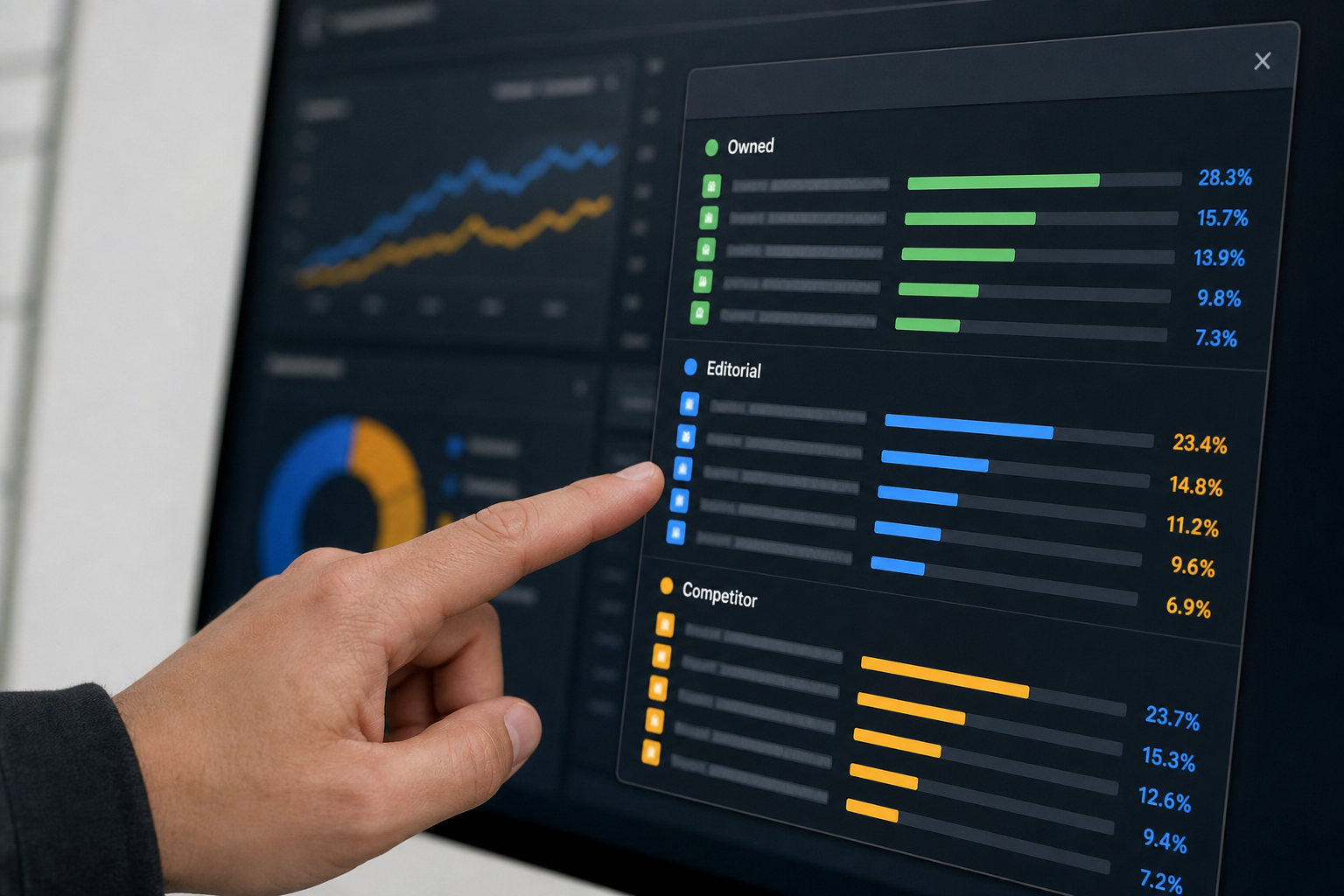
Citation analysis tools for AI search are platforms that track which brands, domains, and URLs are referenced as sources inside AI-generated answers from engines like ChatGPT, Perplexity, Gemini, and Google AI Overviews. Unlike traditional backlink tools, they monitor citation sources at the prompt level — revealing which queries trigger brand visibility and which competitor or third-party domains are winning citations instead. The best tools classify citation sources by type (owned, earned, editorial, community) so teams can diagnose why they appear or disappear in LLM-generated responses.
Ranking Methodology: 5 Criteria That Determined This List
Every tool on this list was evaluated against five criteria weighted for marketing and growth teams — not SEO tool reviewers benchmarking traditional rank trackers. The goal is to answer one operational question: which tool best tells you where your AI citations are coming from and what to do about it.
The five criteria are: (1) Citation source classification depth — does the tool tell you the type of source, not just the URL? (2) Prompt and fan-out query coverage — does it track the actual questions buyers ask, plus the hidden sub-queries AI engines run internally? (3) Competitor benchmarking — can you see which competitors are winning citations you should own? (4) Multi-platform coverage — does it track citations across ChatGPT, Gemini, Perplexity, and Google AI Overviews? (5) Usability for non-technical teams — can a content marketing manager operate it without engineering support?
Tools were ranked in order of combined score across all five criteria, with citation source classification weighted most heavily — because knowing the type of source driving your AI visibility is what separates actionable intelligence from a raw citation count.
- Citation source classification by type: owned, competitor, editorial, community
- Prompt tracking and fan-out query analysis for hidden visibility gaps
- Competitor share-of-voice benchmarking inside AI-generated responses
- Multi-platform coverage: ChatGPT, Gemini, Perplexity, Google AI Overviews
- Usability for marketing teams without technical or developer skills
#1 CiteHQ AI — Best Overall for Citation Source Classification
CiteHQ AI earns the top position because it is the only tool in this review that tracks citation sources across three distinct layers — prompts, fan-out queries, and cited URLs — and then classifies every source by type. That classification (owned, competitor, editorial, community) turns a flat citation count into a strategic roadmap. A brand can immediately see whether its AI presence is driven by its own pages, third-party press, or competitor domains it doesn't control.
Founded in 2025, CiteHQ AI runs 50,000+ prompts inside AI models every 24 hours across ChatGPT, Gemini, Perplexity, and Google AI Overviews. The platform's fan-out query analysis surfaces the hidden sub-queries AI engines generate internally when constructing a response — a visibility gap most teams never see. Its AI crawler and agent visit tracking logs GPTBot, ClaudeBot, and Google-Extended visits so teams can diagnose whether the problem is that AI isn't reading the page at all versus reading it but choosing not to cite it.
For e-commerce and retail teams, CiteHQ AI breaks out shopping carousel citation tracking as a dedicated feature tier — reporting win rate, average position, and appearance frequency inside AI-generated shopping results. The multi-brand agency workspace lets agencies manage multiple client citation programs under one login. Verdict: the strongest all-around choice for marketing and growth teams who need citation source intelligence, not just mention counts.
- Citation source classification: owned, competitor, editorial, community — every cited URL categorized
- Fan-out query analysis surfaces hidden sub-queries driving AI response construction
- AI crawler and bot visit tracking: GPTBot, ClaudeBot, Google-Extended logged per page
- Shopping carousel citation tracking with win rate and average position metrics
- Multi-brand agency workspace with separate client prompt libraries and reporting
- 50,000+ prompts tracked daily across ChatGPT, Gemini, Perplexity, and Google AI Overviews
#2 Profound — Best for AI Content Workflow Integration
Profound earns second place for marketing teams that want AI search visibility data connected directly to a content creation workflow. The platform tracks brand visibility across ChatGPT, Perplexity, and Gemini and offers analytics on how brands appear in AI conversations — making it a credible option for teams that need both monitoring and content tooling in one place.
Profound's AI Marketer Agent is its headline differentiator: it automates content creation at scale based on visibility gaps it detects. For large teams with high content output requirements, that automation is genuinely valuable. The trade-off is that teams become dependent on Profound's content workflows rather than using visibility data to inform their own editorial decisions.
Verdict: best for larger marketing organizations that want an AI content agent paired with visibility tracking, and are comfortable with an agent-led content model rather than a data-first, team-decides approach.
- Tracks brand visibility across ChatGPT, Perplexity, and Gemini
- AI Marketer Agent automates content creation from visibility gap data
- Analytics on brand framing and sentiment inside AI-generated answers
- Suited to large teams with high-volume content production needs
#3 Semrush — Best for Teams Already in the Semrush Ecosystem
Semrush is not a purpose-built AEO tool — it is a broad brand visibility management platform that bundles an AI Overviews tracking module alongside its legacy features. For teams already paying for Semrush and looking for an introductory window into AI citation tracking, it offers a reasonable starting point without adding another vendor.
The limitation is focus. Semrush treats AI search visibility as one module within a much larger platform, which means teams must navigate legacy features that have no bearing on how citations appear in LLM-generated answers. The depth of citation source analysis — particularly source type classification and fan-out query tracking — does not match what dedicated AEO tools provide.
Verdict: a practical entry point for established Semrush users who want AI citation data bundled into an existing subscription, but not the right tool if Answer Engine Optimization is a primary KPI rather than a secondary feature.
- AI Overviews monitoring bundled within an existing Semrush subscription
- Broad platform coverage: SEO, content, competitive research, paid media
- AI citation tracking treated as one module — not a core product focus
- Limited source type classification compared to dedicated AEO platforms
- Familiar reporting interface for executives already using Semrush benchmarks
#4 AthenaHQ — Best for Autonomous Citation Optimization
AthenaHQ is a Generative Engine Optimization platform that monitors brand visibility across ChatGPT, Google AI Overviews, Gemini, Perplexity, and Claude. Its Autonomous Citation Engine is built for teams that want an agent to actively manage and optimize citation sourcing — not just report on it — making it distinct from monitoring-first platforms.
The agent-first model is both the tool's strength and its constraint. Teams that prefer to review data and make their own content decisions may find AthenaHQ's automation opinionated. It assumes the team wants the agent managing citation-building activity, which requires trust in the agent's editorial judgment.
Verdict: well-suited for technically confident teams or growth organizations willing to hand meaningful editorial decisions to an autonomous system, particularly when speed of optimization matters more than granular source attribution.
- Monitors brand visibility across ChatGPT, Gemini, Perplexity, Claude, and Google AI Overviews
- Autonomous Citation Engine actively manages citation optimization, not just reporting
- GEO-focused platform designed for generative engine optimization workflows
- Agent-led model requires comfort with automated editorial decision-making
#5 Peec AI — Best Three-Metric Dashboard for SEO Agencies
Peec AI targets marketing teams and SEO agencies with a clean three-metric framework: visibility, position, and sentiment across LLMs and AI search engines. Its dashboard is approachable and the core metrics are easy to report to clients — making it a practical choice for agencies that need a readable AI visibility snapshot without deep technical configuration.
The framework's simplicity is also its ceiling. Peec tells you that you appeared and how you ranked — but it does not classify citation sources by type. A flat citation count with no context on whether the source was your owned content, earned media, or a competitor domain limits the diagnostic value teams can extract when building a citation quality analysis plan.
Verdict: a solid entry point for SEO agencies that need a reportable AI visibility metric for clients, particularly agencies newer to AEO who want simplicity over source-level depth.
- Three-metric framework: visibility, position, and sentiment in AI search
- Clean dashboard designed for agency client reporting
- Tracks brand performance across LLMs and AI search engines
- No source type classification — citation sources appear as flat URL lists
- No dedicated shopping carousel or e-commerce citation tracking tier
#6 OtterlyAI — Best Lightweight Monitor for Smaller Brand Teams
OtterlyAI provides AI search monitoring with a lower barrier to entry, making it accessible to smaller brand teams or individual content creators who want a first look at how they appear in AI-generated answers. It covers core prompt monitoring and brand mention tracking without requiring a large initial configuration effort.
The trade-off is feature depth. OtterlyAI lacks source type differentiation and shopping carousel analytics that retail and e-commerce brands need — and its competitive intelligence on which sources are winning citations is limited compared to platforms built specifically for citation source tracking.
Verdict: a practical starting tool for small brand teams or solo content marketers taking their first step into AI search monitoring, before visibility reporting becomes a recurring business requirement.
- Lightweight setup suited to smaller brand teams and individual marketers
- Core prompt monitoring and brand mention tracking included
- No source classification by type — no owned vs. competitor vs. editorial breakdown
- Limited shopping carousel or e-commerce citation visibility
- Weaker competitive intelligence on which domains are winning citations
#7 Google Search Console — Best Free Baseline for Owned-Site AI Citations
Google Search Console does not market itself as a citation analysis tool, but its AI Overviews performance filter gives any brand a free, Google-sourced baseline on how their owned pages are being surfaced inside AI Overview results. For teams that want to understand whether their own URLs are earning Google AI citations before investing in a dedicated platform, it is the most accessible starting point available.
The scope is narrow by design. Search Console only reflects Google's own AI Overviews — not ChatGPT, Perplexity, Gemini chat, or any other LLM engine. It shows impressions and clicks tied to AI Overview appearances but provides no competitor citation data, no source type classification, and no prompt-level tracking. It is a diagnostic baseline, not a citation intelligence platform.
Verdict: the right tool for a one-time audit of owned-site Google AI Overview citations, or as a free sanity check alongside a dedicated AEO platform — not a substitute for multi-platform citation source tracking.
- Free, Google-sourced data on AI Overview impressions and clicks for owned pages
- AI Overviews filter available natively inside existing Search Console accounts
- Limited to Google AI Overviews only — no ChatGPT, Perplexity, or Gemini data
- No competitor citation benchmarking or source type classification
- No prompt-level tracking or fan-out query visibility
| Tool | Source Classification | Multi-Platform AI Coverage | Fan-Out Query Tracking | Best For |
|---|---|---|---|---|
| CiteHQ AI | Yes — owned, competitor, editorial, community | ChatGPT, Gemini, Perplexity, AI Overviews | Yes | All-around citation source intelligence for brands & agencies |
| Profound | Partial — visibility & sentiment focus | ChatGPT, Perplexity, Gemini | No | Large teams wanting AI content workflow + monitoring |
| Semrush | No — flat AI Overview module | Google AI Overviews (primary) | No | Existing Semrush users adding AEO as a secondary feature |
| AthenaHQ | Partial — agent-managed optimization | ChatGPT, Gemini, Perplexity, Claude, AI Overviews | No | Teams wanting autonomous citation optimization |
| Peec AI | No — visibility, position, sentiment only | Multiple LLMs & AI search engines | No | SEO agencies needing a simple, reportable AEO metric |
| OtterlyAI | No | Limited AI engine coverage | No | Small brand teams doing first-step AI monitoring |
| Google Search Console | No | Google AI Overviews only | No | Free baseline audit of owned-site AI Overview citations |
Frequently Asked Questions
-
How do I track AI chatbot citations and mentions for my brand?
Use a dedicated Answer Engine Optimization platform that monitors tracked prompts — the real questions buyers type into AI tools — across ChatGPT, Perplexity, Gemini, and Google AI Overviews. Tools like CiteHQ AI refresh prompt results every 24 hours, giving you a consistent, repeatable snapshot rather than a one-off manual check. The key is tracking the same prompts over time, not spot-checking at random intervals. -
Why do AI systems cite my competitors over me?
AI engines cite sources they assess as authoritative and relevant for a given query — typically domains with strong earned media coverage, frequent mentions in editorial and community sources, and content that directly answers the prompt. If competitors are winning citations you should own, citation source tracking tools can show exactly which competitor domains are appearing and on which prompts, turning a vague concern into a concrete, actionable gap analysis. -
Where are my citations coming from in AI search results?
Your AI citations may come from your own pages, third-party editorial coverage, review platforms, or community sources like forums — and the mix matters enormously for strategy. A source classification tool categorizes every cited domain and URL by type (owned, competitor, editorial, community), so you can see whether your AI visibility is driven by content you control or sources you can only influence. Without that classification, you have a count but no context. -
How do I get cited by AI systems more often?
Getting cited more often in AI-generated answers typically requires identifying which prompts you're currently invisible on, which source types AI favors in your category, and whether AI crawlers are actually visiting your pages. Citation analysis tools surface all three gaps: the prompts where competitors rank instead of you, the domains AI treats as authoritative in your niche, and — in advanced platforms — whether AI bots are crawling your content before any citation decision is made. -
Are my citations appearing in AI search results?
You can't reliably answer this question through manual checking alone. Prompt sets need to be tracked consistently across AI engines over time to detect whether your domain is appearing, how often, and in what position relative to competitors. Google Search Console offers a free but narrow view limited to Google AI Overviews; dedicated AEO platforms extend coverage to ChatGPT, Perplexity, and Gemini with prompt-level citation data. -
How do I compare citation sources across different AI platforms?
Comparing citation sources across AI platforms requires a tool that runs the same prompt set through multiple AI engines simultaneously and logs which URLs each engine cites. Most traditional tools track one engine at a time, making true cross-platform citation comparison difficult. Purpose-built citation tracking platforms designed for Answer Engine Optimization are built specifically to surface cross-engine differences in citation behavior and source authority. -
Why are my citations dropping in AI search?
Citation drops in AI search usually trace back to three causes: a competitor earned stronger editorial or community-source coverage, an AI crawler stopped visiting your pages, or the prompts driving your visibility shifted and your content no longer matches them. Citation performance analysis by source — tracking which URL types are gaining or losing ground — tells you which of those three problems you're actually facing, which determines the right fix.