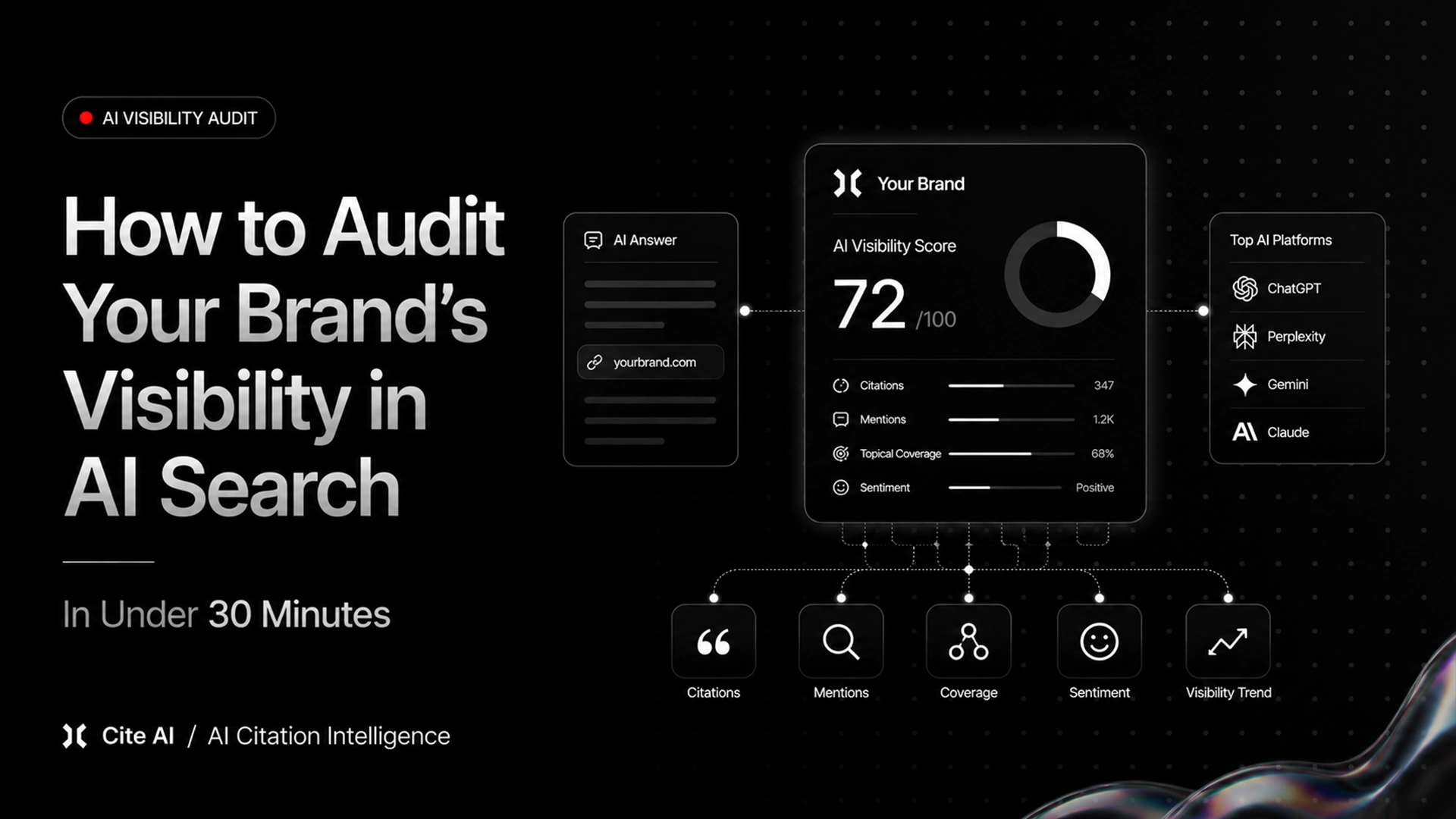
How to Audit Your Brand’s Visibility in AI Search in Under 30 Minutes
Share this Article:


AI tools are now the first stop for millions of buyers researching products, comparing vendors, and making decisions. If your brand is not showing up in those answers, you are losing ground to competitors who are. A quick, structured AI visibility audit tells you exactly where you stand and what to fix first.
In this guide, we walk through how AI search has changed the way buyers discover and evaluate brands, what an AI visibility audit actually measures compared to a traditional SEO audit, and what you will walk away with after 30 minutes of structured testing.
What an AI Visibility Audit Actually Measures
An AI search audit is not the same as checking your Google rankings. Traditional SEO audits measure where your pages rank in search results. An AI visibility audit measures something different: whether your brand appears in AI-generated answers at all, how it is described, whether it gets cited as a source, and how its share of voice compares to competitors across platforms like ChatGPT, Gemini, and Perplexity.
Specifically, an AI search audit looks at brand mentions and citations across AI platforms, the accuracy of how your brand is described in AI-generated answers, your share of voice relative to competitors in those responses, and which prompts trigger your brand and which ones do not. Those last two points are where most marketing teams currently have zero visibility.
What You’ll Need Before You Start
Before running the audit, gather four things:
- A short list of 5 to 10 prompts that your buyers are likely to ask AI tools.
- Your top two or three competitors to benchmark against.
- Access to ChatGPT, Gemini, and Perplexity for manual testing.
- An AI search visibility tool to scale and track what manual testing alone cannot capture.
Having these ready ensures that you spend your 30 minutes on analysis, not setup.
Step 1: Build Your Prompt Set (0–5 Minutes)
Your prompt set should include three types: category queries (“what is the best tool for X”), comparison queries (“X vs. Y”), and branded queries (“what does [your brand] do”). Think like your buyer, not your SEO team. The goal is to reflect how real people phrase questions in AI assistants, not how you would structure a keyword strategy.
Keep the list tight and representative. Ten well-chosen prompts covering your core categories and a few competitor-comparison angles will give you a more useful snapshot than 40 loosely related prompts. This is the foundation of both AI search optimization and generative engine optimization work.
Step 2: Test Across AI Platforms (5–15 Minutes)
Run each prompt across ChatGPT, Gemini, and Perplexity. As you go, look for three things: whether your brand is mentioned, whether it is cited with a link to a specific page, and how it is described. Also note which competitors appear by default and how often they do so. If a competitor shows up in eight out of ten responses and you show up in two, that is a measurable share-of-voice gap you now have data on.
Spotting gaps where your brand is entirely absent from relevant answers is just as important as tracking where you appear. The absence of a high-intent prompt is a concrete content problem you can act on.
What “Cited” vs. “Mentioned” Actually Means
A mention means your brand name appears somewhere in the AI’s response. A citation means the AI links back to a specific page on your site as a source for its answer. Citations carry more weight for brand authority and can drive direct referral traffic. A brand that gets cited consistently is one AI engines treat as a credible source, and that status compounds over time.
Step 3: Log What You Find (15–20 Minutes)
Use a simple scoring system: for each prompt-platform combination, mark your brand as mentioned, cited, absent, or misrepresented. Track which pages are being cited and which are not. Flag any inaccurate or outdated brand descriptions you find in AI responses. These are reputation risks that most teams have no system to catch.
Once you have logged the results, identify the highest-priority gaps. A prompt in which a direct competitor is cited and you are entirely absent is a higher priority than one in which you are mentioned but not linked.
Step 4: Check Technical Accessibility (20–25 Minutes)
AI search visibility is not only a content problem. It is also a technical one. Check whether AI crawlers can actually access your key pages. Review your robots.txt settings for any directives that may unintentionally block AI bots. Many teams have these blocks in place without realizing it.
Also look at structured data and page clarity. AI engines read your content and draw from it to build answers. Pages that are clearly structured, use descriptive headings, and answer specific questions directly are more likely to be cited. This is a core part of any AI search visibility audit for marketing teams.
Step 5: Turn Findings Into a Priority Action List (25–30 Minutes)
Rank your gaps by impact. Being missing from a high-intent, high-volume prompt is more urgent than being uncited on a peripheral topic. Being misrepresented is a different kind of priority because it carries reputation risk.
Quick wins include updating existing content to better answer the prompts when you are absent, fixing structured data on pages that should be cited, and ensuring your most authoritative pages are technically accessible.
Longer-term plays include building source influence through third-party mentions, earning coverage in the publications AI engines frequently cite in your category, and developing a generative engine-optimization content strategy around the prompts that matter most. Set a monthly cadence to re-run the audit so you can track whether changes are working.
How to Scale This Audit Beyond 30 Minutes
Manual testing gives you a useful snapshot. It does not give you ongoing monitoring. AI-generated answers shift in response to platform updates, new content, and competitor activity. A one-time audit tells you where you stood on one day.
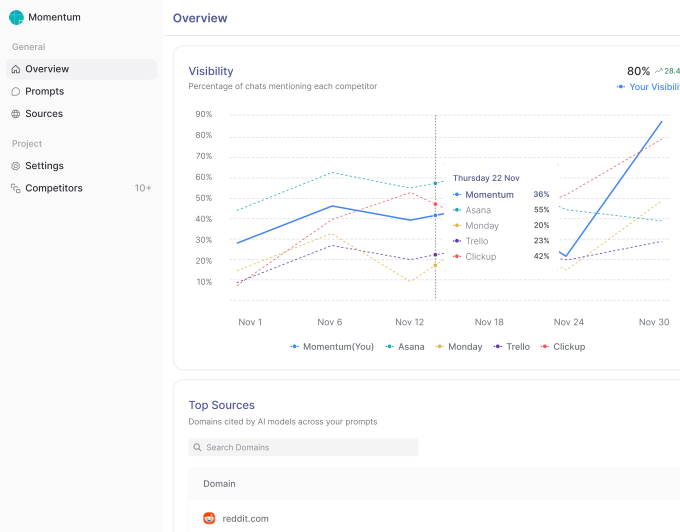
An AI search visibility tool tracks what manual testing cannot: prompt volume at scale, share-of-voice trends over time, and competitor movement across platforms.
Cite AI monitors 50,000+ prompts daily across ChatGPT, Gemini, Perplexity, Google AI Overviews, and Google AI Mode. It tracks brand mentions, citations, source influence, and competitor presence in one place. The plans are affordable and built for marketing teams, agencies, and multi-brand operations.
FAQs
How is an AI visibility audit different from a standard SEO audit?
SEO audits measure rankings and crawlability in traditional search engines. AI visibility audits measure brand presence, citation accuracy, and share of voice in AI-generated answers. Both matter, but they measure different discovery channels. A brand can rank well in Google and be almost invisible in AI search, or vice versa.
Which AI platforms should I test during an audit?
Start with ChatGPT, Gemini, and Google Overview as the core three. Add Google AI Overviews and Google AI Mode for search-adjacent visibility. Prioritize the platforms where your buyers are most active. If your audience skews toward business users, ChatGPT tends to be higher priority. If they use Google heavily, AI Overviews are essential to include.
How often should I run an AI search audit?
Run a manual audit at least once a month as a baseline. Use a continuous AI search-monitoring tool to detect real-time shifts between those check-ins. Re-audit after major content changes, product launches, or significant competitor moves, since those events can shift how AI engines describe and cite brands in your category.
AI search is not a future concern. It is where your buyers are already making decisions. A 30-minute audit gives you a clear picture of where your brand stands, which competitors are winning the answers you should own, and what to fix first.
AI search visibility is dynamic; one audit is a starting point, not a finish line. The gap between brands that monitor their AI presence and those that do not is widening. The brands that act on this data consistently will be the ones AI engines describe, cite, and recommend.
Explore Cite AI to audit your brand’s visibility today!
Start writing with confidence
Verify your content, add real citations, and publish with trust.