We Analyzed 500,000 AI Answers Across 12 Industries: Here’s Who Gets Cited and Why
Share this Article:


Most brands assume they have an AI search problem. Few know exactly what that problem is. The real issue is not just visibility; it is the complete absence of insight into how AI engines describe, cite, and recommend brands in generated answers.
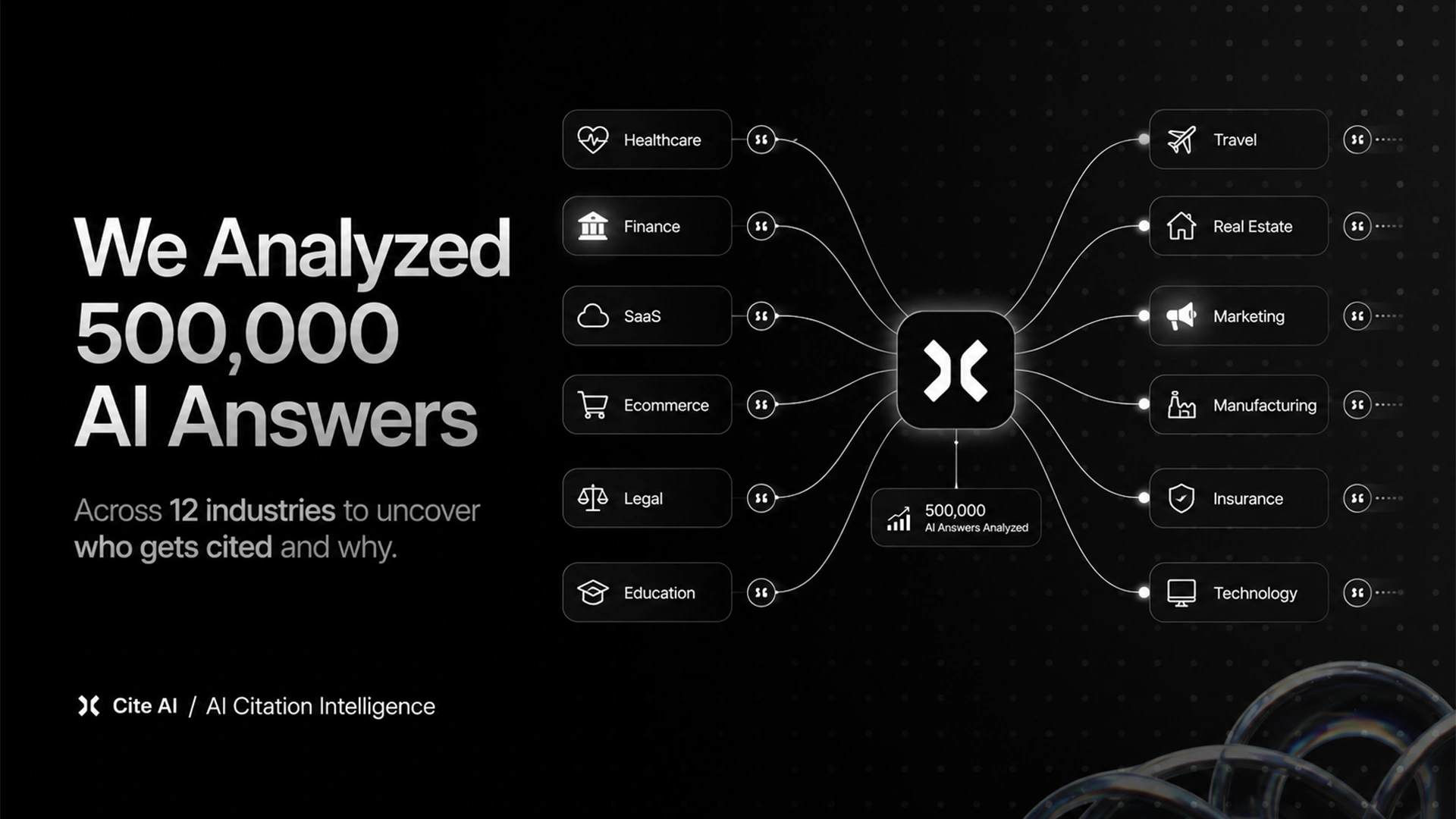
We tracked 500,000 AI responses across 12 industries to find out who gets cited, how often, and why. The patterns are clear, and they have direct implications for every marketer, SEO professional, and brand team working in competitive categories today.
In this post, we analyze citation patterns and how to navigate them.
The Problem: Your Brand Is Invisible in AI Answers
AI search is now a primary discovery channel for buyers. When someone asks ChatGPT or Perplexity for a product recommendation or a service comparison, they take the answer at face value. Most brands have no visibility into how AI engines describe or cite them in those moments.
Ranking on Google no longer guarantees presence in ChatGPT, Gemini, or Perplexity. These platforms pull from their own training data and real-time source evaluation, not a direct reflection of search rankings. A brand that holds the top position in organic search can be completely absent from AI-generated answers in the same category. That absence has a real cost: a competitor gets named, gets trusted, and gets the click instead.
What We Analyzed: 500,000 AI Responses Across 12 Industries
We analyzed 500,000 AI-generated responses across ChatGPT, Gemini, Perplexity, and Google AI Overviews. The dataset spans 12 industries: finance, healthcare, retail, e-commerce, technology, SaaS, travel, hospitality, legal, education, food and beverage, and consumer goods. We tracked which sources AI platforms cited most frequently, which content formats earned citation, and how citation patterns shifted across platforms and prompt types.
Citation patterns were measured by tracking source attribution within responses, including both named references and implied sourcing, across thousands of prompts per industry. The goal was to identify which websites are most frequently cited in ChatGPT and comparable platforms, and what those sources have in common.
Who Gets Cited Most and What They Have in Common
High-citation sources share four traits: they carry recognized authority in their domain, they update content regularly, they structure information clearly, and they publish original data or research. Across all 12 industries, the dominant citation types were publisher sites, industry databases, educational institutions, and review platforms.
Brands that publish original research earn disproportionate citation share. An annual industry report or a data-backed study gives AI engines a citable, specific source that generic content cannot replace. Citation frequency also varies by content format. Long-form guides consistently outperform product pages. News articles earn short-term citation spikes. Product-only pages rarely appear in AI-generated answers at all.
Industry-by-Industry Breakdown: Citation Leaders and Patterns
Finance and Healthcare
Regulatory bodies, academic institutions, and established publishers dominate citation share in both finance and healthcare. AI engines treat trust signals, such as author credentials, sourcing transparency, and institutional affiliation, as primary factors in their weighting schemes. Brand-owned content competes poorly here unless it mirrors the structural rigor of institutional sources.
Retail and E-Commerce
Review aggregators and comparison sites earn more AI citations than brand-owned pages in retail. Product-level content rarely gets cited. Category-level buying guides and comparative content perform significantly better. Brands that invest only in product descriptions are largely invisible in AI-generated purchase-intent answers.
Technology and SaaS
Documentation, how-to content, and third-party review platforms lead citations in technology and SaaS. Brands with active thought leadership, such as original opinions, data-backed posts, and structured guides, get cited more than product-only sites. G2, Capterra, and similar platforms appear consistently across AI answers in this vertical.
Travel, Hospitality, and Other Verticals
Aggregator platforms and editorial travel content dominate over brand sites in travel and hospitality. Niche vertical publishers frequently outperform large generalist sources on specific prompt topics. A focused travel publication covering a single region often outranks a major hospitality brand’s blog in AI answers about that destination.
These variations in patterns provide insight into placement for your brand.
Why Some Brands Get Cited More: The Real Factors AI Engines Weigh
Source authority, as understood through AI training data, is the foundational factor. Domains that accumulate consistent external references across the web carry more weight in AI citation patterns. Content structure matters equally. Responses that use clear headers, direct answers, and high factual density are easier for AI engines to extract and attribute.
Citation velocity, meaning how frequently a source is referenced across the broader web, also correlates with AI citation frequency. This makes earned media and PR directly relevant to AI search visibility, not just traditional SEO. Freshness matters too, particularly for prompt topics tied to current events, pricing, or product availability.
How to Measure and Improve Your AI Citation Presence
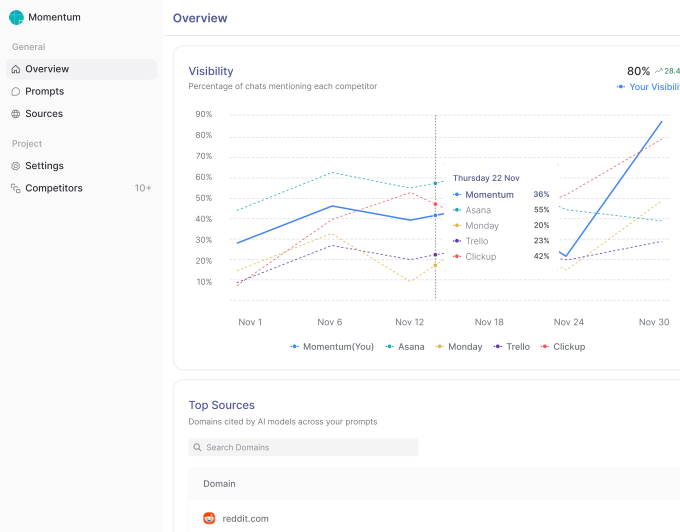
Improving AI citation presence starts with measurement. Tracking brand mentions and citation share across AI platforms, not just Google, gives marketing teams a factual baseline. Without that data, content decisions and PR investments are made without knowing which prompts trigger competitor citations instead of yours.
Source influence data identifies where to publish and earn coverage. If AI engines consistently cite three specific industry publications in your category, those are the PR targets that directly affect AI search visibility.
Cite AI monitors 50,000+ prompts daily across ChatGPT, Gemini, Perplexity, and Google AI Overviews, tracking brand mentions, citations, share of voice, and competitor presence in one place. It is built for marketing teams, SEO professionals, and agencies that need this data without having to pay enterprise-level pricing.
FAQs
What does it mean for a brand to be “cited” in an AI answer?
A citation in an AI-generated response means the platform attributes specific information to a named source, either with a direct link or by naming the source within the answer. This differs from a brand mention, in which the brand name appears in a response without formal source attribution. AI engines cite sources when they draw factual claims, data points, or structured information from identifiable content. Understanding this distinction matters because citations carry more weight for brand credibility and drive more measurable traffic than passing mentions.
Which AI platforms were included in this analysis?
The analysis covered ChatGPT, Gemini, Perplexity, and Google AI Overviews. Cross-platform tracking is important because citation behavior varies significantly by engine. A source that earns frequent citations in Perplexity may appear far less in Google AI Overviews, and vice versa. Each platform weights source authority, content structure, and freshness differently, so a brand’s AI search visibility profile looks different depending on where the prompt is asked.
Can smaller brands realistically compete for AI citations against large publishers?
Niche authority is a real competitive advantage in AI search. Focused, well-structured content that addresses specific prompt categories with depth and accuracy can outperform high-domain-authority generalist sites in those topics.
AI citation patterns follow measurable logic. The data from 500,000 responses confirms that presence in AI-generated answers is earned through content authority, structure, and consistency. Monitoring AI citations is now a baseline requirement for any brand competing in a category where buyers use AI tools to make decisions.
AI engines are not simply rewarding size; they are rewarding relevance and structure relative to the prompt. A smaller brand that publishes a comprehensive, well-sourced guide on a specific topic in its vertical can earn consistent citation share in that prompt category, even against significantly larger competitors.
Choose better for your brand. Choose visibility with Cite AI!
Start writing with confidence
Verify your content, add real citations, and publish with trust.