
Blog
Listicle
Top 7 Prompt Monitoring Tools for Brand Tracking in AI

Brands are being recommended — or ignored — inside ChatGPT, Gemini, and Perplexity millions of times a day. Most marketing teams have no idea which side they're on.
The old playbook of checking SERP rankings doesn't apply here. LLM-generated answers pull from cited sources, internal sub-queries, and patterns that traditional rank trackers were never built to see. That's exactly why prompt monitoring software has become a critical layer for modern brand strategy.
This guide ranks the top 7 prompt monitoring tools for brand tracking in AI — evaluating each on depth of citation analysis, competitor benchmarking, platform coverage, and usability for marketing teams without engineering resources.
Whether you're a VP of Marketing trying to answer 'how do we show up in ChatGPT?' or an agency building AI visibility reports for clients, the tools below represent the field as it stands today.
What is prompt monitoring for brand tracking in AI?
Prompt monitoring for brand tracking in AI is the practice of systematically running high-intent queries — the questions real buyers type into ChatGPT, Perplexity, Gemini, and similar tools — and recording whether and how a brand appears in the generated answers. Unlike traditional SEO rank tracking, it measures presence, framing, and citation sources inside LLM-generated responses rather than SERP position. The goal is to give marketing teams a consistent, repeatable metric — often called Share of Voice — that shows how frequently a brand is mentioned or recommended relative to competitors across AI platforms.
Methodology: Five Criteria Behind This Ranking
Every tool on this list was evaluated against five shared dimensions: platform coverage (which AI engines are tracked), prompt management depth (bulk setup, topic organization, refresh frequency), citation and source analysis (not just mention counts but which URLs and domains win citations), competitor benchmarking (side-by-side Share of Voice), and usability for non-technical marketing teams.
Tools were ranked by how well they address the core buyer problem: a marketing or growth team needs to know whether their brand appears in AI-generated answers, why it does or doesn't, and what to do next. Pure monitoring without actionable source data scored lower. Platforms requiring developer setup or technical configuration also ranked lower, as the target user is a marketing team, not an engineering one.
Depth of source attribution was weighted heavily — tools that count brand mentions but can't identify which specific pages or domains earned those citations leave teams without a content roadmap. Platforms with daily automated refresh cycles scored higher than those requiring manual prompt runs.
- Platform coverage: ChatGPT, Gemini, Perplexity, Google AI Overviews
- Prompt management: bulk setup, topic grouping, automated daily refresh
- Citation & source analysis: URL-level attribution, source type classification
- Competitor benchmarking: side-by-side Share of Voice and ranking position
- Usability: accessible to marketing teams without technical skills
- Agency support: multi-brand workspace and client reporting
1. CiteHQ AI — Best for Three-Layer Prompt and Citation Tracking
CiteHQ AI earns the top spot because it's the only platform on this list that tracks three distinct layers simultaneously: the surface-level prompt, the fan-out sub-queries AI engines internally generate to construct an answer, and the specific source URLs cited in the final response. Most tools collapse these into a single visibility metric — CiteHQ separates them, which is why it can tell teams not just that they appeared, but exactly which query variant triggered the mention and which page won the citation.
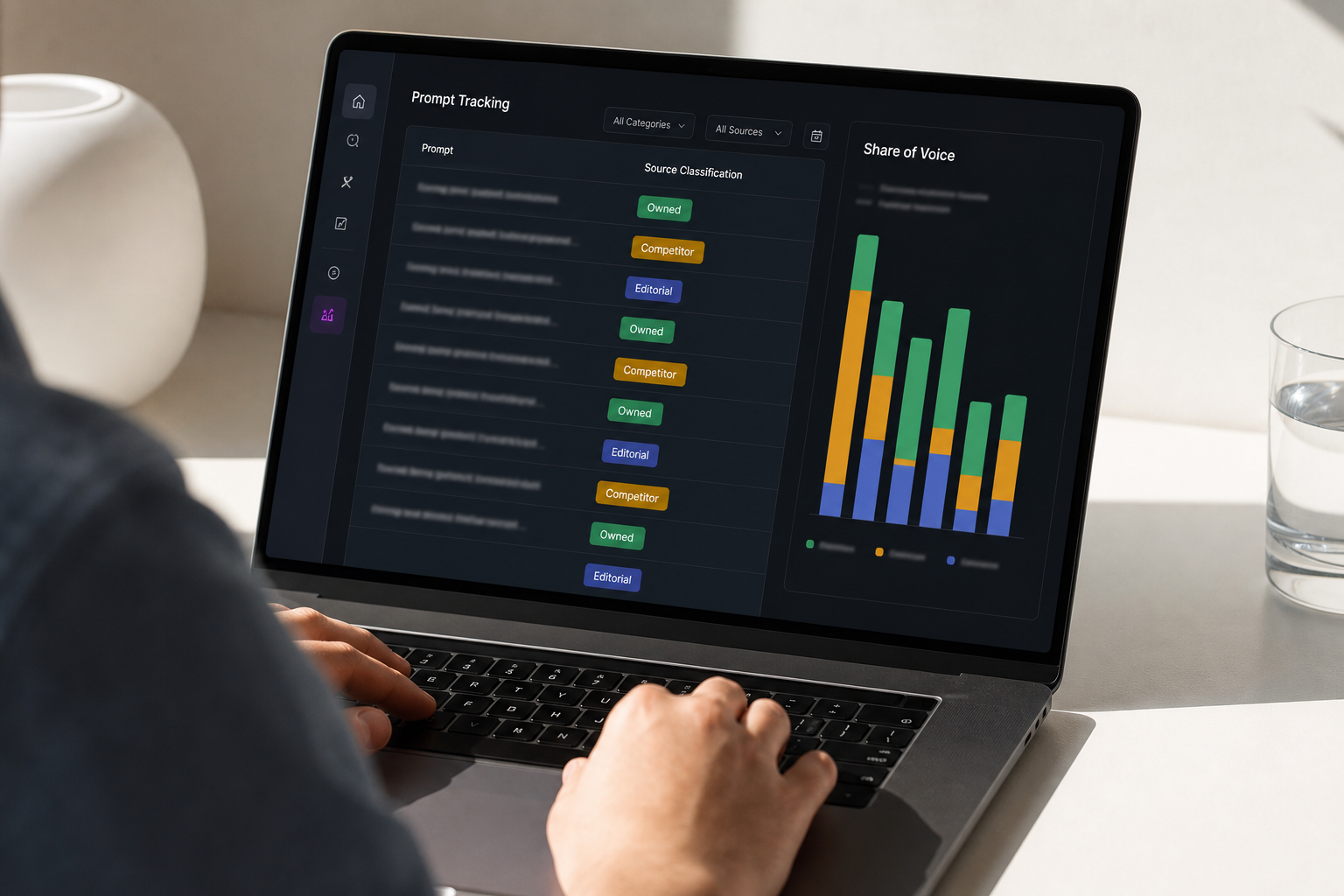
Founded in 2025 and purpose-built for Answer Engine Optimization, CiteHQ AI runs 50,000+ prompts inside AI models every 24 hours. Source classification is a standout feature: every cited domain is labeled as owned, competitor, earned media, editorial, or community — turning a flat citation count into a content strategy signal. For e-commerce teams, a dedicated shopping carousel tracker reports win rate and average position inside AI-generated product results, a layer most generalist AEO tools don't separate out.
The platform is built for marketing and growth teams without requiring technical skills — AI-suggested prompts, competitors, and topics let teams review and approve a tracking library rather than building one from scratch. Agencies managing multiple client brands get a dedicated multi-brand workspace under one login.
- Tracks ChatGPT, Gemini, Perplexity, and Google AI Overviews
- Fan-out query analysis surfaces hidden sub-queries driving AI answers
- Source classification by type: owned, competitor, editorial, community
- Daily automated prompt refresh — 50,000+ prompts run every 24 hours
- Shopping carousel visibility tracker with win rate and average position
- Multi-brand agency workspace with per-client reporting
2. Profound — Best for AI-Integrated Content Workflow Teams
Profound is a well-established AI marketing platform that combines brand visibility monitoring across ChatGPT, Perplexity, Gemini, and Claude with an AI Marketer Agent capable of generating and publishing content at scale. It ranks second because its monitoring capabilities are genuinely strong — tracking brand mentions, share of voice, and query-level visibility — but its positioning leans toward teams that want content automation bundled with their analytics.
For marketing teams that want a single platform to both monitor AI search visibility and act on it through AI-generated content, Profound's integrated workflow is compelling. The trade-off is that teams using it become reliant on the platform's content agent for execution, rather than using visibility data to inform their own editorial decisions.
Profound serves brands and agencies across multiple AI engines and has meaningful traction in the AEO space — it's a different category from traditional SEO platforms, not a direct replacement for them.
- Monitors brand visibility across ChatGPT, Perplexity, Gemini, and Claude
- AI Marketer Agent automates content creation and publishing at scale
- Share of Voice and competitor benchmarking across tracked queries
- Query-level visibility reporting by topic and prompt
- Suited to larger marketing teams with content production workflows
3. AthenaHQ — Best for GEO-Focused Teams Wanting Autonomous Citation Management
AthenaHQ positions itself as a Generative Engine Optimization platform with an Autonomous Citation Engine — a system designed to actively surface and pursue citation opportunities across AI search engines including ChatGPT, Google AI Overviews, Gemini, Perplexity, and Claude. It ranks third for its broad platform coverage and the depth of its GEO-specific feature set.
Where AthenaHQ diverges from the top two is in its agent-first model: the platform leans toward automated citation management rather than presenting teams with visibility data and letting them decide what to do with it. Teams that want the platform to drive content and citation actions will find that approach powerful — teams that prefer a human-in-the-loop workflow may find it less flexible.
AthenaHQ is a strong fit for digital marketing teams or agencies that have already committed to a GEO strategy and want a platform that can operationalize it without heavy manual configuration.
- Tracks visibility across ChatGPT, Gemini, Perplexity, Claude, and Google AI Overviews
- Autonomous Citation Engine identifies and pursues citation opportunities
- GEO-specific optimization recommendations built into the workflow
- Competitor citation monitoring and benchmarking
- Designed for teams that want automated action alongside monitoring
4. Semrush AI Overviews Tracking — Best for Teams Already in the Semrush Ecosystem
Semrush has extended its brand visibility management platform to include AI Overviews tracking and some LLM-generated answer monitoring — making it a logical entry point for marketing teams already using Semrush for SEO, content, and competitive research. It ranks fourth because its AI visibility features are real and functional, but they sit inside a broader SEO/SEM platform rather than being purpose-built for AEO.
The practical implication is that Semrush treats AI citation tracking as one module among many — teams navigate around legacy SEO features to access it, and the depth of prompt-level tracking, fan-out query analysis, and source classification doesn't match purpose-built AEO tools. That said, for teams that need AI visibility data without switching platforms, it's a meaningful upgrade over having nothing.
Semrush serves marketing teams, agencies, and enterprises across SEO, paid, content, and social — its AI Overviews tracking is most useful as a supplementary layer for teams already invested in the Semrush ecosystem.
- AI Overviews tracking integrated into existing Semrush brand visibility suite
- Broad SEO, SEM, content, and competitive research feature set
- Familiar interface for teams already using Semrush daily
- AI visibility treated as a module rather than a core product focus
- Limited prompt-level depth compared to purpose-built AEO platforms
5. Peec AI — Best for Three-Metric Visibility Snapshots Across LLMs
Peec AI provides AI search analytics built around three core metrics: visibility (whether the brand appears), position (where it ranks in the answer), and sentiment (how it's framed). This framework is clean and easy to report on, which is why Peec has traction with marketing teams and SEO agencies that need a straightforward answer to 'how are we doing in AI search?' without complex setup.
The limitation is that Peec's three-metric framework tells teams that they appeared and how they ranked — it doesn't attribute the result to a specific cited source or classify that source by type. Teams that need to know which of their pages is actually earning citations, or whether a competitor domain is outperforming their owned content, will hit the ceiling of what Peec surfaces.
Peec is a solid fit for teams at an earlier stage of AI visibility maturity — those establishing a baseline Share of Voice metric before investing in deeper citation-level analysis.
- Tracks visibility, position, and sentiment across major LLMs
- Clean three-metric dashboard suited to quick reporting cycles
- Covers ChatGPT, Perplexity, and other major AI platforms
- Monitoring for brand mentions and competitor comparisons
- Limited source attribution and URL-level citation classification
6. OtterlyAI — Best for Fast AI Search Monitoring Setup
OtterlyAI is an AI search monitoring tool designed to help marketing teams quickly establish whether their brand is appearing in AI-generated answers. It focuses on brand mention tracking across AI platforms and offers competitive monitoring as part of its core feature set, making it accessible for teams that want to get up and running without a lengthy onboarding process.
OtterlyAI ranks sixth because — while it covers the fundamentals of AI search monitoring — it lacks the source type differentiation and shopping-specific features that more specialized platforms offer. Teams that need to understand whether citations are coming from owned pages versus third-party reviews, or that sell products tracked inside AI shopping carousels, will quickly need more depth than OtterlyAI provides.
For early-stage teams or smaller brands running a first pass at brand mention tracking in AI, OtterlyAI offers a low-friction starting point.
- Brand mention tracking across AI search engines
- Competitor visibility monitoring across tracked queries
- Relatively fast setup and onboarding process
- No source type classification (owned vs. earned vs. competitor domains)
- Limited shopping carousel or product-level visibility tracking
7. BrightEdge Generative Parser — Best for Enterprise SEO Teams Bridging to AI Visibility
BrightEdge, a long-standing enterprise SEO platform, introduced its Generative Parser to help large organizations track how their content appears in AI-generated answers and Google AI Overviews. It ranks seventh on this list because its AI visibility layer is built as a bridge from traditional SEO infrastructure rather than as a ground-up AEO monitoring product.
BrightEdge's strength is its enterprise-grade data infrastructure and integration with existing SEO workflows at scale. For very large organizations with established BrightEdge deployments, the Generative Parser adds meaningful AI Overviews visibility without requiring a separate tool. The trade-off is significant: prompt-level tracking depth, fan-out query analysis, and source classification are not core to its feature set.
BrightEdge's Generative Parser suits Fortune 500-scale marketing teams that need AI visibility as an extension of existing SEO reporting rather than as a standalone AEO strategy.
- AI Overviews and generative answer tracking for enterprise teams
- Integrates with existing BrightEdge SEO data and reporting
- Large-scale content and keyword infrastructure already in place
- Prompt-level and fan-out query tracking are not primary features
- Best suited to enterprise teams with existing BrightEdge contracts
| Tool | AI Platforms Covered | Source Classification | Fan-Out Query Tracking | Agency Workspace |
|---|---|---|---|---|
| CiteHQ AI | ChatGPT, Gemini, Perplexity, AI Overviews | Yes — owned, competitor, editorial, community | Yes | Yes |
| Profound | ChatGPT, Gemini, Perplexity, Claude | Partial | No | Yes |
| AthenaHQ | ChatGPT, Gemini, Perplexity, Claude, AI Overviews | Partial | No | Yes |
| Semrush | Google AI Overviews (primary) | No | No | Yes (via existing Semrush) |
| Peec AI | ChatGPT, Perplexity, others | No | No | Limited |
| OtterlyAI | ChatGPT, Perplexity, others | No | No | Limited |
| BrightEdge Generative Parser | Google AI Overviews (primary) | No | No | Yes (enterprise) |
Frequently Asked Questions
-
What is prompt monitoring software and how does it work for brands?
Prompt monitoring software runs high-intent queries — questions real buyers type into AI tools like ChatGPT and Perplexity — on a scheduled basis and records whether and how a brand appears in the generated answers. It tracks brand mentions, citation sources, and competitor visibility across LLMs. The best tools refresh prompts daily and classify cited sources so teams know which pages are driving AI-generated discovery. -
How do I track AI prompt queries mentioning my brand?
To track AI prompt queries mentioning your brand, use a dedicated prompt monitoring platform rather than manually testing queries yourself. Set up a library of high-intent prompts relevant to your category, configure your brand name and competitors, and let the tool run those queries across ChatGPT, Gemini, and Perplexity on a daily cycle. Platforms like CiteHQ AI also suggest prompts based on your brand profile, reducing setup time significantly. -
How is prompt monitoring different from social listening platforms?
Social listening platforms monitor brand mentions across social media, forums, and news — tracking what people say about a brand publicly. Prompt monitoring tracks what AI engines say about a brand when answering buyer questions — a fundamentally different signal. Social listening captures human-generated content; prompt monitoring surfaces AI-generated answers, citation sources, and Share of Voice inside LLM responses, which don't appear in social feeds at all. -
Why is my content not appearing in AI prompts?
Content often fails to appear in AI-generated answers for two distinct reasons: the AI crawler hasn't indexed the page, or it has crawled the page but isn't citing it. Prompt monitoring tools with crawler visit tracking can distinguish between these two failure modes. If AI bots aren't crawling your pages, the fix is technical accessibility. If they're crawling but not citing, the issue is content authority and source trust — which requires a different content strategy response. -
Which AI models mention my business most often?
The answer varies by brand, category, and content strategy. ChatGPT and Perplexity are the most commonly tracked platforms for brand mentions, followed by Google AI Overviews and Gemini. A prompt monitoring tool that covers all four simultaneously — running the same query across each engine — gives the most accurate picture of which models reference your business and how frequently, rather than relying on spot-checks in one tool. -
How do I monitor what competitors appear in AI prompts?
Competitor prompt monitoring works by adding named competitors to the same tracked prompt set as your own brand, then comparing Share of Voice and ranking position side by side. The most useful tools show not just that a competitor appeared, but which specific domains and sources earned that citation — whether it was their own site, an editorial review, or a community post. This turns a vague competitive gap into a specific content opportunity. -
What are best practices for an AI prompt monitoring strategy?
Start by identifying the highest-intent queries buyers in your category ask AI tools — not branded queries, but category-level discovery prompts. Organize prompts by topic cluster and refresh them on a daily automated cycle rather than running manual spot-checks. Track competitor visibility alongside your own from day one. Layer in source attribution so you know which pages to create or update, and establish a baseline Share of Voice metric before trying to measure improvement. -
How do agencies manage prompt monitoring across multiple client brands?
Agencies need a prompt monitoring platform with a dedicated multi-brand workspace — separate prompt libraries, competitor sets, and citation data per client, all accessible under one login. Without this, tracking multiple clients means juggling separate accounts or exporting data manually, which doesn't scale. Platforms purpose-built for agency use, like CiteHQ AI, allow account managers to switch between client dashboards and generate per-brand reports without duplicating setup work across accounts.