
 Documentation
 -
-
 Start Tracking Your Brand
 - Brand Profile
- Prompt Setup Guide
- Track Competing Brands
-
-
-
Take Actions
- Actions
-
-
-
 Agent Analytics
 - Connect Cloudflare
- Crawl Insights
- Crawlability
- Use Cases
-
 Get Started
 AI Shopping
 Understanding AI Responses
Learn how to analyze the AI-generated answers that power your visibility insights.
Every metric inside Cite AI starts with a response generated from your tracked prompts. These AI responses form the foundation of:
- visibility tracking
- share of voice analysis
- brand positioning
- citation tracking
- and competitive benchmarking
Understanding how these responses work helps you interpret your analytics more effectively.
What Is an AI Response?
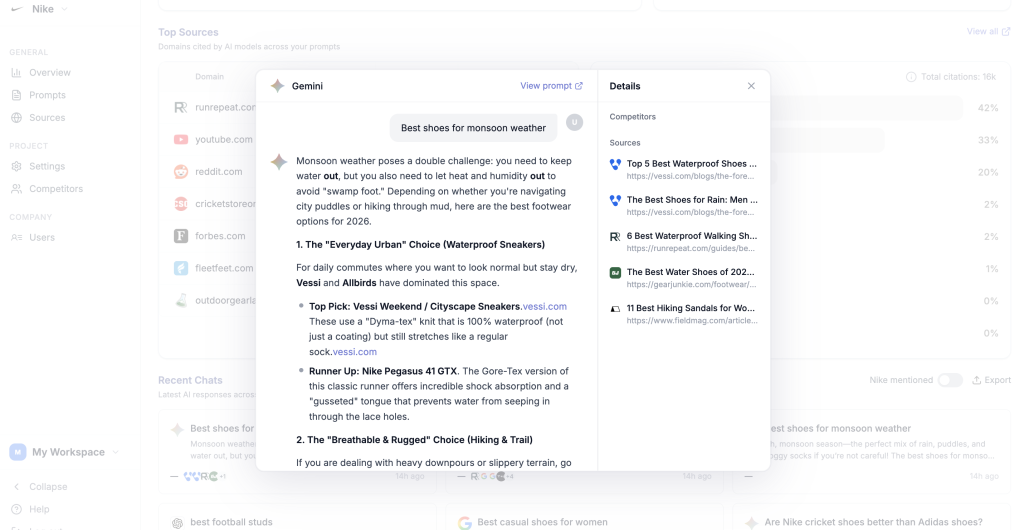
Each time Cite AI runs a prompt across platforms like ChatGPT, Gemini, Google AI Overviews, Google AI Mode, or Perplexity, the generated answer is stored as a tracked response.
These responses are analyzed to understand:
- which brands were mentioned
- where brands appeared
- which sources influenced the answer
- and how AI platforms describe your brand
Viewing Responses
You can access:
- recent responses from your dashboard
- or historical responses directly from individual prompts
Each prompt stores previous response history so you can monitor changes over time.
Response Breakdown
Every tracked response contains multiple components that contribute to your visibility analysis.
Response Status
Indicates whether the prompt completed successfully.
AI Platform
Shows which model generated the response.
Examples:
- ChatGPT
- Gemini
- Perplexity
- Google AI Overviews
- Google AI Mode
Location
Shows the geographic region used for the prompt request.
AI responses can vary significantly by country or region.
Main Response
This is the full AI-generated answer returned for the prompt.
Cite AI analyzes this response to determine:
- brand visibility
- mention order
- citations
- and positioning
Brand Mentions
Tracks:
- which brands appeared
- where they appeared
- and how prominently they were positioned within the response
This data powers:
- visibility
- share of voice
- and position metrics
Source Tracking
Cite AI captures the websites and sources referenced while generating responses.
This helps you understand:
- which websites influence AI answers
- which domains support competitor visibility
- and where your authority originates
Sources vs Citations
Sources and citations are related, but not identical.
Citations
Citations are websites directly referenced inside the AI response itself.
These are explicit references tied to specific parts of the answer.
Citations usually represent stronger visibility because users can directly see the source association.
Sources
Sources include all websites used during response generation, even if they were not explicitly referenced inside the final answer.
A source may influence the AI response without being visibly cited.
Example
An AI response may:
- cite 4 websites directly
- while referencing 8 total sources during generation
All 8 influenced the response, but only 4 appeared visibly within the answer.
Why This Difference Matters
Citations
Help drive:
- visibility
- trust
- referral traffic
- and direct attribution
Sources
Help build:
- topical authority
- AI understanding
- and overall brand influence
Both are important for long-term AI visibility growth.
How AI Platforms Behave Differently
Each AI platform handles responses, citations, and sources differently.
ChatGPT
Sometimes uses web search and sometimes responds from existing model knowledge.
When no web search occurs, responses may contain no visible sources.
This is expected behavior.
Perplexity
Typically references many sources during generation but cites fewer directly inside the response.
This often results in:
- high source counts
- lower visible citation counts
Gemini and Other Models
Each platform has unique behaviors around:
- source retrieval
- citation placement
- and response formatting
Response patterns naturally vary across models.
Understanding Position Rankings
When multiple brands appear in a response, Cite AI calculates ranking based on mention order.
Example
If a response mentions:
- Nike
- Adidas
- Puma
then Puma receives position 3 for that response.
If another response includes:
- Nike
- Adidas
- Under Armour
- Puma
then Puma’s position becomes 4.
This ranking includes all detected brands, not just manually tracked competitors.
Why Position Matters
Earlier mentions generally indicate stronger authority and relevance.
Brands appearing closer to position 1 are more likely to be:
- trusted recommendations
- category leaders
- or top-of-mind references within AI-generated answers
Tracking position over time helps measure whether your brand is gaining or losing prominence across AI platforms.
 On this page
- What Is an AI Response?
- Viewing Responses
- Response Breakdown
- Response Status
- AI Platform
- Location
- Main Response
- Brand Mentions
- Source Tracking
- Sources vs Citations
- Citations
- Sources
- Example
- Why This Difference Matters
- Citations
- Sources
- How AI Platforms Behave Differently
- ChatGPT
- Perplexity
- Gemini and Other Models
- Understanding Position Rankings
- Why Position Matters